The surprising part is how easily approval can masquerade as authorship. A sentence can feel familiar, balanced, and intelligent while still expressing a position you have never properly examined. The goal is not to reject AI. It is to make sure AI reduces the cost of expression, not the ownership of thought.
Why does an AI-generated claim feel right before you know it is yours
AI is good at producing the kind of claim that sounds reasonable before it has earned your confidence. It can mirror the language of your field, supply a tidy qualification, and land on a conclusion that seems broadly true. Reading it, an expert may think, “Yes, that sounds right.” But recognition is not ownership.
Ownership means you can show where the conclusion came from and why you stand behind it. Perhaps it grew from a client pattern, a documented process, research you can name, an observation that changed your method, or an explicit professional belief. Without that path, the model has supplied more than wording. It has supplied the public thinking.
What people miss is that polish can conceal this gap. A clear sentence is not proof of a clear judgment.
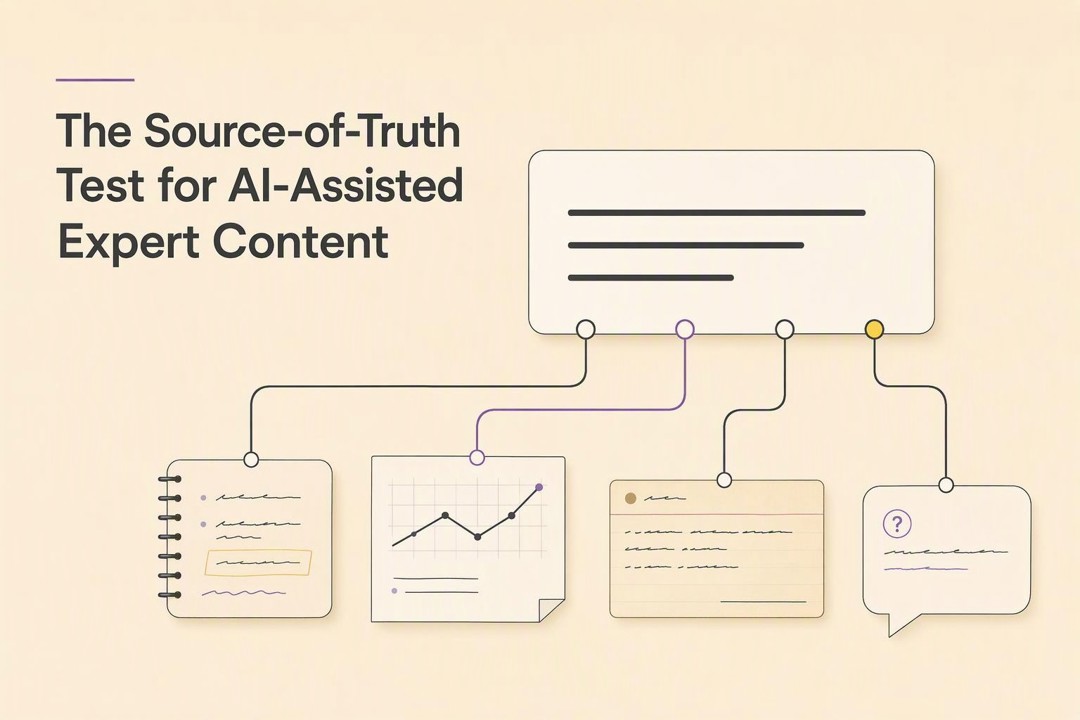
What is the source-of-truth test for AI-assisted content
The source-of-truth test asks whether an expert can account for every material claim before publishing it. “It sounds accurate” is not enough. The claim needs a basis that can survive a thoughtful reader’s question.
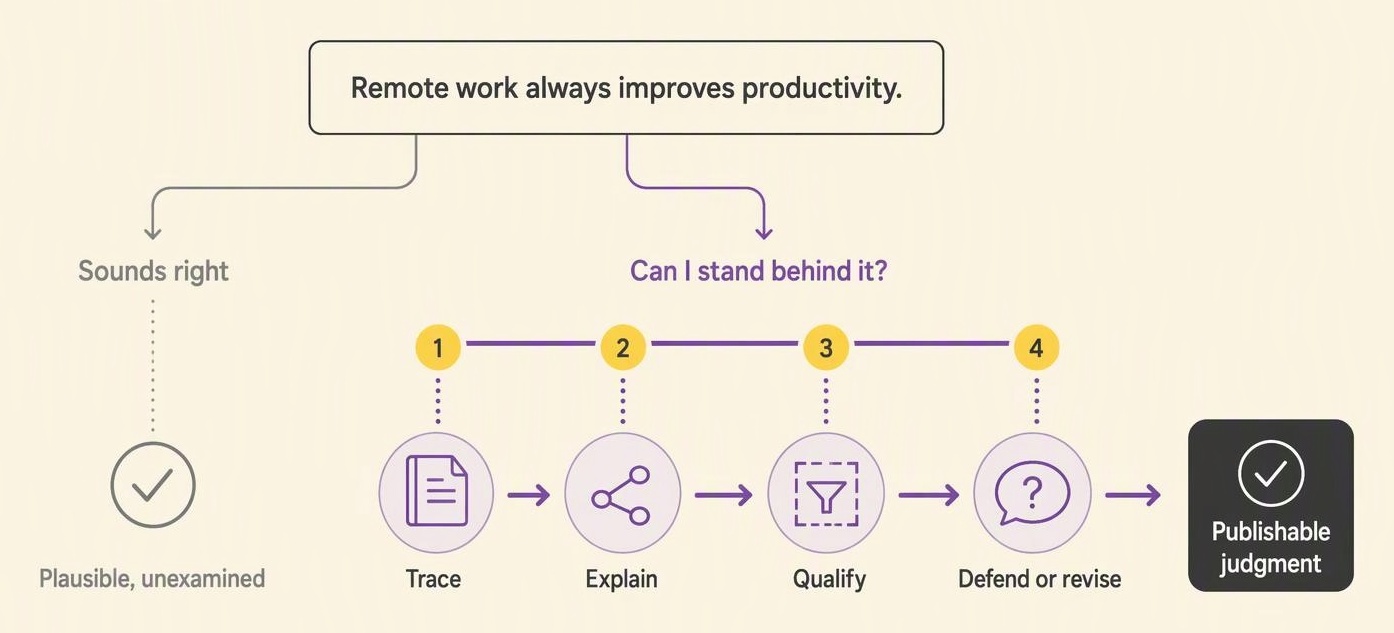
Use this four-part check:
- Trace it. Identify the source: lived experience, a client pattern, research, a documented decision, a tested process, or a clearly stated belief.
- Explain it. State the reasoning that connects the source to the conclusion. What happened, what did you observe, and why does that support this point?
- Qualify it. Name where the claim may not apply. Consider context, exceptions, uncertainty, confidentiality, and professional boundaries.
- Defend or revise it. Let an informed skeptic ask, “What would change your mind?” If the objection exposes a weak claim, soften it, research it, or remove it.
The goal is not to turn every post into an academic paper. The goal is to know what makes a claim true enough to publish. Inkflare.ai’s authority approach treats AI as a tool for extracting, organizing, challenging, and expressing expertise, while the expert remains responsible for the belief itself.
How do you review an AI draft without handing it your judgment
Reviewing an AI draft should begin with claims, not commas. Highlight every statement that offers advice, interprets a pattern, makes a promise, or asserts a belief. Then label each one by source type: experience, evidence, reasoning, or opinion.
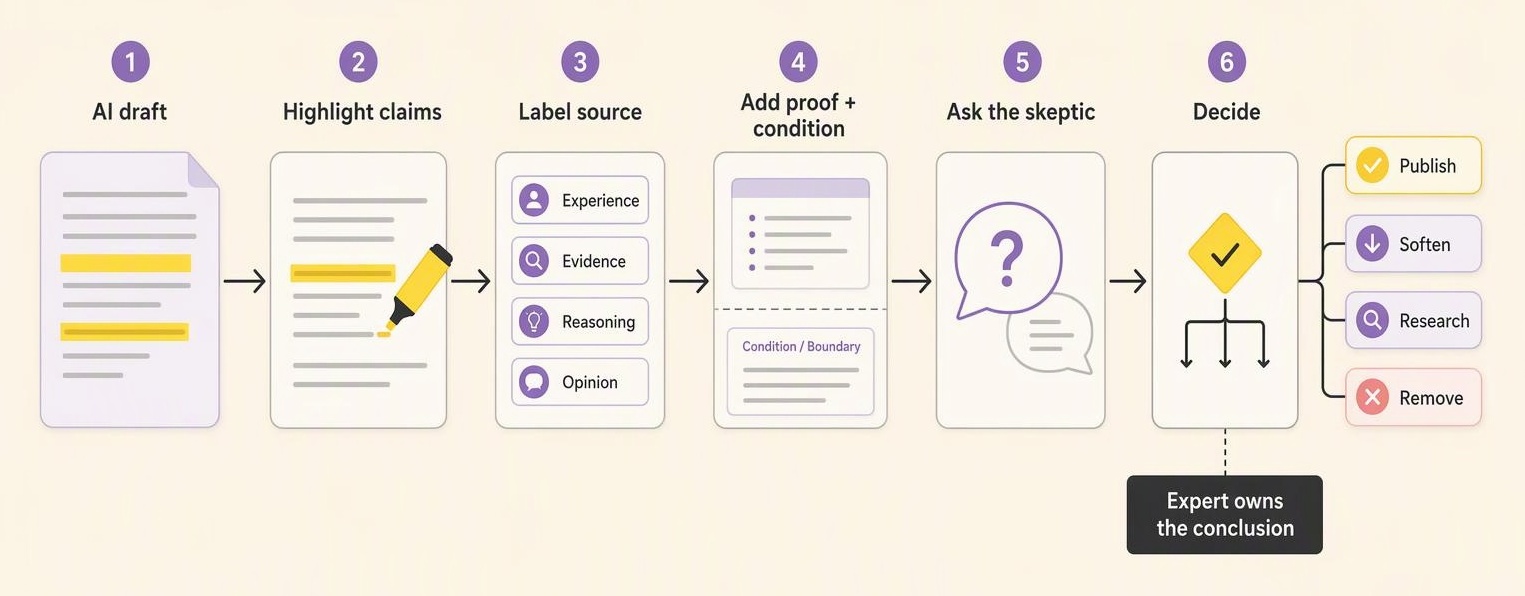
Next, add the detail that makes the claim inspectable. Replace a broad statement with the mechanism, example, or decision rule behind it. Write one condition that prevents overreach. Then ask what a smart skeptic would challenge, not to weaken your content, but to make the final conclusion more precise.
If a claim has no source, it has four honest options: remove it, research it, soften it into a bounded observation, or turn it into a question the expert must answer. This workflow keeps AI useful as an interviewer, analyst, editor, challenger, and production assistant without letting it become the authority for your public beliefs.
Build a public record you can still stand behind
Public content becomes a record of how you see problems and make decisions. Borrowed certainty may sound credible in one post, but it becomes fragile when a client, peer, or reader asks what supports the claim.
The goal is not manual writing for its own sake. It is a body of work where your stories, proof, standards, and judgment remain visible as AI helps with the surrounding work. Polish is not ownership. Agreement is not judgment. Publish the claims you can trace, explain, qualify, and defend, and your content will stay recognizably human when it matters.