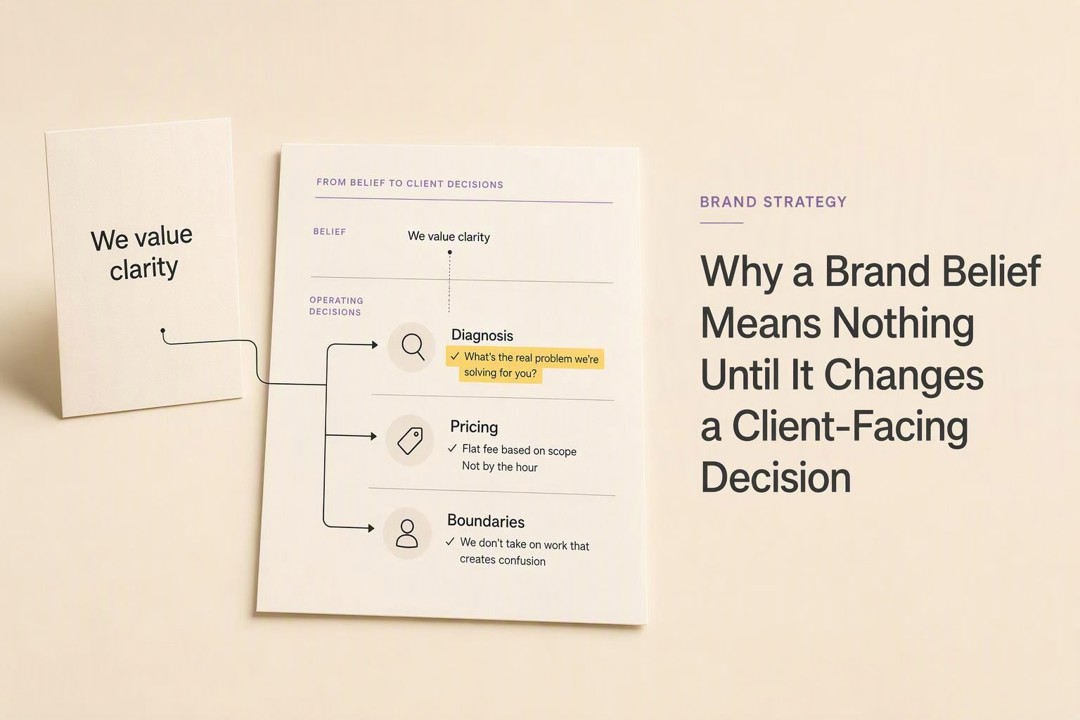
That is the useful standard: do not make beliefs louder. Make judgment easier to see. Design can help people recognize a business, but it cannot tell them what working with that business will actually be like.
Why does a clear brand manifesto still feel interchangeable
A brand belief is a conviction about what matters, what causes a problem, or what good work requires. It becomes differentiating when it acts as an operating rule, not a line of positioning copy.
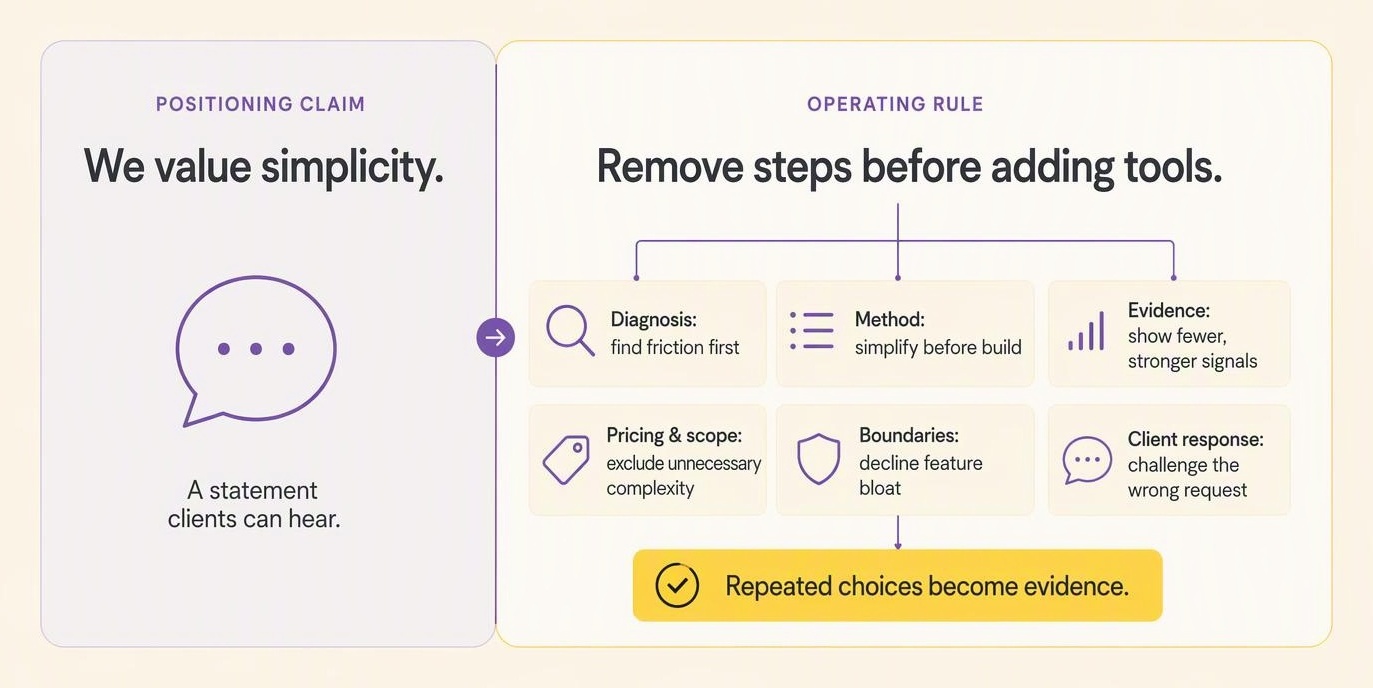
The distinction is simple. A claim is something a business says: “We value simplicity.” An operating rule is something it repeatedly chooses: “We remove steps before adding tools, even when a client asks for a larger system.” The second statement reveals a tradeoff, a method, and a boundary.
What people miss is that prospective clients are not only comparing offers. They are trying to infer judgment they cannot fully inspect before buying. They want to know whether an expert sees the problem at the right level, values the same tradeoffs, and will say no when the obvious request is the wrong solution.
What makes a business belief visible to prospective clients
Clients can see a belief when it leaves a trail across the business. Look for it in these six client-facing areas:
- Diagnosis: What questions are asked before a recommendation is made?
- Method: What sequence or standard shapes the work?
- Evidence: What proof is trusted, and what claims need more support?
- Pricing and scope: What is included, excluded, or refused because it would weaken the result?
- Boundaries: What shortcuts, timelines, or requests are declined?
- Client response: What happens when a client asks for a solution that does not address the real problem?
A consultant who believes strategy must precede execution may insist on a diagnosis phase. A coach who believes change requires practice may avoid selling advice-only sessions. A small expert team that values clear evidence may show its reasoning instead of making broad promises.
One example is an instance. Repeated examples become evidence. When the same standard appears in content, sales conversations, proposals, and delivery, clients can connect the dots.
How repeated choices create recognizable authority
Polish can attract attention. Consistent judgment creates recognition.
For expertise-led businesses, the product is often partly invisible before purchase. A prospective client cannot fully test how a consultant will think through ambiguity or how a specialist will handle a difficult tradeoff. So they look for signals: the questions asked, distinctions made, standards held, and examples used to support a recommendation.
A visible operating rule reduces that uncertainty. It helps the right client predict the experience of working together and helps the wrong client recognize a mismatch early. That is not a loss. The goal is not maximum agreement. It is accurate expectation.
This is also why generic content weakens a strong business. If public thinking never shows how decisions are made, the audience cannot infer depth that has not been demonstrated.
How to turn one belief into an operating rule
Start with one belief you genuinely hold, then give it consequences:
- Name the belief in plain language.
- Identify the tradeoff it requires.
- Choose one client-facing decision it must alter.
- Document the resulting standard in your process, offer, or boundary.
- Show real examples of that standard in content and client experience.
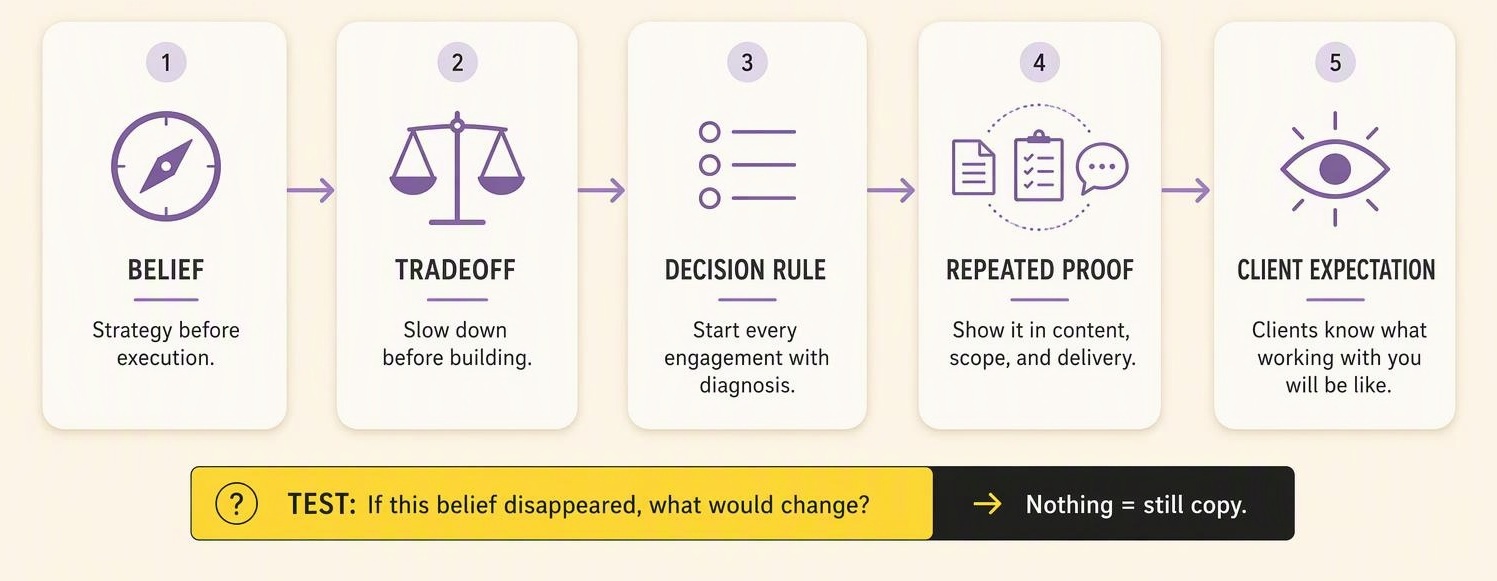
Use this test: If this belief disappeared tomorrow, what would we do differently? If the honest answer is nothing, it is still copy.
AI can help organize examples, shape drafts, and distribute the resulting content. But it cannot be the source of the belief. The expert must supply the judgment, real context, and evidence that make the rule worth trusting.
A belief becomes a brand when clients can predict your choices
The strongest brand beliefs do not merely describe a business. They shape what people encounter across content, conversations, offers, methods, and boundaries.
The goal is not more impressive language. It is a consistent pattern of decisions that lets the right clients recognize the fit before they buy.