

The Expertise Legibility Playbook for Connected Content That Compounds Authority
A connected content cluster network turns one clear area of expertise into a system of assets that reinforce each other across search, social, and AI discovery. This playbook shows how to choose what to be known for, build pillars and supporting posts, repurpose without diluting quality, wire everything together with intentional links, and set a continuity rhythm that survives busy weeks, so authority compounds instead of resetting.
A quick map for orientation: the first section defines the visibility advantage (legibility), the next three sections walk through building the system (known-for claim, pillars, clusters), and the final section covers the two compounding levers that most experts skip (interlinking and continuity).
Expertise legibility is the real visibility advantage
Expertise legibility is the ability for strangers, algorithms, and buyers to instantly understand what an expert stands for, what problems they solve, and why their perspective is credible. Visibility without legibility is just exposure, people might see a post, but cannot place it. Legibility is what makes someone feel “this person is for me” after a single touch.
Most content strategies fail here because they treat content as isolated pieces. One week is a great thread, the next is a random carousel, then a podcast appearance, then silence. Each asset might be solid on its own, but the overall footprint stays fuzzy, and fuzziness is expensive.
Imagine a talented consultant who posts three times in a week about pricing, then disappears for a month, then returns with a hot take on hiring. Nothing is “wrong,” but nothing connects. The market cannot summarize the expertise in one sentence, so the market does what it always does with ambiguity, it moves on.
The hidden cost is not only lost leads. It is lost retrieval. When someone searches, scrolls, or asks an AI system for a recommendation, the system is looking for repeated, consistent signals that converge on a clear topic and viewpoint. Mixed signals create a discovery tax, the content has to work harder to be understood, and it often gets filtered out before it reaches the right people.
Inkflare does not treat content as isolated pieces. It treats it as a connected system, where every asset has a job, every job supports the positioning, and every format points back to a small set of core themes. That is how authority compounds, not by posting more, but by building a network where each piece strengthens the others.
Step 1 and 2: Define the “known for” claim, then choose three core themes
A “known for” claim is a sentence that makes the market legible. It is not a bio, and it is not a slogan. It is a precise statement of the outcome delivered, the domain it lives in, and the lens used to get there.
A strong known for claim has edges. It excludes as much as it includes, because clarity is what creates memory. Instead of “helps businesses grow,” it sounds like “helps early-stage SaaS founders turn product expertise into organic demand without hiring a content team.” That kind of specificity is what gives future content something to orbit.
A practical test is the “three-second label.” If someone reads the claim and can confidently answer, “What category is this person in, and what result do they produce?” the claim is doing its job. If the answer becomes a paragraph, the claim is still a draft.
Another test is whether the claim generates obvious content angles. A claim that is too broad produces generic posts. A claim that is too narrow produces repetition. The goal is a claim that naturally creates a field of teachable problems, which can be turned into pillars and clusters without inventing a new identity every week.
Once the claim is set, pick three core themes that will carry the full weight of the authority narrative. Three is a constraint that prevents an expert from turning every interest into a content lane. Each theme should be big enough to produce dozens of angles, and narrow enough that it still feels like one category of thought.
For example, a leadership coach who wants to be known for “building high-trust teams that execute without burnout” might choose themes like decision systems, team communication, and sustainable performance. The supporting subtopics then become the buyer’s questions inside those themes, such as meeting hygiene, conflict rituals, delegation, metrics that do not create panic, and how to rebuild trust after a miss. The point is not to cover everything, the point is to become unmistakable in a few places.
Then add supporting subtopics under each theme, but treat them like ingredients, not separate brands. Subtopics exist to answer the questions buyers ask on the way to trusting the core claim. If a subtopic cannot be explained as strengthening one of the three themes, it is not a subtopic, it is a distraction.
Step 3: Build a pillar explanation that becomes the reference point
A pillar is the anchor document that explains one theme end-to-end. It is not just a long post, it is the definitive explanation that can be referenced, summarized, quoted, and expanded for months. A pillar gives the ecosystem a stable spine, which is what makes interlinking meaningful.
The most effective pillar format is simple: define the problem in the reader’s language, show why common approaches fail, introduce a better model, then walk through implementation. The key is to write it so it still makes sense when read by someone who found it through search, social, or an AI overview. That means clear definitions, explicit steps, and concrete examples.
A pillar should also carry a point of view. Generic content can rank, but it rarely positions. Positioning shows up in the choices, what gets emphasized, what gets rejected, and the standards being set. For Inkflare’s worldview, the point of view is that authority is built through connected articulation over time, not through sporadic posting or shallow volume.
One non-obvious move is to design pillars for “citation,” not just consumption. That means including short, quotable definitions, naming the core mechanism (not just describing it), and being explicit about the sequence. People do not share or reference a fog. They reference a clean idea they can borrow.
When a pillar is done well, it becomes the easiest place to send someone who asks, “Where should someone start?” It becomes the content equivalent of a home base.
Step 4: Repurpose into a cluster, then follow the wiring rule
A content cluster is the set of supporting assets that expand the pillar from different angles. This is where consistency stops being exhausting, because the job is no longer inventing new topics, it is expressing the same expertise in formats that match how people learn and where they discover.
Repurposing works when it is translation, not duplication. A blog post can handle nuance and structure, a short video can carry a single sharp point, a carousel can teach a framework visually. Each format should do what it is good at, while pointing back to the same theme.
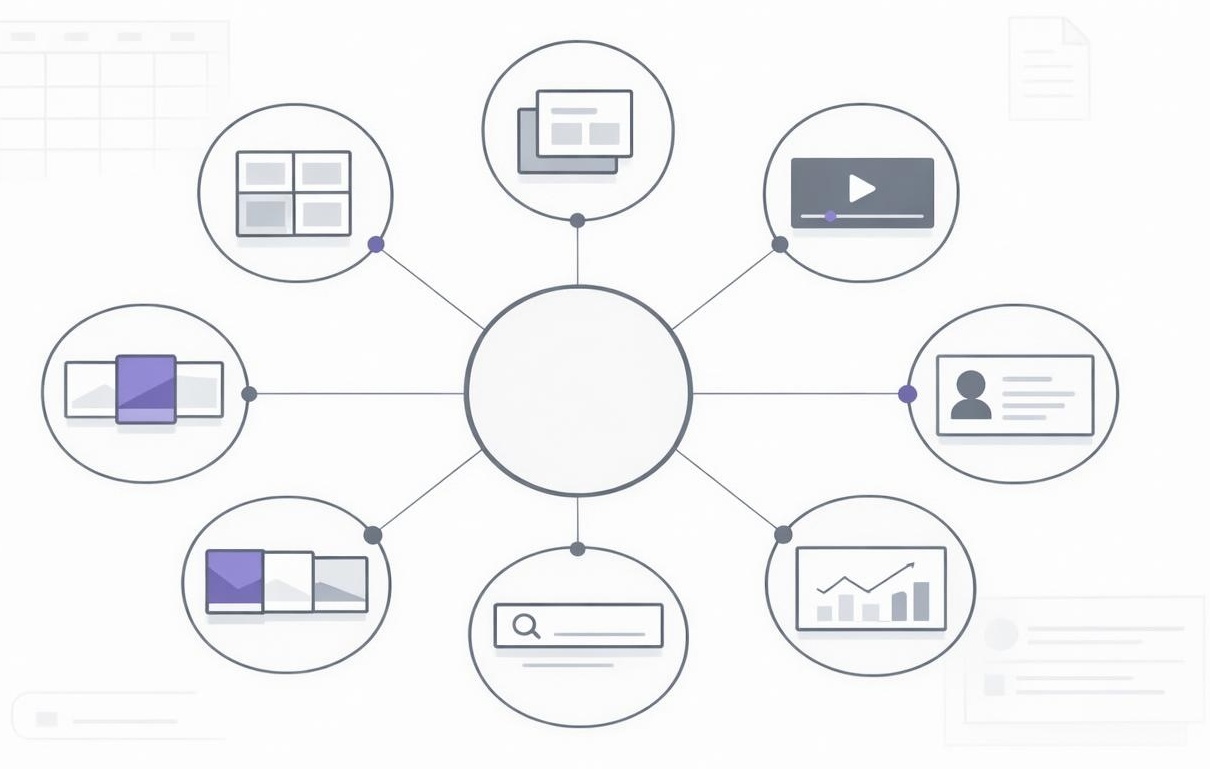
The wiring rule keeps repurposing from becoming random content confetti: your video supports your post, your post supports your pillar, your blog reinforces your positioning. In other words, the assets are not siblings competing for attention, they are a chain.
If a simple map helps, think in terms of roles rather than formats: the pillar earns trust with a full explanation, the supporting post expands one slice with a concrete example, short-form social creates curiosity around one sharp idea, and video adds voice, presence, and emphasis so the idea sticks.
When each asset has a role, the system becomes coherent. When each asset also points to another asset, the system becomes compounding. Someone can discover a short clip, land on a supporting post, then reach the pillar that frames the full approach, and each step increases confidence rather than repeating the same surface-level point.
Step 5 and 6: Interlink deliberately and schedule continuity to break the on-off cycle
Interlinking is not an SEO trick, it is network design. A reader should be able to enter the ecosystem from any page and naturally find the next best piece. That is how understanding builds, and understanding is what turns attention into trust.
Practically, interlinking means every cluster post links back to its pillar, and also links laterally to one or two related posts within the same theme. The pillar, in turn, should link out to the best supporting posts for each subtopic. This creates a loop: the pillar distributes authority to the cluster, and the cluster strengthens the pillar.
Deliberate interlinking is also a clarity signal. Links are not only navigation, they are a claim about what belongs together. When a post about “delegation that scales” points to a pillar on “decision systems,” it teaches the reader how the ideas connect. That same connection is what helps discovery systems interpret the footprint as a coherent body of expertise.
Here is what “compounding” looks like in real life: a founder searches for a fix to a bottleneck, finds a supporting post on decision rights, clicks into the pillar that defines the full decision system, then follows a link to a post on meeting structure. By the time they reach the end, the founder is not only convinced that the problem is real, but also convinced the expertise is organized. That feeling of organized competence is a buying trigger, and it is created by wiring, not by volume.
Continuity is what keeps the loop alive. Most experts do not lack ideas, they lack an operating system that survives busy weeks. The on-off cycle trains the market to forget, and it trains algorithms and AI systems to stop expecting new signals. Consistency does not have to mean daily posting, but it does have to mean predictable presence.
A workable continuity schedule is one that can be sustained during a “bad week.” For many expertise-led businesses, that looks like one pillar or major update per month, one supporting post per week, and a few short-form translations pulled from what already exists. The rhythm matters because it keeps the network warm: new entry points appear, older posts get reactivated through internal links, and the body of work continues to look alive.
Continuity also prevents a common trap: posting only when energy spikes. That pattern creates an emotional roller coaster, followed by guilt, followed by silence. A connected system flips that dynamic. Instead of asking, “What should be posted today?” the system asks, “Which node in the network should be strengthened next?” That is a much easier question to answer, especially when time is limited.
This is the underlying Inkflare philosophy in practice: build a connected system that carries expertise across surfaces without relying on bursts of willpower. When the system is connected, every new piece makes the previous pieces more valuable, and the authority curve stops resetting.
The playbook is simple: decide what to be known for, commit to three themes, write pillars that define the territory, translate them into clusters, wire the assets so they reinforce each other, then keep the system running. What would change if the next 90 days of content were designed as a network, not a series of posts?