
Stop Chasing Attention and Build Recognition People Remember
Stop Chasing Attention: Being Seen Once Is a Losing Strategy Now
Attention is a spike, recognition is a signal. One gets a glance, the other earns a default choice. If the goal is real demand, not temporary activity, the strategy has to change.
“You don’t win by being seen once. You win by being remembered.” That line is uncomfortable because it exposes the trap behind most content habits. A post pops off, the notifications flood in, and for a moment it feels like momentum. Then the feed moves on, the algorithm resets, and it is back to shouting into a crowd that barely recalls the name.
Attention buys a moment. Recognition buys a mental shortcut. When recognition exists, the buyer does not need a fresh burst of persuasion every time. The brand or expert is already categorized as credible, already associated with a problem space, already “one of the options.”
This matters more than ever because discovery no longer happens in one place. Prospects see ideas on social, check credibility through search, skim AI-generated summaries, and triangulate trust across multiple surfaces. The old playbook, post harder and louder, is built for noise. The modern requirement is identity.
The Better Mental Model: Recognition Is Repeated Validation
Recognition is not volume, it is repeated validation that resolves into certainty. It forms when the same expertise shows up consistently enough that the brain stops treating it as a one-off and starts treating it as a known entity.
The first real “yes” rarely sounds like “this is the best person.” It sounds like “I keep seeing this person,” and that is the moment everything changes. Familiarity lowers perceived risk. Repetition signals legitimacy. Consistency implies competence. A buyer may not be ready to purchase today, but recognition quietly moves that buyer from stranger to shortlist.
Consider a coach who teaches boundary-setting for high performers. One post about burnout may earn likes, but a pattern earns recognition: a steady stream of clear, repeatable insights about overcommitment, difficult conversations, and sustainable ambition. A founder scrolling late at night sees the same viewpoint again, not as spam, but as a reliable lens. The result is not applause, it is recall.
Or take a consultant known for pricing and positioning. A single thread about “charge more” is forgettable. A recognizable angle repeated across formats, pricing myths dismantled, buyer objections reframed, case examples used to teach, becomes a signature. When a prospect later searches for pricing guidance or asks an AI tool for recommendations, the consultant’s footprint reads as coherence, not coincidence.

Why Scattered Posting Fails: Without a Pattern… There Is No Identity
Scattered posting feels productive because it produces output, but output without coherence does not compound. It burns time while leaving trust untouched.
“Without a pattern… there is no identity.” Pattern is what makes the brain able to label what someone stands for. It is repeatable themes, a consistent point of view, recognizable language, and a predictable kind of help. Pattern is also what makes platforms and search systems understand where to place a creator or business in the map of topics.
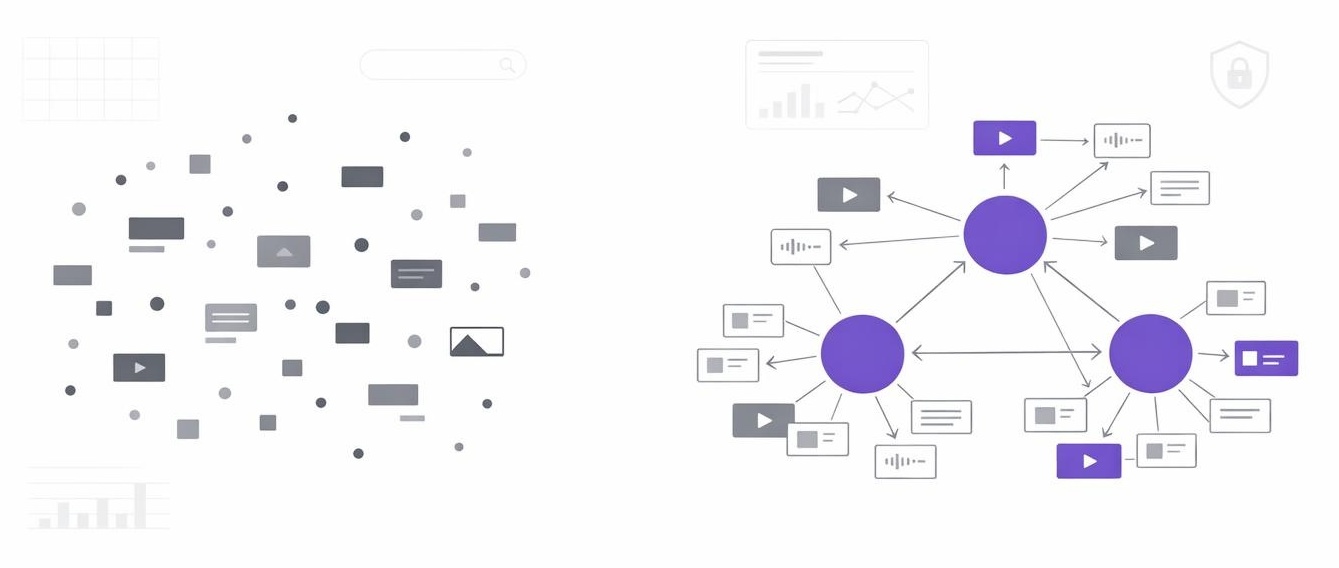
Random posting fractures that map. One week it is leadership quotes, the next week it is product updates, then a meme, then a personal story, then a hot take on something unrelated. None of it is inherently wrong, but the combined signal is fog. The audience cannot summarize what the account is “about,” and if the audience cannot summarize it, neither can an algorithm.
The hidden cost is brutal: every post has to start from zero. There is no accumulated context, no familiar expectation, no sense that the next piece will reinforce the last. The result is a treadmill where effort increases and recognition stays flat.
Build Recognition on Purpose: The 3 Layers of Durable Visibility
Durable visibility is built in layers, not bursts. A simple system can create the “keep seeing this person” effect without turning content into a second full-time job.
Start with the Identity Layer, what gets repeated. This is where most experts accidentally stay vague, not because they lack expertise, but because they refuse to choose a lane. The fix is not narrowing into a tiny niche, it is choosing 3 to 5 pillars that reflect real demand and real strengths. A founder might choose pillars like category education, product philosophy, customer outcomes, and operational lessons. A coach might choose pillars like diagnosis, frameworks, examples, and mindset rewires. Add a signature point of view, a stance that the market can recognize (not generic motivation), plus a few repeatable frameworks or phrases that make the thinking sticky.
Next is the Distribution Layer, where repetition happens. Distribution is not about being everywhere, it is about building a channel stack that matches reality. Most authority builders need one primary social channel where ideas are tested and conversation happens, plus a durable home base that compounds (blog and search). Then use resurfacing to manufacture repetition without manufacturing new ideas. The same pillar can be expressed as a short post, a longer article, a small carousel, and a reframe for a different audience segment. Not because content should be churned, but because recognition is created by encountering the same competence from multiple angles.
Finally comes the Memory Layer, how it compounds. Memory is built through interlinking, sequencing, and controlled repetition over time. A post should not live and die in a feed. It should point to a deeper explanation, which points to a related framework, which reinforces the same pillar again. This is not only for humans. Consistent topical signals across connected assets make it easier for search engines and AI-driven summaries to interpret expertise as a coherent body of work instead of isolated fragments.
A practical cadence can be simple: one pillar per week, expressed in two short social posts and one durable asset that becomes the reference point. The second week returns to a different pillar, but uses the same signature lens. Over a month, the market starts to hear a voice, not a series of unrelated updates. That is the point.
The Mindset Shift: Content Is Infrastructure, Not Short-Term Attention
Content that builds recognition is not entertainment for the feed, it is infrastructure for trust. Infrastructure keeps working when the creator is busy, when launches are not running, and when the algorithm is feeling unpredictable.
Attention fades quickly because it is designed to. Recognition compounds because it is stored, in memory, in search results, in shared links, in AI summaries, in the quiet background of a buyer’s decision process. The goal is not to be noticed, the goal is to be legible.
“You don’t win by being seen once. You win by being remembered.” Remembered means the market can describe what expertise is offered, what outcomes are delivered, and why the perspective is different. It also means that the next time a prospect is ready, the decision feels like a continuation, not a cold start.
This is why the future belongs to systems, not sprints. Inkflare is built around that reality: consistent, interlinked, expertise-led visibility that reinforces identity across the surfaces where buyers actually check. Choose a pattern, then protect it. Recognition does not reward intensity, it rewards coherence.