

Make Your Expertise Legible at a Glance and Become the Obvious Choice
Expertise legibility: why “knowing” isn’t the same as being trusted
Expertise legibility is the ability for other people, and the systems that mediate discovery, to correctly interpret what an expert does and why it matters in seconds. It is the missing layer between real competence and real market trust.
Plenty of capable experts are stuck in the same invisible loop: the work is excellent, the insights are real, the results are there, but the market still hesitates. Not because the expertise is weak, but because it is unreadable at a glance. A stranger can’t quickly answer basic questions, like “What does this person help with?”, “Who is this for?”, and “What outcomes are typical?” When that clarity is missing, trust doesn’t form, it stalls.
This gap is getting wider because discovery is no longer a single channel problem. Prospects bounce between social feeds, podcasts, blog posts, search results, AI Overviews, and AI assistants that summarize “who to trust” before a human ever clicks. Those systems do not surface potential. They surface patterns. The market does the same.
Inkflare’s core premise lands hard here: the deeper challenge is making expertise legible. Not louder. Not busier. Legible.
The good news is that legibility can be built. It tends to come down to four layers, and when they stack together, credibility becomes obvious: (1) known-for clarity, (2) connected themes that form a network of expertise, (3) continuity across formats, and (4) pattern strength.
Layer 1 — Known-for clarity: the shortest path from “expert” to “obvious choice”
Known-for clarity is a one-line claim that makes the market categorize an expert correctly, without effort. It is not a slogan, it is a precision instrument.
Most bios and positioning statements fail because they describe a role, not a result. “Leadership coach” is a role. “Helps first-time managers run high-trust 1:1s that prevent avoidable attrition” is a result. “Fractional CFO” is a role. “Helps bootstrapped SaaS founders build a weekly cash system so growth stops feeling like roulette” is a result. “Marketing consultant” is a role. “Helps B2B teams turn one point of view into a repeatable content system that compounds in search and AI” is a result.
A strong known-for statement usually contains four ingredients, even when it reads naturally: a category claim, a specific audience, a measurable outcome, and a proof domain (the kind of work or context that makes the claim credible). This is the difference between “sounds like everyone else” and “sounds like the obvious choice.”
A fast micro-check makes this concrete: if a stranger reads a header, a short bio, and three recent posts, can they answer what this expertise is for? If the answer is fuzzy, the market will treat it as risky. Clarity is a constraint, and that constraint is what makes compounding possible.
Layer 2 — Connected themes: from isolated posts to a network of expertise
Connected themes are 3 to 6 repeatable topic clusters that interlink, reinforce each other, and make an expert’s thinking feel like a map instead of a pile. This is where audiences stop seeing “content” and start seeing a body of work.
Variety is easy, and it often looks like intelligence. One post about mindset, another about tools, another about a client win, another about a hot take. The problem is that variety without structure reads like static. Range is different. Range means multiple angles that all point back to the same underlying promise, the same thesis, the same domain of proof.
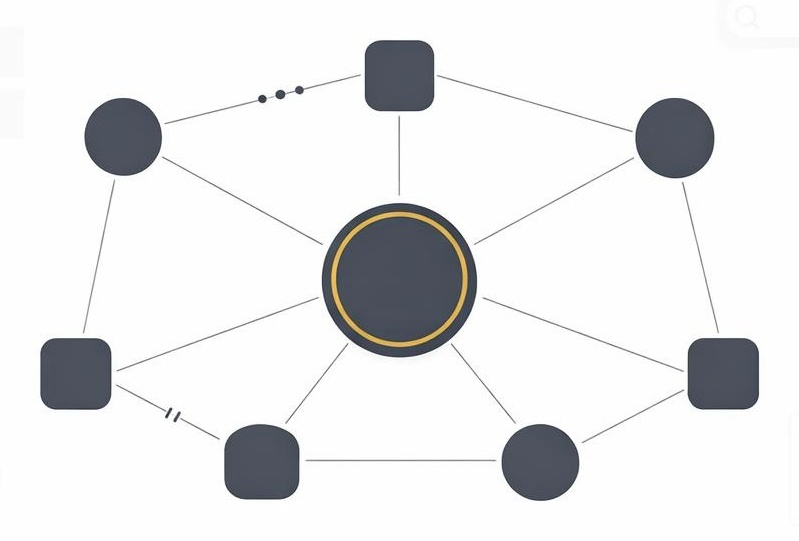
Building themes is less about brainstorming and more about architecture. Start with one core promise, then pull out the clusters that naturally surround it: the surface problem people complain about, the deeper causes that keep it recurring, the framework or method used to solve it, the implementation details that make it work in real life, the case patterns that show it across different scenarios, and the objections that smart buyers will raise before they trust.
This is why the “network of expertise” idea matters. A single post can persuade, but a network can position. When one theme points to another, it becomes a set of conceptual hyperlinks, even when no literal link exists. A blog post hints at a framework, a short social post names the same framework, an email answers the obvious objection, a long-form piece shows the implementation in practice. Humans remember connected ideas. AI systems retrieve connected entities. Either way, the expert becomes easier to find and easier to trust.
Layer 3 — Continuity across formats: one expertise, many surfaces, one voice
Continuity is the discipline of sounding like the same authority everywhere, even when the format changes. Without continuity, expertise leaks.
It is common to see an expert with a sharp long-form article, and a social feed that feels like a different person, or worse, weeks of silence between bursts of activity. From the market’s perspective, inconsistency is not a scheduling issue, it is a credibility signal. If the story changes by platform, the audience assumes the thinking changes too.
Continuity does not require repeating the same post. It requires repeating the same thesis. That shows up as a stable vocabulary (signature phrases that appear again and again), consistent examples (the same kinds of scenarios used to teach), and one or two frameworks that anchor the worldview. It can even show up in structure, such as opening with a clear claim, backing it with a concrete mechanism, and closing with an implication the reader can use.
This is where experts hit the time wall. Maintaining continuity manually across formats is hard when client work, shipping, delivery, and leadership take priority. That is why continuity has to be system-driven, not motivation-driven. When the same core ideas are consistently translated into multiple formats, the market gets the “everywhere effect” without the expert living on the internet.
Layer 4 — Pattern strength: the credibility signal both people and AI can’t ignore
Pattern strength is the density of coherent signals over time, across topics, claims, frameworks, examples, and outcomes. It is how trust is formed when no one has the time to investigate every detail.
Humans are pattern-recognition machines. So are modern discovery systems. When the market sees the same promise supported by the same reasoning, illustrated with consistent examples, and reinforced with clear results, it stops debating whether the expertise is real. It starts assuming it. Incoherence creates friction. Coherence creates inevitability.
A useful way to build pattern strength is to run a legibility audit that forces clarity in each layer:
- Known-for clarity: Can a stranger describe the expertise in one sentence, identify who it is for, and name the outcome? Does the language point to a proof domain (specific context) rather than a generic title?
- Connected themes: Do 3 to 6 themes show up repeatedly, do they naturally reference each other, and do they all orbit the same core promise? If the last ten pieces were shuffled, would they still look like they belong to one mind?
- Continuity across formats: Do short-form and long-form sound like the same authority, using the same key terms and frameworks? Do readers see consistent structure and consistent point of view, even when the medium changes?
- Pattern strength: Over the last 30 to 90 days of visibility, do repeated signals stack (claims, mechanisms, examples, outcomes), or do they restart from zero each time? Would an AI summary of the body of work sound crisp, or confused?
The next step is simple, and it is strategic. Fix known-for clarity first, because it tells the market what to look for. Then build connected themes so the expertise becomes a network, not a sequence. Then enforce continuity so every surface reinforces the same authority. Finally, increase pattern density so trust becomes the default interpretation.
This is the core Inkflare philosophy in practice: authority is not a single post that performs, it is a coherent ecosystem that runs continuously. When expertise becomes legible at a glance, visibility stops being a grind and starts acting like an asset.