Stop Calling Yourself Versatile and Start Being Clear Online
“Versatile” sounds like a compliment, but online it often lands as a warning label. When positioning tries to serve too many people with too many outcomes, the audience rarely thinks “multi-talented.” They think “unclear,” and unclear gets skipped.
The perspective shift is simple: broad messaging does not create more opportunity, it creates more doubt. Doubt creates friction, and friction is where attention dies.
That is why two experts with the same skill can get wildly different results. One feels “everywhere” with half the output, because the message is legible and consistent. The other posts in bursts, covers a dozen topics, and stays strangely invisible.
Broad positioning doesn’t look inclusive, it looks undecided
Broad messaging fails online for a simple reason: discovery runs on pattern recognition. Feeds, search results, AI summaries, and even human skim-reading are all trying to answer the same question fast, “What is this, and why should it matter?”
When a profile, website, or content stream tries to cover everything, it forces the reader to do categorization work that should have been done for them. Instead of “This is the person for X,” the brain gets “This could be about anything.” That is not versatility, it is ambiguity.
There is also a status trap hiding inside the word “versatile.” Experts use it to signal capability, range, and experience. Audiences often read it as hedging, especially when the market is crowded and everyone claims to be able to help. Broad claims sound like a lack of a point of view.
A quick analogy makes the problem obvious. A restaurant with a three-page menu (sushi, BBQ, pasta, vegan bowls, brunch) might be capable, but it does not feel confident. A smaller menu signals a kitchen that knows exactly what it’s doing. Online works the same way, clarity reads as competence because it implies a deliberate choice.
Online authority is not awarded for having many skills. It is awarded for being legible.
Why “versatile” reads as unclear in feeds, search, and AI discovery
“Versatile” fails because it is not a category. It is an adjective. People do not search for adjectives when they have a problem, they search for outcomes, constraints, and specific situations.
A coach might genuinely be able to help with leadership, confidence, communication, hiring, habits, and burnout. But if every post rotates topics with no visible throughline, the audience never learns what to associate with that name or brand. Memory needs repetition. Repetition needs a theme.
This is where broad positioning quietly breaks conversion. Picture a founder who needs help selling a B2B offer. They land on an expert’s page and see posts about “mindset,” “productivity,” “branding,” and “wellness,” with no consistent lens tying them together. The founder cannot tell whether the expert is the right fit, so the founder moves on, not because the expert is wrong, but because the signal is fuzzy.
Search and AI-driven discovery intensify this. Systems that summarize and recommend content look for stable signals: consistent language, consistent topics, consistent angles, and consistent relevance to a particular intent. When content is scattered, signals are diluted, and the brand becomes harder to retrieve, harder to recommend, and easier to replace.
Even when the content is good, a scattered footprint often produces fragmented outputs: a blog ranks for one topic, a social post performs on another, an AI summary associates the brand with a third. That splintering is the opposite of authority. Authority is a strong association between a problem, an approach, and a name.
The hidden cost is not just lower engagement. It is lower trust. Clarity is a proxy for competence because clear experts tend to have clear methods.
A practical way to test legibility is to scan the last ten pieces of content and ask a blunt question: if a stranger saw only headlines and opening lines, would they be able to finish this sentence confidently, “This expert helps with ___”?
The inconsistency cycle turns “multi-talented” into “unreliable”
Inconsistent posting is not just a frequency issue, it is an identity issue. The on, off, on, off cycle creates a stop-start impression, and stop-start impressions feel risky when someone is deciding who to trust with money, time, or reputation.
Broad messaging makes inconsistency worse because it removes the natural momentum that a tight theme creates. When topics are loosely connected, returning to content after a gap feels like starting over. The audience has to re-learn what the brand is about, and the creator has to re-invent what to say.
A continuity system solves this problem at the root, because it treats visibility as an engine, not a mood. That is the philosophy Inkflare is built on: clear themes, consistent expression, and a content ecosystem that keeps expertise present even when time and attention are limited.
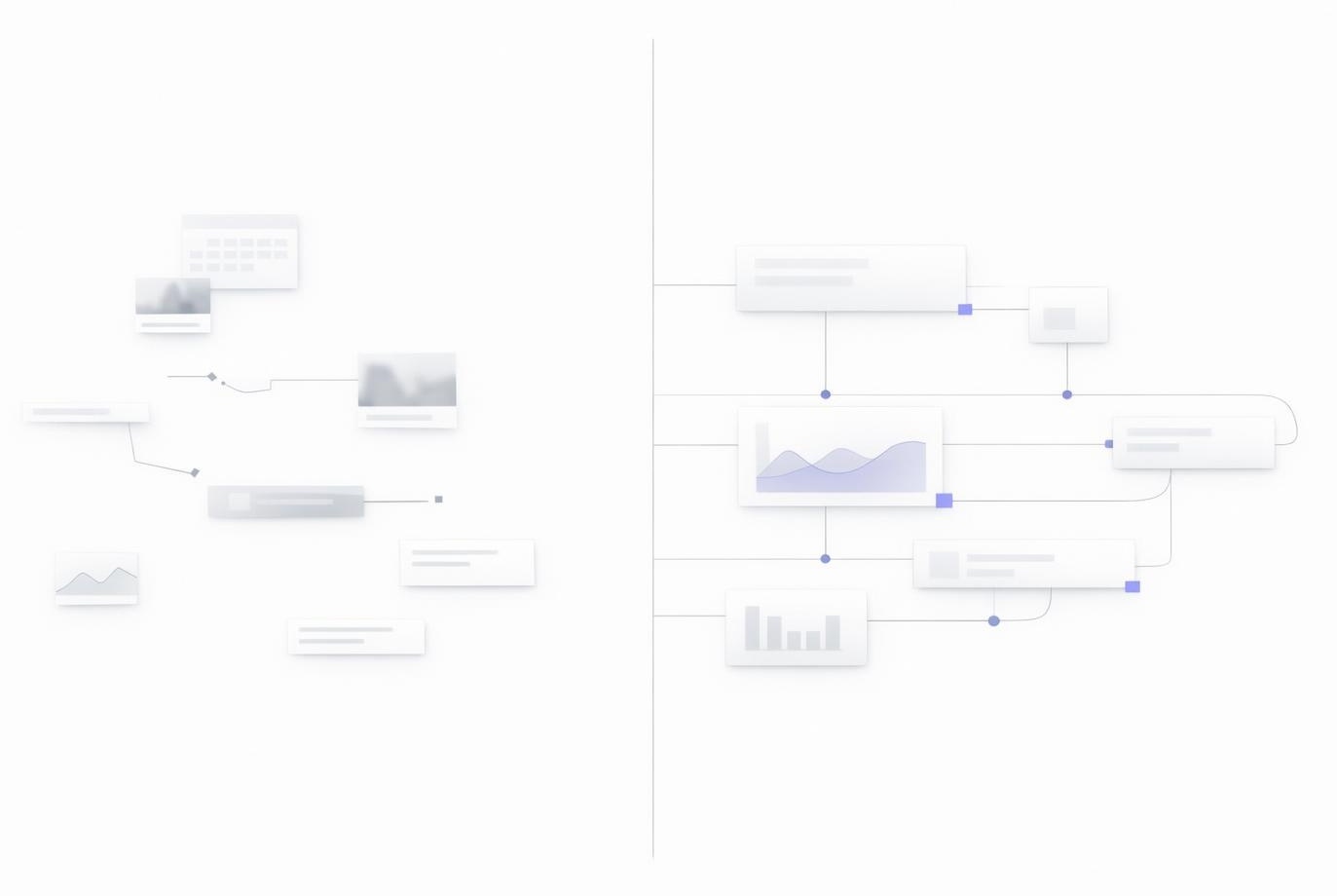
That is how invisibility happens without anyone “failing.” There is effort, there is talent, there are bursts of activity, and still no compounding. The content does not stack. It resets.
The market does not punish versatility. It punishes unpredictability. A clear thematic lane makes a brand feel stable even when output is modest, because every new piece reinforces what came before.
The better mental model is a tight theme with multiple angles, not a narrow life sentence
Clarity is often misunderstood as choosing one tiny niche forever. That fear drives experts back into broad claims, which then keep them stuck. The alternative is not a smaller identity, it is a sharper signal.
A useful model is a theme stack: one primary theme that anchors the brand, supported by a small set of recurring angles that prove depth without scattering the message. The audience experiences range, but within a recognizable world.
The simplest version is:
- One audience (or one high-similarity cluster) the brand is built to serve
- One core problem the content returns to repeatedly
- One signature approach that shows how results are produced
- Three to five angles that keep the theme fresh (myths, mistakes, case examples, frameworks, trade-offs)
This is what “versatile” is supposed to mean in practice: not many unrelated offerings, but one coherent expertise expressed in multiple forms.
The non-obvious insight is that the angles are not there to entertain the algorithm. They are there to build mental availability. When people face the problem, the brand should come to mind automatically. That only happens when the brain has seen the same idea enough times in enough contexts to trust it.
A theme stack also changes what “content ideas” feel like. Instead of brainstorming from scratch, the work becomes refinement: the same core idea, expressed through different angles, for different moments, for different objections. The result is more depth with less scatter, and it reads like authority instead of experimentation.
Continuity beats volume, and systems beat willpower
Most experts do not need to post more. They need content that connects.
Continuity has two jobs: it makes the audience feel like the brand is present, and it makes the content ecosystem easier for discovery systems to map. When the same theme is reinforced across social posts, blogs, and search-focused pages, authority becomes easier to recognize and easier to surface.
This is where a visibility system matters. Inkflare is built around a simple philosophy: brilliant expertise should not disappear between bursts of motivation. By turning a clear theme stack into a continuous, interlinked content presence across channels (social, blog, search, and AI discovery surfaces), the work starts to compound instead of reset.
The goal is not noise. The goal is being unmistakable.
Stop calling it “versatile.” Call it what it needs to be online: a clear signal delivered with consistency. When the message becomes legible and the cadence becomes steady, the brand stops asking the audience for patience and starts earning recognition.