
Consistency in Content Marketing Is a System Problem Not a Willpower Problem
Consistency rarely fails because discipline is missing, it fails because the content system is missing. The usual advice, “just show up every day,” treats visibility like a character trait. In reality, visibility is infrastructure, and infrastructure either carries weight or collapses.
When momentum dies after the first burst of posting, the cause is almost never a lack of ambition. It is a slow leak of decisions, friction, and unrewarded effort that turns publishing into a daily negotiation. The fix is not more grit, it is better design: fewer choices, clearer pathways, and content built to compound.
The logic is straightforward: first diagnose the decision fatigue that breaks consistency, then treat visibility like infrastructure, then publish for compounding (not closure), then build a minimum viable system that holds up under real-life constraints, then choose engines and processes that protect signal instead of inflating noise.
“Be consistent” fails because decision fatigue quietly eats the work
Consistency breaks down when every post begins with four questions that should have been answered once. What to say, where to say it, how to format it, and when to publish are not creative questions, they are operational questions. Operational questions drain attention, and attention is the scarcest resource for coaches, founders, course creators, and small teams.
This is the hidden tax in modern content. The internet trains people to blame willpower, then quietly hands them a workflow that requires dozens of micro-decisions per week. The result is predictable: posts become sporadic, quality gets inconsistent, and the “content habit” starts to feel like a moral failing.
A useful mental model is to treat publishing like any other production system. If a restaurant had to decide the menu, the kitchen layout, the plating style, and the supplier list every morning, it would not matter how motivated the chef was. The service would collapse under choice.
The same thing happens online. When each post is created from scratch, the creator becomes both the strategist and the assembly line. That setup can work for a week. It cannot carry a year.
There is another quiet failure mode hiding underneath the fatigue: the feedback loop is delayed. A single post rarely pays back immediately, so the brain treats the work as “effort with uncertain reward.” Systems fix that by making the work smaller, more repeatable, and more connected, so each publish action has a clear next step rather than a cold reset.
Visibility is infrastructure, build the system that reduces choices
A visibility system is the set of constraints that makes publishing the default, not the struggle. It is not a content calendar taped to a wall. It is the design that turns expertise into repeatable outputs with minimal decision load.
The difference between “posting” and “publishing” is intent. Posting is a one-off act performed for a feed. Publishing is placing an asset into a network where it can keep working after the day it appears.
That network has three layers, and each layer needs different inputs.
Social needs clarity and angle, it rewards sharp framing and fast comprehension. Search needs structure and specificity, it rewards problem language, definitions, and durable answers. AI-driven discovery surfaces increasingly reward coherence, interlinking, and repeatable signals, they need content that reads like a connected body of knowledge instead of isolated quotes.
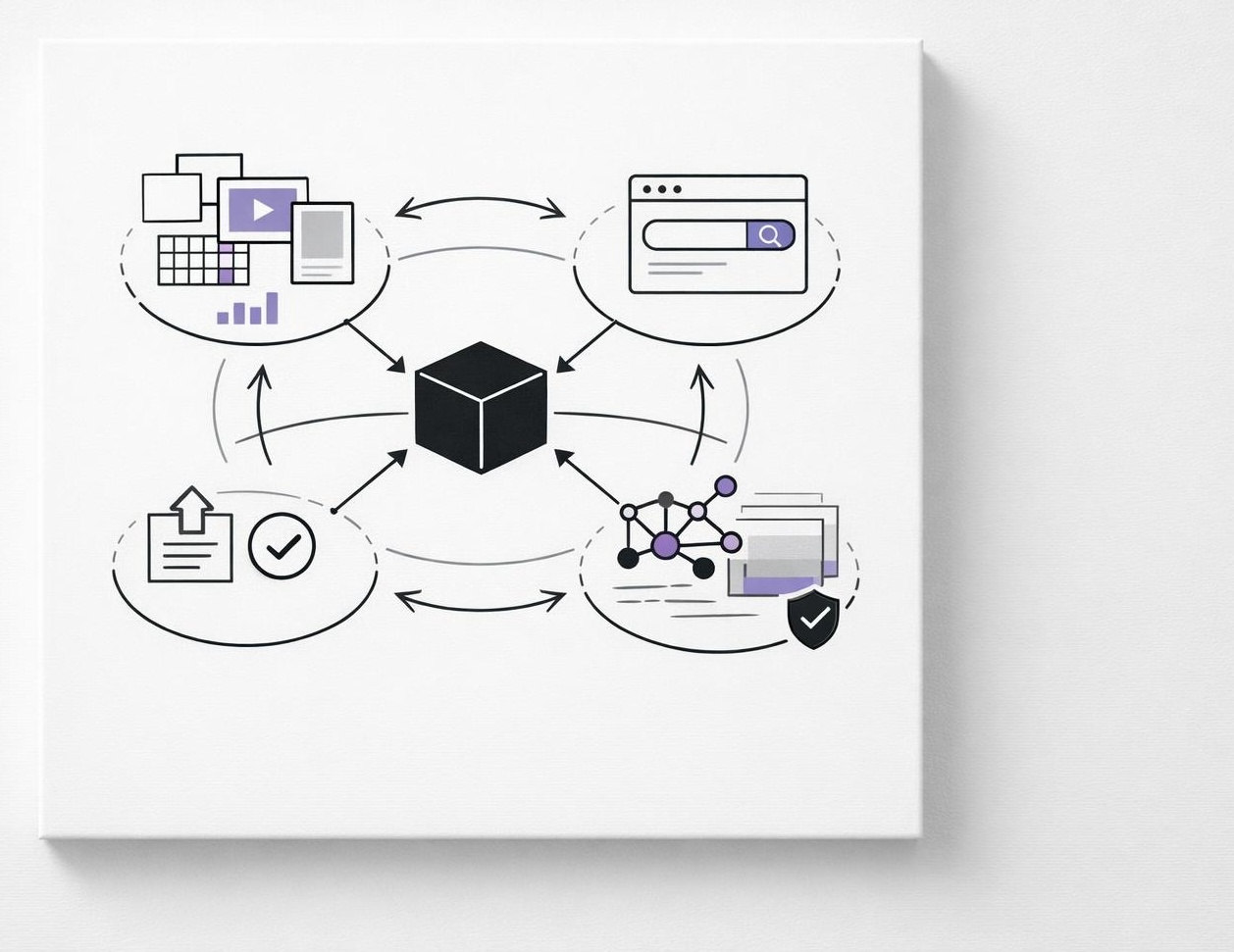
The problem is that most creators build for one layer at a time. A week of posts for social, a separate sprint for a blog, a separate “SEO push” later, then a quiet month of exhaustion. That pattern feels productive because it creates bursts, but it destroys continuity because nothing connects.
Infrastructure thinking flips the order. Decide the core idea first, then design the outputs that express it across layers, with clear pathways between them. When each surface points somewhere useful, a short post is no longer a throwaway, it is a doorway. When each doorway leads into deeper proof, consistency stops being a performance and starts being a pipeline.
A system does not ask an expert to become a posting machine. A system does the opposite, it protects the expert from the feed’s endless appetite by standardizing the parts that should never be reinvented.
This is where infrastructure thinking changes everything. The goal is not to force daily motivation. The goal is to design away the daily debate.
Stop publishing to finish, start publishing to plant
Publishing to finish means treating each piece as a task to complete, ship it, cross it off, move on. It creates a treadmill, not a library. Publishing to plant means treating each piece as a seed in a larger ecosystem, something that can sprout into multiple surfaces, reinforce prior ideas, and keep producing returns.
That compounding effect is the real prize, and it has nothing to do with hustle. A planted piece becomes a social post that introduces the idea, a longer page that explains it, and a chain of related ideas that make the concept harder to ignore over time. The internet does not reward effort, it rewards accumulated evidence of expertise.
The strongest creators are not louder, they are more interconnected. Their content behaves like a map. Each new piece points back to a few core themes and forward to deeper explanations. Over months, that internal linking creates a recognizable signature, not just a larger volume.
This is also why “consistency beats intensity” is true for the reasons people rarely discuss. Intensity produces spikes. Systems produce coverage. Spikes may get applause, coverage builds trust.
A practical way to see this is to ask a simple question: if a stranger discovers one piece, can they easily find the next three that deepen the idea? If the answer is no, the content is being published to finish. If the answer is yes, the content is being published to plant.
The minimum viable visibility system for overwhelmed experts
A content system does not need to be complex, it needs to be explicit. The enemy is not a lack of creativity, it is ambiguity.
Start by locking three decisions that remove most of the daily chaos.
First, choose topic rails, a small set of recurring problem areas the audience already pays for. Not “marketing” or “mindset,” but the concrete tensions clients and customers bring into calls: why leads stall, why offers get ignored, why teams lose focus, why students don’t finish, why retention slips. Topic rails prevent the weekly panic of “what should be posted.”
Second, choose default formats, the repeatable containers that make ideas easy to ship. A short argument post, a mini case breakdown, a “myth versus reality” clarification, a simple framework explanation, and an objection answer are enough. The point is not variety, the point is reusable structure.
Third, choose a distribution pattern that matches how discoverability actually works. Modern visibility is multi-surface, and the best move is not to be everywhere, it is to make content travel. One core idea can be expressed in different shapes across surfaces, with each surface pointing back to the most durable asset.
This is the cause-and-effect chain most people miss:
When inputs are constrained, output becomes easier. When output becomes easier, frequency stabilizes. When frequency stabilizes, signals accumulate. When signals accumulate, authority becomes legible to humans and machines.
The system is the lever. Willpower is just the ignition.
What a self-running content engine is actually for
Tools that promise “more content” miss the point, because volume is not the problem. The problem is that brilliant people are invisible, and invisibility is usually a systems failure.
A visibility engine is valuable only when it protects signal. It should reduce decision fatigue by standardizing the repeatable parts of publishing, without flattening the point of view that made the expertise worth listening to in the first place. It should also create continuity, so each piece increases the odds that the next piece gets understood faster.
A system like that is less about “creating content” and more about preserving meaning. It keeps language consistent, themes connected, and proof easy to find, so the audience does not have to reconstruct expertise from scattered fragments. That is what turns a body of work into a trust surface.
Inkflare is built around that philosophy: sustainable visibility comes from interconnected assets that reinforce each other across social, search, and AI discovery surfaces. Not random posting, not generic “content at scale,” not a louder feed, but a system that makes expertise easier to find, easier to trust, and easier to follow.
Consistency stops being a personality test when the system carries the load. The most important shift is simple: stop measuring success by whether motivation showed up today, start measuring success by whether the machine can keep producing signal even when attention runs thin.
If consistency has been slipping, the question is not “why is discipline failing?” The better questions are: what decisions are being made too often, what friction is being tolerated as normal, and what would change if visibility were treated like infrastructure instead of a mood?