The AI Discoverability Playbook for Experts Who Refuse to Become a Content Farm
After reading this, a simple system will exist for earning AI mentions without publishing 200 shallow posts. The outcome is not “more content.” The outcome is a tighter, interlinked knowledge footprint that an AI can reliably quote, summarize, and recommend.
AI visibility is not a lottery ticket. It is a retrieval problem. Models and search systems pull from what they can understand, trust, and connect. Content farms try to brute force that reality with volume. Authority builders win by engineering clarity.
AI discoverability rewards connected truth, not constant output
AI discoverability is the likelihood that AI systems cite, summarize, or surface a brand’s ideas when users ask relevant questions. That sounds like “SEO, but with robots,” yet the mechanism is different enough to punish old habits.
Traditional content marketing often treats posts like independent shots on goal. Publish, promote, move on. AI-driven discovery behaves more like a librarian. It looks for stable definitions, consistent terminology, and obvious relationships between concepts. When a site reads like a coherent body of knowledge, it becomes easier to retrieve and safer to reference.
The cause and effect chain is straightforward. Narrow expertise produces consistent language. Consistent language makes pages easier to classify. Pages that reinforce each other make the whole domain feel less like opinion and more like an index. That index is what gets “mentioned” when an AI needs a clean answer.
This is why Inkflare pushes a different posture: build an ecosystem, not a feed. Content Interlinking (blogs, videos, and posts intentionally connected) is not a formatting trick. It is how expertise becomes legible at scale.
Step 1: Pick a narrow expertise lane that can be named in one breath
A narrow expertise lane is a clearly defined topic area with a specific audience, specific problems, and specific vocabulary. It is the difference between “leadership coaching” and “leading a remote product team through delivery chaos.”
Broad positioning creates broad content, and broad content creates weak signals. Weak signals force writers to compensate with frequency, which turns into the very content treadmill most experts are trying to escape.
The fastest test is linguistic. If the expertise area cannot be said in one breath without adding “and also,” it is not a lane, it is a pile. A lane has edges. Those edges do two things: they help readers self-select, and they help AI systems map the work to a consistent set of queries.
A useful mental model here is the “gravity well.” A niche is not a cage, it is gravity. The tighter the gravity, the more adjacent questions orbit naturally. That orbit is what will power the rest of the playbook.
Step 2: Create one source-of-truth page that defines the category on your terms
A source-of-truth page is a single, durable page that acts like the canonical reference for the expertise lane. It is where definitions live, where the “why” gets clarified, and where the most common confusions are resolved.
This page does not need to be long. It needs to be unambiguous. AI systems love pages that make concepts concrete and repeatable. Humans do too.
Build it like a field guide, not a sales page. The structure should make it easy to quote:
- A crisp definition of the core concept in 2 to 4 sentences
- A short “what this is not” to prevent misclassification
- A FAQ section that answers the 6 to 10 questions people repeatedly ask
- A simple framework (even a three-part model) with consistent labels
Notice what is missing: endless persuasion. The goal is not to win a debate, it is to become the reference.
This is also where most experts accidentally sabotage themselves. They change terms every week, they rename the same idea in three posts, or they bury the real definition under storytelling. Story has its place, but the source-of-truth page is infrastructure. Infrastructure should not be poetic. It should be reliable.
Step 3: Publish supporting pages that answer adjacent questions and point back to the source
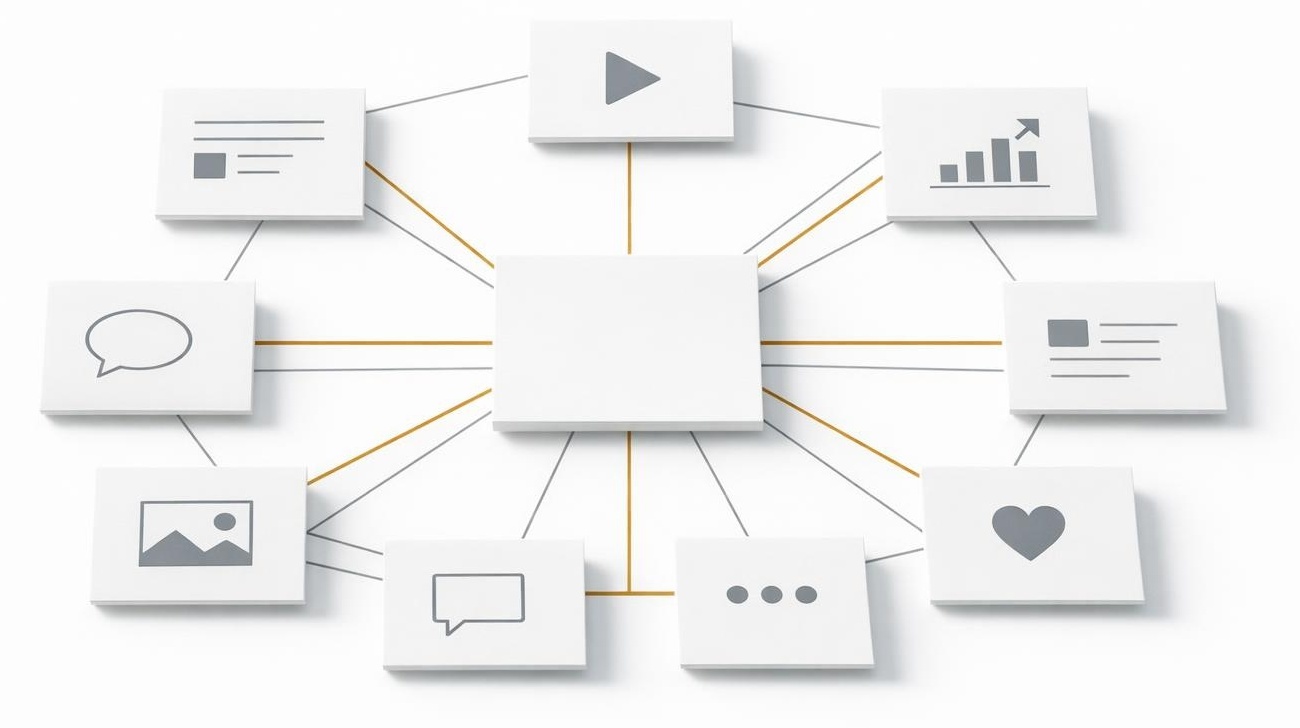
Supporting pages are focused answers to the natural adjacent questions that orbit the expertise lane. Each page should solve one problem, explain one concept, or clarify one trade-off, then connect back to the source-of-truth page like spokes to a hub.
The mistake to avoid is chasing whatever sounds trending. Trends produce scattered pages with no shared language. Scattered pages force AI systems to guess what the site is “about.” Guessing lowers confidence, and lowered confidence reduces mentions.
Instead, think like a curriculum designer. If a person needed to become competent in this expertise lane, what sequence of questions would they ask next? Those become the supporting pages. Each one should do three jobs at once: answer the question, reuse the lane’s core vocabulary, and link to the hub page and at least one sibling page.
That last part matters. Inkflare’s Content Interlinking idea is simple: interlinked content behaves like an ecosystem, not a pile of assets. Ecosystems create reinforcement. Reinforcement creates trust. Trust is what makes an AI comfortable referencing a source.
Step 4: Turn scattered assets into an interlinked ecosystem across formats
An interlinked ecosystem is the same set of ideas expressed across multiple surfaces, intentionally connected so that each asset strengthens the others. A blog post can link to the definition page. A short video can cite the blog post and point back to the hub. A social thread can summarize one supporting page and send readers to the full explanation.
The point is not omnipresence. The point is consistency across contexts.
When everything is isolated, each piece has to earn attention from zero. When everything is connected, each piece inherits meaning from the network. This is the hidden compounding effect most creators miss. Consistency beats intensity because consistent systems create cumulative retrieval pathways.
A practical rule keeps this clean: every new piece should either (1) deepen the hub concept, (2) answer an adjacent question, or (3) connect two existing pages that should have been related all along. Anything else is noise dressed as productivity.
This is also where “not becoming a content farm” becomes a design decision. Content farms publish to fill slots. Authority builders publish to strengthen a map. The map is what lasts.
The weekly refresh loop that keeps AI mentions growing without adding burnout
A weekly refresh loop is a lightweight routine that uses performance signals to strengthen existing content before creating new content. It is how visibility compounds without demanding a larger calendar.
The loop should be boring in the best way. Pick one day a week, review a small set of signals, make small edits, and reinforce internal links.
Signals to watch are not vanity metrics. They are clarity metrics. Which pages get impressions but weak clicks? Which pages get traffic but high bounce? Which supporting pages attract readers but fail to route them to the hub? Each of those is a visibility leak, and most leaks are fixed with sharper definitions, better headings, and more intentional linking.
A strong weekly pass often looks like this: tighten the opening definition on the hub, expand one FAQ answer based on real queries, add two internal links where the ecosystem is currently thin, then refresh one supporting page so it better matches the vocabulary of the lane. Small moves, repeated.
That is the real playbook. Pick a lane. Publish a source of truth. Build adjacent answers. Interlink everything like a curriculum, not a casino. Then refresh based on signals, not on panic.
If visibility is engineered, not hoped for, the question shifts. What would change if the goal stopped being “post more” and became “become the reference”?