
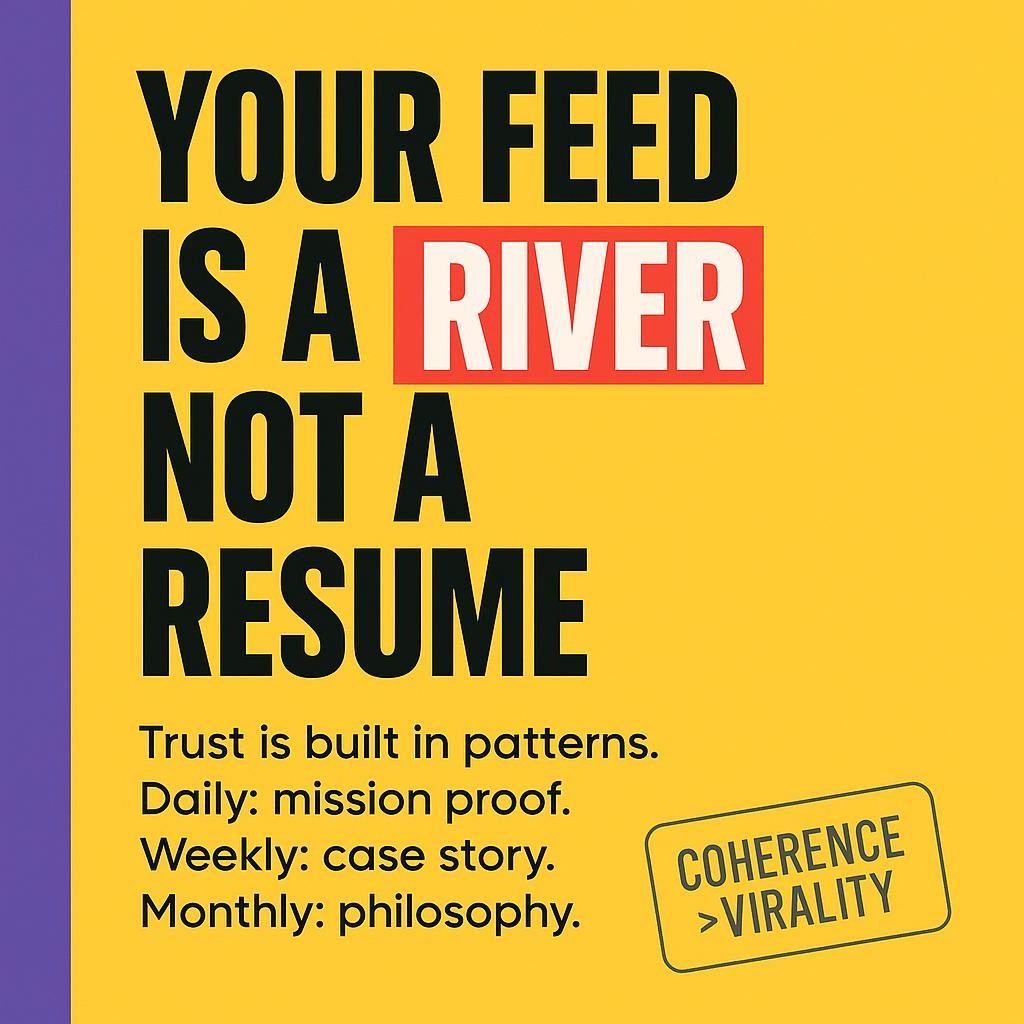
Your Feed Is a River, Not a Resume: Why People Learn Through Streams Now
You can spend all week polishing your About page, and your audience will still meet you somewhere else.
They’ll meet you in the scroll. In the middle of a busy day. Between a meme and a trending clip. In a half-watched video while they’re waiting for coffee.
That’s why this line hits so hard: “A page is a room. A feed is a river.”
Most founders are still building like people enter the room politely.
They don’t.
They drift into the river.
Your About page isn’t dead, it’s just not the first impression anymore
There was a time when a website page could carry your whole story.
Now, your feed does that job. Your content becomes the place where reputation forms, trust builds, and identity takes shape.
The simplest way to say it is also the sharpest: “Your ‘About’ Page Isn’t Dead, But It’s No Longer First Impression.”
Your About page is supporting documentation.
Your feed is the front door.
People don’t learn in pages now, they learn in streams
Here’s what “streams” really means.
Your audience enters the river with no plan. They see whatever the algorithm drops in front of them:
- a snippet of your story
- a post about your mission
- a carousel explaining a concept
- a clip of a founder speaking passionately
- a customer testimonial buried in the noise
That’s not a marketing problem. That’s the new reality.
And the key line most brands miss is this: “Their understanding of you forms through a constellation of micro-moments, not one static page.”
So each post does more than “perform.”
It signals.
It tells the audience who you are.
You’re not judged by one post, you’re judged by a pattern
In the river, every piece of content becomes a clue:
- “One post becomes a character clue.”
- “One video becomes proof of competence.”
- “One carousel becomes a philosophy lesson.”
- “One quote becomes evidence of your values.”
Then comes the line that should reset your entire content strategy:
“You aren’t judged by a page. You’re judged by a pattern.”
This is the heart of the whole message.
Your content is not a resume.
It’s identity in motion.
Your feed becomes proof (not marketing)
Here’s the trust problem founders don’t want to admit:
People don’t trust what you claim.
They trust what you repeat.
The text says it clean: “People don’t trust what a brand claims to care about. They trust what the brand consistently talks about.”
That’s why the feed matters so much for mission-driven work. If you care deeply, but you don’t express it, you become invisible.
And when your values show up daily, something flips. Your audience starts seeing evidence.
They start thinking:
- “Oh, they really believe this.”
- “They’re still here.”
- “They’re stable.”
Or as the book puts it: “Your feed becomes proof. Not marketing. Evidence.”
At Inkflare, this is exactly what we protect. Not hype, not random posting, not trendy noise.
A living pattern that makes your mission visible.
The feed is your public ledger (and silent followers are reading it)
Most founders look at engagement and assume that’s the audience.
But the book calls out a more important truth: the silent followers.
They don’t like, comment, or DM.
They watch. They evaluate. They internalize. They take you seriously.
Your feed becomes a record of who you are.
Not just what you sell.
The book says it directly: “Your content history becomes your reputation archive.”
And people check for things you cannot fake in one polished moment:
- how often you show up
- what tone you use
- what you emphasize
- what you repeat
- what you avoid
- what you stand for
- how you teach
This is why “just write a better About page” is the wrong solution.
The problem is not your page.
The problem is the pattern.
Consistency is not just strategy, it’s emotional safety
If you’ve ever disappeared for a few weeks and felt that weird mix of guilt and pressure, you’re not broken.
The book explains this as a real cycle founders fall into. You get busy, you vanish, the brand cools off, you panic, you post again, you burn out, repeat.
The deeper issue is what silence signals to your audience.
When you disappear, their brain quietly asks:
- Are they still active?
- Are they stable?
- Should I trust them with my money?
That’s why consistency creates emotional stability. It reduces anxiety.
And the book makes this point even stronger: people don’t bond with random interactions. They bond with rhythm.
It says it plainly: “Posting daily with recognizable cadence, tone, and thematic throughlines is ritual.”
And also: “Customers don’t bond with randomness.”
Ritual is what makes your brand feel safe, steady, familiar.
It’s the heartbeat.
Virality is a mood swing, the slow burn builds believers
The internet loves spikes. Founders get addicted to the dream of one big hit.
The book cuts through that fantasy: “Virality isn’t a growth strategy. It’s a mood swing.”
Virality can create attention.
But the slow burn creates loyalty.
The book paints the difference like this:
Virality is fireworks. The slow burn is a lantern.
Steady, reliable, always lighting the way forward.
And this is where the real compounding happens. The book describes the long curve of trust, built through repeated touchpoints:
- Post 1: “Interesting.”
- Post 5: “I like their style.”
- Post 12: “They’re consistent.”
- Post 25: “I’m learning from them.”
- Post 40: “I trust this brand.”
- Post 60: “I’m ready to act.”
That’s not luck.
That’s accumulated presence.
Inkflare was built to keep that presence alive even when you’re tired, traveling, parenting, deep in product, or doing actual client work.
Build a “pattern plan” your audience can recognize (daily, weekly, monthly)
You don’t need more content. You need meaningful repetition.
You need a rhythm people can feel.
Here’s a simple way to build it using what the book emphasizes: worldview reinforcement, story-led teaching, and narrative continuity.
Daily: reinforce your worldview
The book calls it out directly: you win with “daily reinforcement of your worldview.”
That does not mean repeating the same sentence forever.
It means saying the same truth through many angles, many formats, many emotional tones.
Because, as the book reminds you: “Repetition does not bore people. Repetition teaches people.”
Weekly: create segments people can expect
The book explains ritual through:
- weekly segments
- predictable formats
- recurring themes
- signature phrases
- patterns people can anticipate
This is where your audience starts to “know what they’re getting” from you, and they start coming back.
Monthly: build a bigger narrative arc
The book describes how your content becomes part of someone’s internal schedule:
- the morning thought
- the mid-day insight
- the end-of-day reminder
- the weekly ritual
- “the monthly narrative arc”
That monthly arc is how your brand stops feeling like fragments and starts feeling like a living universe.
A quick coherence check (use it before you post the next thing)
If your feed is a reputation archive, treat it like one.
Ask these questions about your recent content:
- What do we consistently emphasize?
- What beliefs keep showing up in different forms?
- Do we feel like one clear voice, or scattered moods?
- Do our posts feel like a world people can enter, or random fragments?
- If someone binge-scrolls us, what do they learn about what we stand for?
The goal is not perfection.
The goal is a pattern.
Because the river rewards the brands that feel alive, clear, and steady.
A final thought to carry with you
If your work is mission-driven, your job isn’t to explode once.
It’s to endure.
To keep the light on.
To let people slowly understand what you believe, and why it matters.
So here’s the question worth sitting with:
If someone only met you through the river of your feed, would the pattern they see feel like a brand they can trust, and a world they want to stay in?