The Empty Room Problem: The Heartbreak of Posting Into Silence (and the Fix Nobody Talks About)
Silence after you post is not proof your message is weak, it’s proof the room was never warmed.
You know the moment.
You hit publish on something that actually matters. Not filler. Not “content for content’s sake.” A real idea, a real lesson, a real piece of your mission.
Then the feed shrugs.
A few views. No traction. No one seems moved. And your brain starts doing what brains do, it turns missing feedback into a painful story:
- “I guess my content isn’t good enough.”
- “I guess people don’t like my message.”
- “I guess we’re too late.”
If that spiral feels familiar, you’re not dramatic, you’re human. Because "Humans are not wired to communicate with no feedback loop. We need response, recognition, reciprocity."
The Empty Room Problem (what’s really happening)
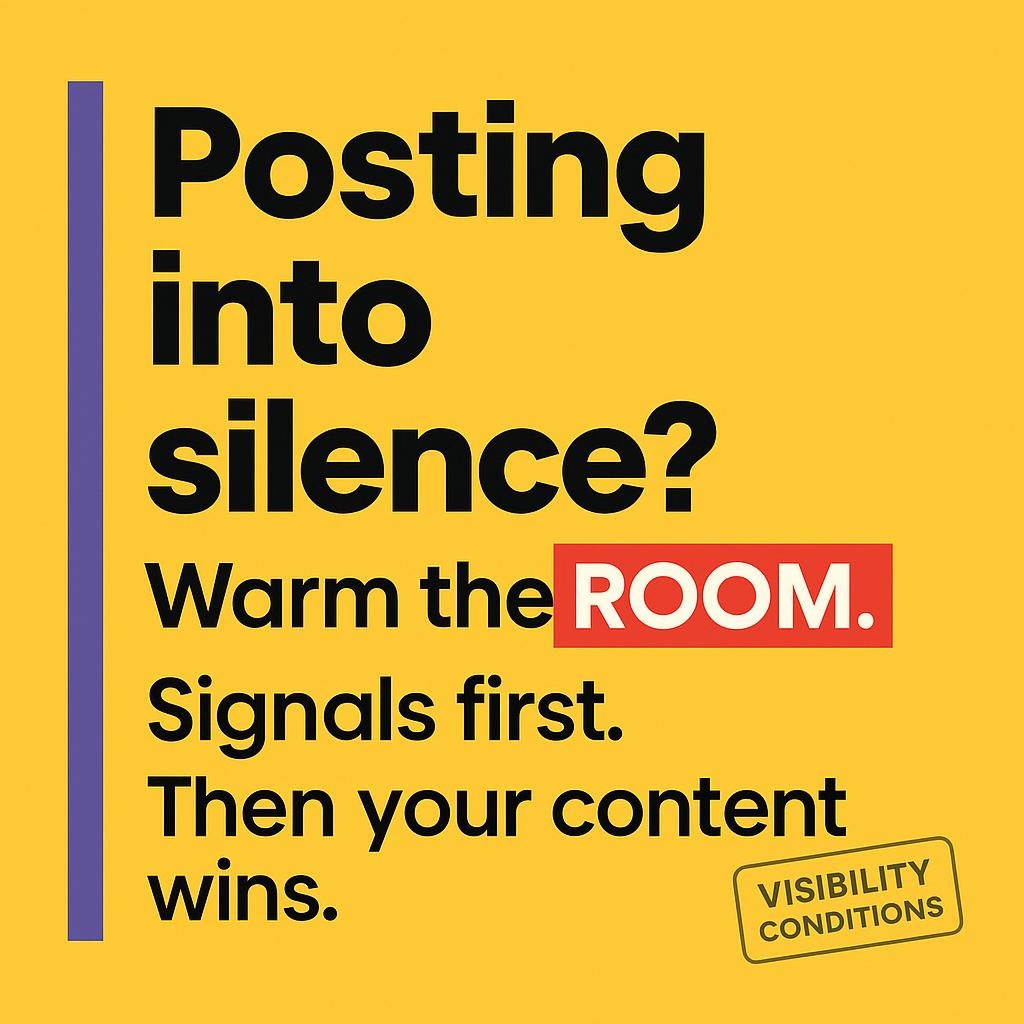
The Empty Room Problem is simple and brutal: you’re delivering your best speech in a theater where the audience never showed up.
Not metaphorically. Literally.
Most brands are posting into a void where:
- no one is listening
- no one is waiting
- no one is engaging
- no one is being transformed
And when this happens, founders don’t just lose reach, they lose heart.
The emotional timeline is predictable:
Day 1: “I’m excited to post.”
Day 5: “This is fun.”
Day 10: “Why is no one engaging?”
Day 20: “What am I doing wrong?”
Day 30: “Maybe our business isn’t interesting enough.”
Day 45: “Let’s skip today.”
Day 60: Silence.
Day 90: A single random post saying, “We’re back!” (You’re not.)
This isn’t laziness. It’s depletion from speaking into a void.
Why your best post gets ignored (even if it’s actually great)
Here’s the hard truth: content doesn’t magically bounce into people’s feeds.
Platforms look for ongoing signals that you’re a brand worth introducing to new viewers. And each platform has its own invisible prerequisites:
- To be seen on Instagram, you need a mix of recency, interaction loops, saves, shares, and aesthetic coherence.
- To be seen on LinkedIn, you need steady posting rhythm, relevancy signals, and people lingering on your posts.
- To be seen on TikTok, you need consistent publishing and strong identity cues for the algorithm to “test you” with the right audience.
- To be seen on YouTube Shorts, you need volume, repetition, and early-watch retention.
Different mechanics, same requirement: they require a warmed room.
Without that warmth, you can drop a masterpiece and the algorithm will quietly whisper: "Cute. Anyway—next."
The hidden prerequisite nobody budgets for: conditions
Most founders blame the post.
They rewrite captions, over-edit videos, debate fonts, delay publishing until it’s “perfect,” then suffer privately when nothing happens.
But the real issue is the room.
"An empty room makes great content invisible. A warmed room makes decent content powerful. A thriving room makes great content unstoppable."
At Inkflare, we’re obsessed with this because it changes how you work. The goal is not to be a marketing genius founder. The goal is to have infrastructure that keeps you visible when you’re busy, tired, or deep in the real work of building a business.
The fix nobody talks about enough: warm the room before you perform
You don’t fill a room by shouting louder. "You don’t fill a room by shouting louder." You fill it by building an environment people can enter, recognize, and return to.
Here’s what “warming the room” actually means in practice.
Step 1: Publish daily, in multiple formats (small-touch consistency wins)
Founders often mistake heat for intensity, they think they need something big, perfect, dramatic.
But "Consistency Beats Intensity."
Temperature is maintained through:
- small-touch consistency
- daily micro-presence
- frequent value
- familiar voice
- ongoing storytelling
- continuous reinforcement
This is why Inkflare is built around daily publishing. Not to create a content treadmill, but to create stability. Your brand stays warm even when your personal energy fluctuates.
Step 2: Distribute across platforms (your message compounds when it travels)
A single message expressed across multiple platforms turns into:
- different impressions
- different audiences
- different discovery pathways
- different search behaviors
- different emotional reactions
And it compounds in a very real way:
- your Instagram audience warms your TikTok audience
- your LinkedIn audience warms your YouTube Shorts audience
- your SEO blogs warm your social audience
- your articles warm your silent followers
- your silent followers warm your inbound leads
This is how visibility becomes a web, not a line.
Step 3: Link everything back to deeper narratives (so nothing floats alone)
A room stays cold when posts are isolated fragments.
That’s why “warming the room” includes:
- daily multi-format posting
- cross-platform distribution
- content linked back to deeper narratives
- psychological consistency
- brand voice clarity
- content loops that build anticipation
- rituals that create familiarity
- patterns that algorithms trust
When these pieces show up together, something shifts: suddenly, your room isn’t empty. It’s alive.
Stop building a room, build an ecosystem
A room has occupants.
An ecosystem has:
- relationships
- energy flow
- consistency
- interdependency
- identity
- narrative arcs
- meaning
The difference matters because ecosystems compound.
When your content becomes interconnected:
- blogs lead to short clips
- short clips lead to posts
- posts lead to new followers
- followers lead to shares
- shares lead to multi-platform discovery
- multi-platform discovery leads to authority
- authority leads to opportunities
That’s not luck. That’s structure.
It also solves a hidden problem most founders can’t name: fragmentation. When your content is scattered, people forget you, not because you lack quality, but because you lack place.
Ritual is what makes people return (and what makes you unforgettable)
Most founders think they need more content.
"What they really need is meaningful repetition that builds belonging."
That’s ritual.
Ritual gives your brand:
- recurring themes
- ongoing storylines
- recognizable formats
- a voice your audience doesn’t have to decode each time
Ritual also reduces decision fatigue for you and your audience. You stop asking “what should we post,” and your audience stops wondering “what is this brand even about.”
And here’s the timeless part: "Ritual Is the Only Future-Proof Strategy." Algorithms change. Trends come and go. But ritual is how humans bond, now and in the future.
Inkflare was built to make this sustainable. You keep building your business, we keep the rituals alive.
Why this works even when people don’t engage
There’s a strange modern truth most founders underestimate: "People form emotional relationships with you before they ever speak to you."
They might see a few clips, a few posts, a blog, a story, then feel like they “know you,” even if they never like, comment, or DM.
That’s why visibility is not the same as relationship.
Visibility is a moment. Relationship is accumulated meaning.
Over time, each post adds a layer:
Post 1 → “Interesting.”
Post 5 → “I like their style.”
Post 12 → “They’re consistent.”
Post 25 → “I’m learning from them.”
Post 40 → “I trust this brand.”
Post 60 → “I’m ready to act.”
This is why sporadic posting feels like starting over, and why steady presence builds trust without forcing you to perform.
Want the step-by-step warm-up plan?
If you want the practical, day-by-day execution plan that turns this into a simple week of action, read: Empty Room Problem: 7-Day Plan to Make Content Seen.
Your mission should never have to speak into a void
Mission-driven brands often go quiet because they assume nobody cares.
But the truth is simpler, and kinder: people don’t see you yet.
And it’s not because your message lacks power.
It’s because you were asked to build the room and perform in it at the same time. That’s not sustainable.
So here’s the question worth sitting with:
If your brand became a warm, familiar place people could count on, what would you finally be brave enough to say out loud every day?