Marketing Gravity: How to Make Your Brand Feel “Heavier” Without Posting More Hours
You can post great content and still feel invisible, not because your work isn’t good, but because you’re talking to an empty room.
The pattern is painfully common:
Day 1: “I’m excited to post.”
Day 10: “Why is no one engaging?”
Day 30: “Maybe our business isn’t interesting enough.”
Day 60: Silence.
That spiral doesn’t mean you’re lazy. It means your marketing has no structure to hold your presence up when life gets loud.
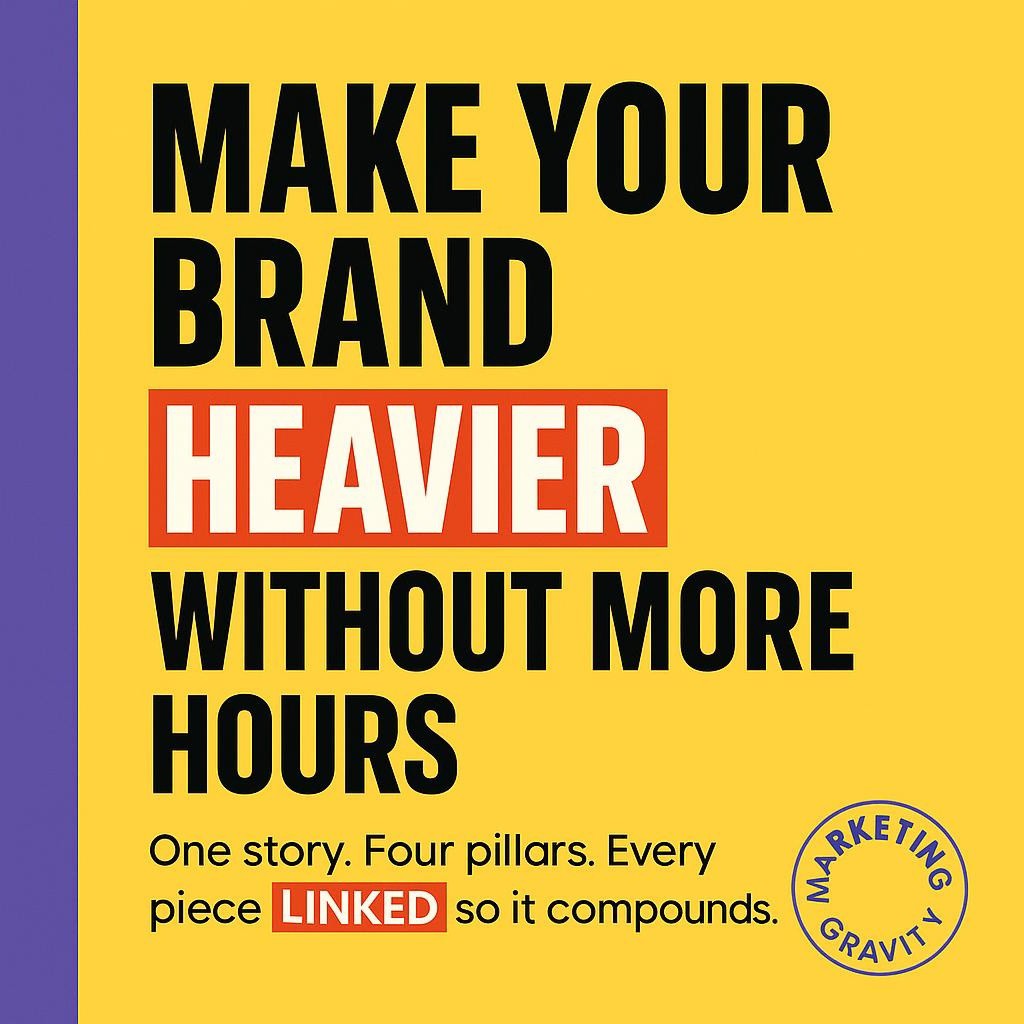
At Inkflare, we don’t obsess over how much you publish. We obsess over how much you weigh.
“We care about making your presence heavier in the market. Heavier in a good way. More real. More felt. More substantial.”
That is marketing gravity.
Marketing gravity is what happens when you stop chasing and start pulling
Most brands are stuck in push mode: push posts, push offers, push yourself to “show up” when you’re already maxed out.
But the brands that feel magnetic do the opposite. They pull.
Marketing gravity is what happens when your mission, message, and content stay aligned long enough that people feel drawn toward you without you begging for attention. They discover you. They come back. They talk about you when you’re not in the room.
And here’s why this matters more now than ever:
AI lowered the cost of output. Anyone can generate 20 posts before breakfast. So output is not the edge anymore. Coherence is.
If your content feels like a random stack of posts, it stays light. Easy to ignore. Easy to forget.
If your content feels like one world with one heartbeat, it gets heavy.
The golden shift: stop making posts, start building orbits
This one line changes how you play the game:
“Most AI tools cannot do that. They generate content. At Inkflare, we build orbits.”
Orbits means nothing is random.
- Your short posts are not standalone thoughts.
- Your videos are not one-off “tips.”
- Your long-form content is not a separate universe from your social.
- Your message does not reset every time you hit “publish.”
Everything points back to the same center.
Because humans remember universes. They forget fragments.
And the market rewards what it can recognize.
If you feel “repetitive,” your audience is still trying to understand you
Founders live inside the full picture, the roadmap, the long-term mission, the deeper philosophy underneath decisions.
Then you post one carousel and wonder why people still don’t get it.
That’s the Founder Projection Trap.
You assume people see what you see. But they’ve seen:
- two Instagram posts,
- one LinkedIn update,
- a three-second scroll past your website,
- maybe one clip if you’re lucky.
So when you think, “I already said this,” the internet is quietly saying, “No, you said it once, to 3 percent of us, on a random Tuesday.”
Repetition is not annoying online. It’s necessary.
But it only works when it’s expressed with variety:
- varied formats (video, text, carousels, short posts, long posts)
- different emotional tones (serious, playful, personal, analytical)
- different contexts (FAQ, story, analogy, customer example)
That’s how people finally get it.
And getting it is not just intellectual.
“People do not buy when they understand you logically. They buy when they feel familiar with you.”
Your brand gets heavier when it has a backbone, not just output
Many brands are posting daily and still feel forgettable.
Why?
Because without philosophy, content collapses into:
- generic advice
- safe statements
- recycled ideas
- interchangeable posts
- surface-level messaging
It becomes digital wallpaper.
A philosophy changes that. It makes your brand stand for something. It turns your content into a beacon. It gives your audience a worldview they can recognize and return to.
This is why we’re so direct about it:
“People don’t follow content. People follow conviction.”
When conviction becomes your center, your content stops being a pile of tactics and starts becoming identity in motion.
Your brand should feel like a place people come back to
A TikTok here. A LinkedIn post there. A random carousel. A blog once in a while. A newsletter when you have time.
Disconnected.
No thread. No emotional stability. No atmosphere.
And that’s why people forget you.
A strong brand does not feel like content, it feels like a place. A place has:
- a recognizable tone
- repeating themes
- consistent emotional presence
- a rhythm people can rely on
Because consistency does something deeper than “help the algorithm.”
It calms the brain.
When you disappear, people feel subtle uncertainty:
“Are they still active?”
“Are they stable?”
“Should I trust them?”
When you show up predictably, they relax. They trust faster. They stop needing to re-learn who you are every time you post.
Predictability builds trust more than perfection ever will.
The practical blueprint: one truth, many angles, one ecosystem
Here’s the simplest way to build gravity without adding more hours.
Step 1: Extract your real worldview (the truth you already have)
You don’t need to “become a philosopher.”
If you built something because you saw a problem, felt a calling, or believed in a better version of your industry, you already have a philosophy.
The raw material is already inside you:
- how you see the problem
- what you believe people get wrong
- what you refuse to do
- the things you say in private that never make it into content
That becomes the center of your content universe.
Step 2: Name it (because shape gives power)
When a belief stays fuzzy, it stays weak.
When you name it, your audience can hold onto it.
You stop sounding like templates. You start sounding like a person with a point of view.
Step 3: Structure it into pillars, sub-themes, emotional arcs, and teaching formats
This is where random posting ends.
Your philosophy becomes organized into repeatable parts, so you can teach it from different angles without drifting.
That structure creates belief clarity.
And belief clarity creates memorability.
Step 4: Express the same core idea in 100 different ways
One core idea can become:
- a story about a customer
- a bold statement post
- a “hot take” reel
- a calm explainer thread
- an FAQ answer
- a visual diagram
- a teaching piece in your newsletter
Same truth, many doors.
Because your audience does not need you to be louder.
They need you to be clearer, more consistent, and more familiar.
Step 5: Publish and interlink everything (so each new piece makes the rest stronger)
This is the compounding move most people miss:
“Publish and interlink everything so it is not just a pile of content, but an ecosystem. Every new piece strengthens your audience’s understanding of who you are and what you stand for.”
That ecosystem creates motion:
- blogs lead to short clips
- short clips lead to posts
- posts lead to new followers
- followers lead to shares
- shares lead to multi-platform discovery
- discovery leads to authority
- authority leads to opportunities
Now your marketing works like a system, not a mood swing.
Ritual is the quiet force that makes your brand unforgettable
Consistency is good. But meaningful repetition is better.
Ritual is what gives your brand a heartbeat.
Customers don’t bond with randomness. They bond with:
- weekly segments
- predictable formats
- recurring themes
- signature phrases
- patterns they can anticipate and emotionally invest in
A ritual makes your brand feel alive. It reduces decision fatigue for you and for your audience. It turns “content consistency” into something people actually wait for.
And ritual is future-proof. Algorithms change. Trends come and go. But humans bond through rhythm.
Warm brands win, cold brands hustle
Every brand has a temperature.
Some brands feel alive, steady, present. Other brands feel cold, quiet, forgotten, even if the product is great.
The difference is not talent. It’s rhythm.
When founders rely on bursts of energy, the brand heats up, then cools down, then panic-posts, then disappears again.
That cycle is brutal.
A warm brand attracts. A cold brand must chase.
This is why Inkflare exists, to keep your brand warm, coherent, and emotionally present even when you’re focused on building the business.
If you want gravity, ask yourself this one question
If someone binge-scrolls your last 30 pieces of content, do they walk away thinking:
“Nice posts.”
Or do they walk away feeling:
“I know what they believe. I know what they stand for. I trust them.”
Because that second feeling is weight.
And weight is what makes a brand impossible to ignore.
If you want two strong companion reads that connect with this idea, start here: