
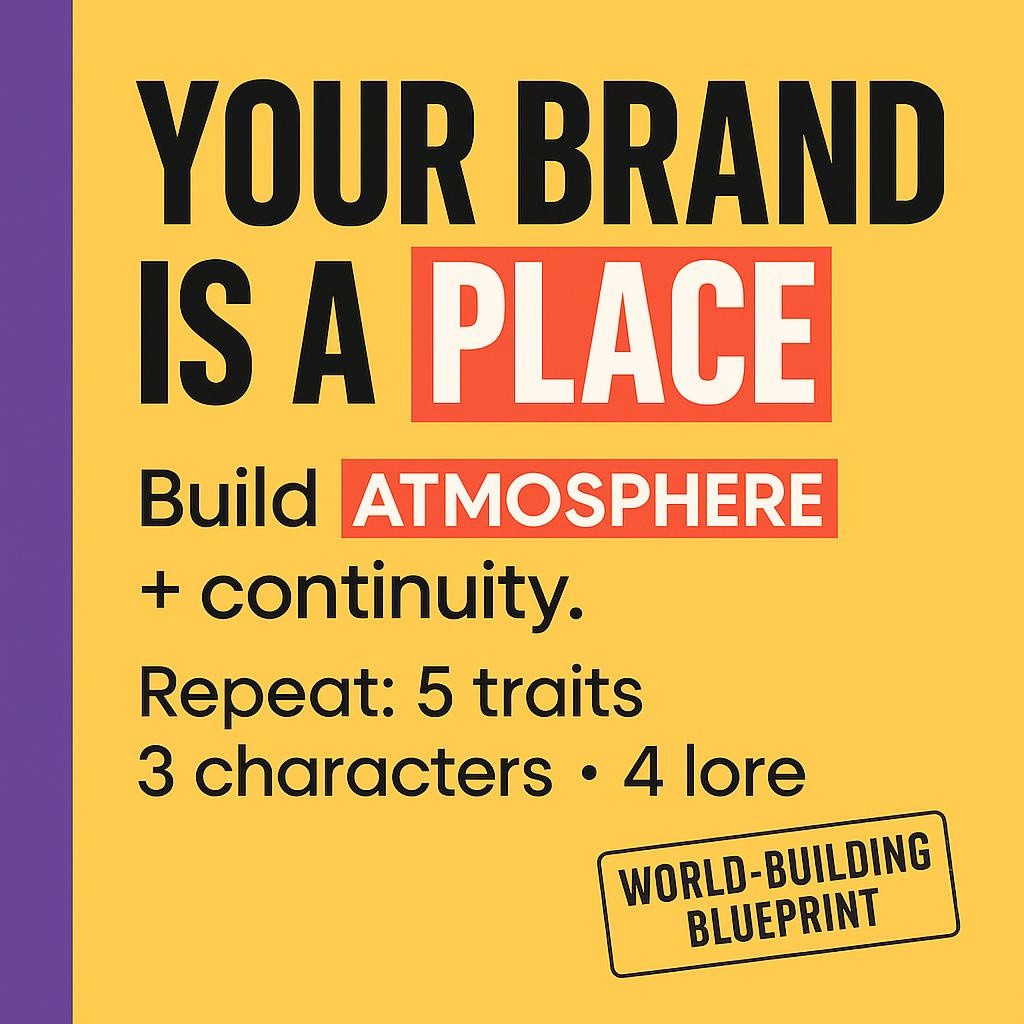
Your Brand Is Not a Product. It’s a Place: A World-Building Blueprint for Multi-Platform Consistency
“Most brands are talking to an empty room.”
You know the feeling.
You post something you actually care about, then you refresh. Nothing.
A day later, you try again. Still quiet.
It can feel personal. Like you’re invisible.
But here’s the hard truth that should also feel like relief: “This problem has nothing to do with skill, timing, or talent. It’s entirely structural.” And yes, it can feel like “walking onto a stage, delivering your best speech, and realizing the theater is pitch black because the audience never showed up.”
That’s the shift this piece is built on:
“People don’t follow brands, they enter worlds.”
And when your world is real, coherent, and emotionally consistent, people don’t just scroll past. They linger. They save. They return. They trust.
Your brand isn’t a product, it’s a place (and that changes everything)
Most marketing advice trains you to think in outputs: more posts, better hooks, cleaner visuals, tighter funnels.
This message cuts through that noise with one clean reframe: “Your Brand Is Not a Product. It’s a Place.”
A place is not a logo.
A place is not a color palette.
A place is a feeling people can recognize instantly, even when your name is not on the screen.
The goal is not “better content.” The goal is a stronger world.
Because “humans remember universes. They forget fragments.”
Why most multi-platform marketing fails (even when the content is good)
If your content looks like this:
- a TikTok here
- a LinkedIn post there
- a random Instagram carousel
- a blog once in a while
- a newsletter when you have time
then your audience isn’t meeting a world. They’re meeting pieces.
The result is exactly what the book calls out:
No narrative thread.
No emotional stability.
No psychological continuity.
No atmosphere.
And that’s why people forget you, not because you lack quality, but because they can’t locate you.
A strong brand fixes that by becoming a place people can return to and recognize.
Blueprint Step 1: Build a recognizable atmosphere (tone + rhythm)
Atmosphere is the felt sense of your brand. The emotional temperature. The steady climate people walk into.
The book puts it simply: “Content without atmosphere is noise. Content with atmosphere is a home.”
Stop choosing “tone words,” start building a voice people recognize
One of the sharpest distinctions is this:
- “Tone is what you sound like. Voice is who you are.”
Most brands pick a few tone words (confident, playful, professional) and still sound like everyone else.
Why? Because voice comes from depth.
A real voice has “tone, texture, rhythm, worldview, emotional nuance, and psychological depth.” It’s the kind of voice people recognize instantly, even when your logo is nowhere in sight.
Even better, voice is not something you manufacture. “Voice isn’t created, it’s uncovered.”
Rhythm is how your brand becomes a heartbeat (and stops feeling random)
Random posting creates random attachment.
The book is blunt: “Customers don’t bond with randomness.” They bond with patterns they can anticipate and emotionally invest in.
That’s why it says: “Posting daily with recognizable cadence, tone, and thematic throughlines is ritual.”
Ritual looks like:
- weekly segments
- predictable formats
- recurring characters or themes
- signature phrases
- patterns people begin to rely on
A ritual gives your brand a heartbeat. When people feel it, they show up for it.
If your team is building an emotional sanctuary and you want a tighter, burnout-proof way to think about atmosphere and rhythm, read: Brand Atmosphere Blueprint: Feel Alive Without Burnout.
Blueprint Step 2: Build continuity people can binge (themes + lore)
Atmosphere gets someone to pause. Continuity gets them to stay.
The book describes what happens when your brand feels like a place:
People scroll through your insights, stories, case studies, transformations, teaching content, mission expansions, punchy statements, philosophical takes, and they recognize the coherence.
Then they do the things that matter:
They linger.
They save.
They return.
They explore.
They binge.
They trust.
That’s not a vanity metric game. That’s relationship economics.
World-building is not fluff, it’s structure
The book gives a simple checklist for what makes a world feel alive:
“A world has rituals, seasons, characters, and lore.”
- Rituals: weekly themes, predictable formats, recurring tones
- Seasons: a brand can shift moods, “reflective in winter, expansive in spring”
- Characters: “your founders, your customers, your internal team, your mission” become a cast with ongoing arcs
- Lore: “the philosophies, frameworks, inside jokes, narratives, beliefs that repeat throughout your content”
This is why some brands live like environments in your mind. The book even names examples like Coca-Cola, Patagonia, Nike, LEGO, and Apple, brands that feel like something when you step into them.
The takeaway is not “be like them.” The takeaway is: build your own place on purpose.
Blueprint Step 3: Turn your brand into an emotional sanctuary people trust
Here’s the part most founders miss because it sounds too human for marketing. It’s also the part that makes the whole thing work.
The book says: “A Brand-Place Is an Emotional Sanctuary.”
And it names what people are hungry for in a chaotic digital world:
- grounded
- wise
- human
- uplifting
- inspiring
- thoughtful
- encouraging
- mission-driven
This is not about being soft. It’s about being stable.
Consistency lowers anxiety (for your audience and for you)
The book calls this the invisible ROI of showing up: emotional stability.
Silence creates subtle tension. People wonder if you’re still active, still stable, still trustworthy.
Consistency signals safety, reliability, competence, maturity.
And then it goes deeper: “Your content doesn’t just communicate, it co-regulates.”
When your brand shows up with calm leadership, grounded truths, emotional maturity, and a stable mission, your audience feels calmer, more focused, more guided.
That is what trust feels like.
Mirror content: stop performing, start reflecting
If your content feels like a stage, people feel like an audience.
If it feels like a mirror, people feel seen.
The book says it plainly: people don’t fall in love with brands that talk about themselves, they fall in love with brands that speak to their inner world.
Because “features are forgettable, but feeling understood is unforgettable.”
Lead like a guide, not a guru
The book draws a clear line:
“You become a guide, not a guru.”
Guides don’t posture. They help. They teach through story. They blend humility with authority. They feel human.
That’s how you build trust without building a pedestal.
Why “place” compounds (and “viral” burns you out)
The book does not romanticize virality. It says: virality is a mood swing. A slow burn is a lantern.
And the compounding curve is painfully honest:
Day 1 = invisible
Day 30 = familiar
Day 100 = recognizable
Day 200 = trusted
Day 365 = inevitable
This is why you keep going even when it feels slow. You’re not collecting likes. You’re building memory.
Or as the book nails it: “Authority isn’t declared, it’s repeated into existence.”
A simple action plan: make your brand-place repeatable
You don’t need a full creative department. You don’t need an in-house storyteller. You don’t need a designer or “brand philosopher.”
You need a system that keeps your world consistent.
Start here:
1) Choose the feeling your place should create
Pick from the sanctuary traits the book lists (grounded, wise, human, uplifting, inspiring, thoughtful, encouraging, mission-driven).
Ask: When someone lands on my page, what should they feel in 10 seconds?
2) Decide your recurring “cast”
Choose the characters your world will keep returning to:
- founder
- customer
- internal team
- mission
The point is not fiction. The point is continuity.
3) Write down your lore (what you will repeat forever)
Pick the pieces the book calls lore:
- philosophies
- frameworks
- inside jokes
- narratives
- beliefs
Then repeat them across posts, articles, videos, captions, and teaching moments until your audience can feel your worldview without you explaining it.
4) Build ritual into your publishing
Create predictable formats and weekly segments. Give your brand a heartbeat.
Remember: “Ritual isn’t repetition, it’s meaningful repetition.”
How Inkflare fits into this (without turning you into a content machine)
Inkflare exists for one reason: to help knowledge creators build a real brand-place, without burning out and without flattening their voice.
We’re not here to make you “post more.” We’re here to keep your world alive.
As the book says:
“We don’t create content. We architect your atmosphere.”
“We build your world.”
“We make your brand a place people come home to.”
So here’s the question that matters, the one you can come back to any time you feel scattered:
If someone binge-consumed your last 30 days of content, would it feel like a world they can enter, or fragments they forget?