The Marketing Thermostat: Why Brands Cool Off (and the System That Keeps Your Heat On)
You can have an amazing product and still feel invisible, because your brand didn’t fail, it just went cold.
Cold looks like this: quiet feeds, stalled reach, people forgetting you exist, even though you are working harder than ever behind the scenes.
And the painful part is how unfair it feels. A brand’s “temperature” rarely reflects its value. It reflects its visibility rhythm.
Why good brands go cold (and why it’s not your fault)
The hard truth is simple: “Every brand has a temperature.” Not a literal one, but “an emotional temperature, a presence temperature, a momentum temperature.”
Some brands feel warm. They feel alive, active, in motion.
Other brands feel cold. Quiet. Stagnant. Forgotten. Even when the product is great.
Most founders don’t cool off because they stopped caring. They cool off because life hits.
The pattern is painfully predictable:
- You start strong, inspired, consistent, your brand heats up.
- Then comes operational overload (sales, product, hiring, customers), you disappear.
- Then guilt kicks in, you force a few posts, but the warmth is gone.
- Then you freeze again, and the brand goes cold.
And the line that should lift a weight off your chest is this: “This isn’t laziness. This is biology.”
Founders cannot do everything forever. Not across multiple platforms. Not while running a real company. When your energy drops, your posting drops, and the thermostat drops because you are the thermostat.
That’s why this isn’t a motivation problem. It’s a system problem.
The real currency of organic marketing is warmth (not metrics)
A lot of marketing advice trains you to obsess over numbers.
But your audience doesn’t experience you as a dashboard. They experience you as a feeling.
They think in sentences like:
- “This brand feels alive.”
- “I see them everywhere.”
- “I trust them.”
- “They show up.”
- “They’re consistent.”
- “They feel human.”
That emotional warmth is not fluff. It drives the outcomes you actually want: engagement, trust, buying behavior, referrals, word of mouth, loyalty.
And it has a business payoff.
A warm brand attracts. A cold brand hustles constantly.
The thermostat principle: consistency beats intensity
Founders often mistake heat for intensity.
They tell themselves:
- I need something big.
- I need perfect content.
- I need a big launch.
But intensity burns out.
The deeper rule is this: “Consistency Beats Intensity.”
Temperature is maintained through:
- small-touch consistency
- daily micro-presence
- frequent value
- familiar voice
- ongoing storytelling
- continuous reinforcement
Or put even more plainly: “Heat isn’t hype. Heat is presence. Heat is trust. Heat is memory.”
This is the shift we want for every founder and creator who uses Inkflare.
Not more pressure. Not more hustle.
A steadier temperature.
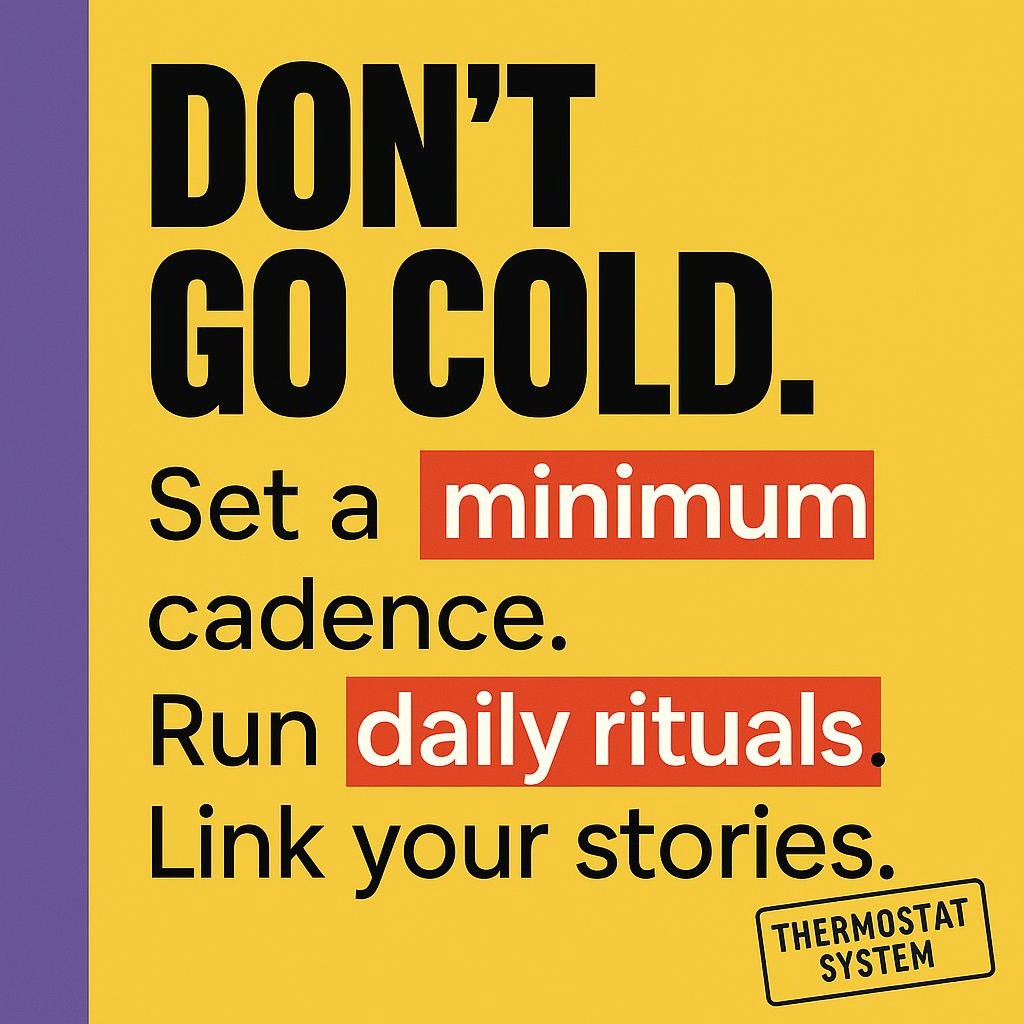
How to set your Marketing Thermostat (so your brand stays warm)
Think of your marketing like a home you want people to return to.
To keep it warm, you need three things:
- a thermostat (the baseline)
- a heater (the daily rhythm)
- insulation (the story that holds the warmth)
1) Your thermostat is a minimum visibility rhythm
Warm brands do not “show up when they feel like it.”
They show up in a way people can trust.
Why? Because predictability builds trust over time. It lowers confusion. It lowers doubt. It makes your brand feel stable.
This matters psychologically for your audience.
When a brand disappears, people don’t always say it out loud, but the silence creates tension:
- Are they still active?
- Are they stable?
- Should I trust them with my money?
Daily presence builds familiarity. Familiarity builds trust.
And it also matters algorithmically.
Platforms reward accounts that show up consistently, with ongoing engagement, consistent posting, multi-format presence, returning viewers, repeat watch patterns.
In plain terms, warm brands get more chances.
Cold brands get ignored, regardless of quality.
2) Your heater is daily content rituals (your brand’s heartbeat)
Random posting is not a strategy. It’s noise.
Ritual is what makes your brand feel alive.
Here’s the line that changes everything: “Posting daily with recognizable cadence, tone, and thematic throughlines is ritual.”
A ritual gives your brand a heartbeat.
It also gives your audience emotional safety. In a chaotic feed full of noise and dopamine traps, your brand becomes a steady anchor.
Ritual can look like:
- weekly segments
- predictable formats
- recurring themes
- signature phrases
- signature visuals
- patterns people can anticipate and emotionally invest in
Ritual also kills decision fatigue.
For you, it ends the daily stress spiral:
- What should we post?
- What format should we use?
- What angle haven’t we done yet?
- Does this even align with our brand?
For your audience, it ends the confusion:
- Who are these people again?
- What do they stand for?
And ritual is timeless. “Ritual is the only future-proof strategy.”
3) Your insulation is narrative cohesion (so your warmth doesn’t leak)
Even if you post often, you can still feel forgettable if your content is fragmented.
A TikTok here. A LinkedIn post there. A random carousel. A blog once in a while.
Disconnected.
No thread. No continuity. No atmosphere.
And that’s why people forget brands, not because they lack quality, but because they lack place.
This idea is the heart of insulation:
Your brand is not just information. It’s an environment.
A cohesive brand feels like a world people can enter.
That’s why narrative cohesion matters so much, across:
- platforms
- formats
- topics
- moods
- angles
- time
Because the brain remembers coherence.
It remembers a universe.
And the line that belongs on your wall is: “Humans remember universes. They forget fragments.”
When your content is connected, people linger. They save. They return. They binge. They trust.
That’s relationship economics.
Why “the empty room” happens (and how warmth fixes it)
If you have ever posted something you were proud of and got nothing back, you know the feeling.
It’s not always that your content was bad.
Sometimes, the room was cold.
Platforms have invisible prerequisites. They want signals that you are worth showing to more people. That’s why an empty room can make great content invisible.
A warmed room makes decent content powerful. A thriving room makes great content unstoppable.
If this hits home, keep going here:
What Inkflare actually does (and why this is bigger than “automation”)
Inkflare exists to break the hot-cold cycle and create a stable, sustainable, healthy brand temperature.
Not by pushing you to perform every day.
By replacing the founder-as-thermostat problem with infrastructure.
The promise is simple and serious: “Inkflare replaces you as the thermostat so your brand never cools, even when you need to rest.”
We do that by stabilizing warmth through:
- daily brand-aligned posts
- platform-specific adaptation
- repeating the same worldview through dozens of angles
- rituals that create familiarity
- stories that build depth
- insights that demonstrate authority
- multi-format presence
- a consistent emotional tone
Because the goal is not just content output.
The goal is a living presence.
A brand that feels like a place people come back to.
If you want a tighter, tactical extension of this idea, read:
A simple checklist to keep your brand warm this week
If you only do one thing, do this: stop betting your visibility on big bursts.
Build steady heat.
- Keep your rhythm small and consistent (micro-presence over intensity).
- Use recognizable rituals (cadence, tone, throughlines).
- Repeat your worldview through many angles (your message should feel familiar).
- Stay multi-format (so your presence is harder to ignore).
- Keep your story connected (build a world, not fragments).
Because “Warm Brands Win. Cold Brands Fade.”
And your mission deserves better than fading.
So here’s the question that matters:
When the busy weeks hit (not if, when), will your brand’s warmth depend on your mood, or on a thermostat you can trust?