The Coherence Advantage: How to Make Every Post Strengthen Every Other Post
Random posts don’t build a brand, they build amnesia. Coherence builds gravity.
Picture this.
You finally ship a post you’re proud of. It’s sharp. It’s real. It has teeth. You hit publish, you refresh… and it lands in silence.
Not because your message is weak.
Because the room is cold.
We’ve seen this pattern everywhere: founders “posting into a void,” feeling like they’re doing everything right, then watching the internet shrug. Or as we say, you can “drop a masterpiece, and the algorithm will quietly whisper, ‘Cute. Anyway—next.’”
That moment messes with your head. You start editing yourself. You start chasing tactics. You start wondering if your mission is too niche, too complex, too late.
It’s not.
It’s structural.
Coherence: The Only Advantage That Gets Stronger Over Time
Coherence is not being “on brand” in a stiff, corporate way.
Coherence is simpler and deeper: your audience can bump into you anywhere, in any format, and still feel the same underlying identity behind it all.
That is why Inkflare is built to generate “blogs, videos, social posts, carousels, and more that all point back to the same core truths,” while also “publishing and interlinking content so each piece strengthens the rest.”
Because right now, output is cheap. Anyone can generate 20 posts before breakfast.
What’s rare is a presence that feels like a place.
And the human brain remembers places.
"Humans remember universes. They forget fragments."
Why Your Best Content Isn’t Working (Even If It’s Great)
Most founders don’t fail because they lack effort.
They fail because their effort is scattered.
A TikTok here. A LinkedIn post there. A blog once in a while. A newsletter “when things calm down.” No narrative thread. No emotional stability. No continuity.
So even good content doesn’t stack.
It doesn’t build familiarity. It doesn’t create a felt identity. It doesn’t teach the market what you believe.
And when the market can’t feel what you believe, it can’t trust you.
Inkflare exists to fix the structure, not to nag you to “try harder.”
The Real Game: Content Compounds (But Only When It’s Connected)
Founders understand compounding in finance.
But almost no one understands compounding in content.
Every piece you publish carries three kinds of value:
- Immediate value (someone sees it today)
- Delayed value (someone finds it months later)
- Compounding value (someone sees many pieces over time and becomes warm, familiar, and ready)
That last one is where the business happens.
And it’s why the brands that publish consistently start to feel “everywhere,” even when none of their individual posts go viral.
Because your audience doesn’t form trust through one brilliant hit. They form trust through repeated touchpoints.
We even map the layers people move through:
- Post 1 → “Interesting.”
- Post 5 → “I like their style.”
- Post 12 → “They’re consistent.”
- Post 25 → “I’m learning from them.”
- Post 40 → “I trust this brand.”
- Post 60 → “I’m ready to act.”
If you only post when you feel inspired, you never reach the later layers. The profitable ones.
The Golden Nugget Most Founders Resist (Then Wish They Didn’t)
Here’s the sentence that changes everything:
"Repetition does not bore people. Repetition teaches people."
Founders secretly worry they’re repeating themselves.
“I already explained our mission.”
“I already told the origin story.”
“I already said the thing.”
Yes. You did. Once. On a Tuesday. To a tiny slice of the people who might someday care.
Online, repetition isn’t annoying. It’s necessary.
But it only works if it’s repeated with variation, through different formats, tones, and contexts.
That’s how your worldview becomes recognizable.
And once your worldview is recognizable, you stop needing to “convince” people so hard.
Because familiarity does the heavy lifting.
From a Pile of Posts to an Ecosystem (The Structure That Builds Trust)
Most marketing systems treat content like a treadmill.
More posts. More hustle. More pressure.
We treat content like infrastructure.
Here’s the shift in one line:
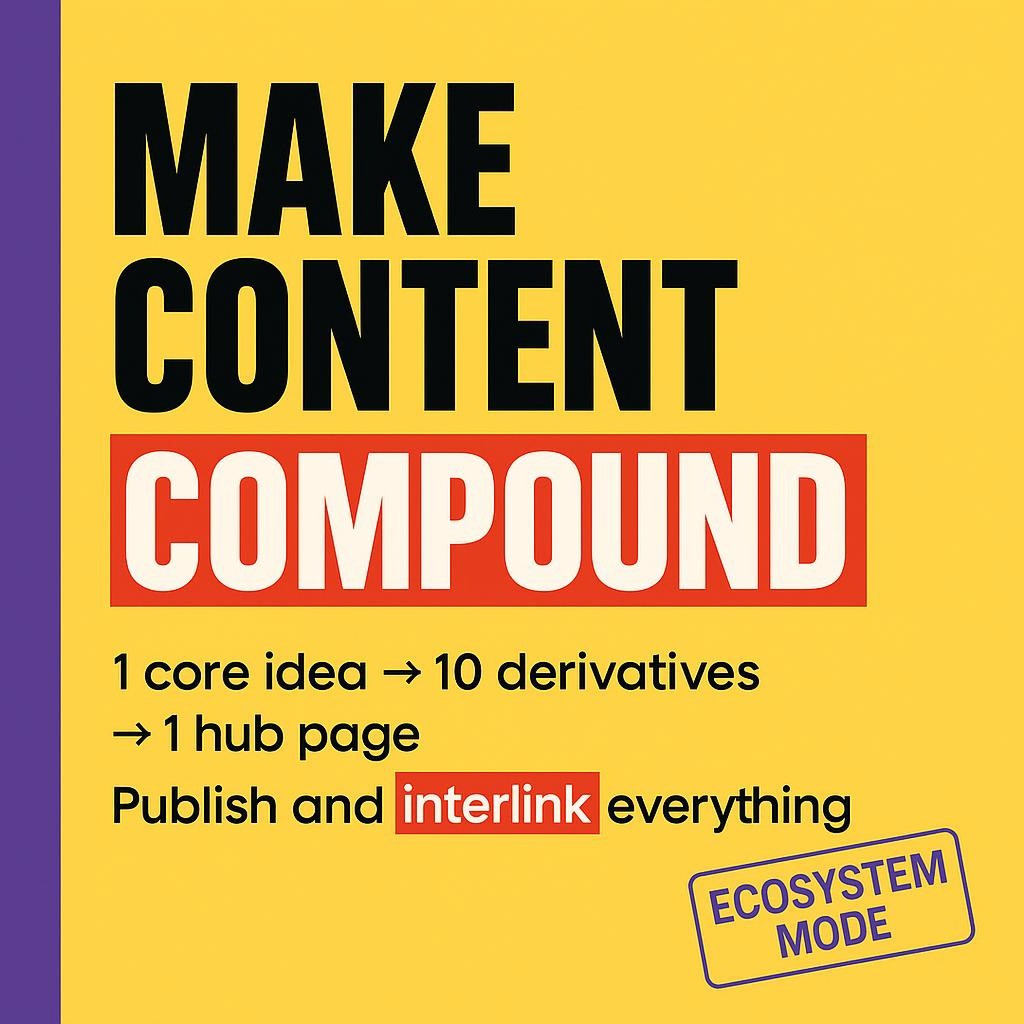
"Publish and interlink everything, so it is not just a pile of content, but an ecosystem. Every new piece strengthens your audience’s understanding of who you are and what you stand for."
That is the Coherence Advantage: every new piece makes every old piece more powerful.
And over time, that creates something most brands never earn.
Gravity.
The Practical Build: How to Create Coherence Without Burning Out
You do not need a bigger team.
You do not need a “content genius” personality.
You need a system that turns one truth into many expressions, then connects them.
Here’s the exact build sequence we use.
Step 1: Extract your core truth (what you believe, not just what you sell)
Your best content doesn’t start with “topics.”
It starts with your mental model, how you see the world, what you believe is broken, and what you believe is true.
This is why we begin by extracting your worldview, not brainstorming random ideas.
When your message has a backbone, content stops feeling like performance.
It becomes expression.
Step 2: Turn that truth into a structured universe
Once the core truth is clear, structure it.
We map:
- core ideas
- supporting beliefs
- objections
- customer fears
- use cases
- stories
This is how your content stops being disconnected and starts feeling like one universe.
Because coherence is not “posting a lot.”
Coherence is building a world people can recognize, enter, and stay inside.
Step 3: Express the same truth in many formats (so your audience actually learns it)
One core idea is not meant to live in one format.
A single idea can become:
- a story about a customer
- a bold statement post
- a “hot take” reel
- a calm explainer thread
- an FAQ answer
- a visual diagram
- a teaching piece in your newsletter
Same truth. New doorway.
This is how you repeat without sounding repetitive.
Step 4: Publish daily to keep the room warm
Most content doesn’t fail because it’s bad.
It fails because there’s no audience prepared to receive it.
Platforms look for ongoing signals. Without those signals, your best post disappears.
That’s why we focus on daily presence. It keeps your brand “warm,” even when your personal energy dips.
You run the business. The system runs the rhythm.
Step 5: Interlink everything so it becomes a web, not a line
When you interlink, your content stops being a stack of isolated moments.
It becomes a network.
A web creates more discovery pathways, more context, and more reinforcement.
This is how your visibility becomes accumulated presence, not random exposure.
And when your presence accumulates, trust becomes almost inevitable.
The Emotional Payoff: Why Coherence Feels Like Relief
Coherence isn’t just a growth strategy.
It’s psychological peace.
It replaces the daily panic loop:
- “What should we post?”
- “What format should we use?”
- “Is this aligned?”
- “Do we even have a voice?”
A coherent rhythm reduces decision fatigue for you.
It also reduces friction for your audience, because they don’t have to decode you every time. They start to recognize you.
And recognition is what makes people stay.
Because, as we say plainly:
"Perfection doesn’t build trust. Predictability does."
A Simple Test Before You Publish Your Next Post
Before you hit publish, ask one question:
Will this make my world feel more connected, or more scattered?
If it connects, it compounds.
If it scatters, it resets the relationship.
Your work is too important to be forgettable. If you’re mission-driven, you’re not here to spike. You’re here to endure, teach, clarify, and stay present long enough for the right people to finally feel, “This is for me.”
So here’s the last question to sit with:
If your next 30 days of content could either become a pile… or become a universe… which one are you building?