Attention Inflation: Why Being Seen Keeps Getting More Expensive (and How to Build a Content Budget You Can Actually Afford)
Picture this.
You show up with your best idea, your clearest teaching, your most honest story. You hit publish. Then you watch it land like a pebble in a black ocean.
That pain has a name in plain language: you’re talking to an empty room.
The hard truth is right in front of us, “Most brands are talking to an empty room.” Not because they’re untalented. Not because their product is weak. The problem is structural, the room was never warmed. And when the room is cold, even great content can feel invisible.
At Inkflare, we build for the part most founders forget to budget for, the conditions that make your message receivable.
What “attention inflation” really means (and why it’s happening)
We live in a world where content output is cheap.
“AI tools made content easy. So everyone is now producing more content than ever, most of it shallow, repetitive, and algorithm-chasing.”
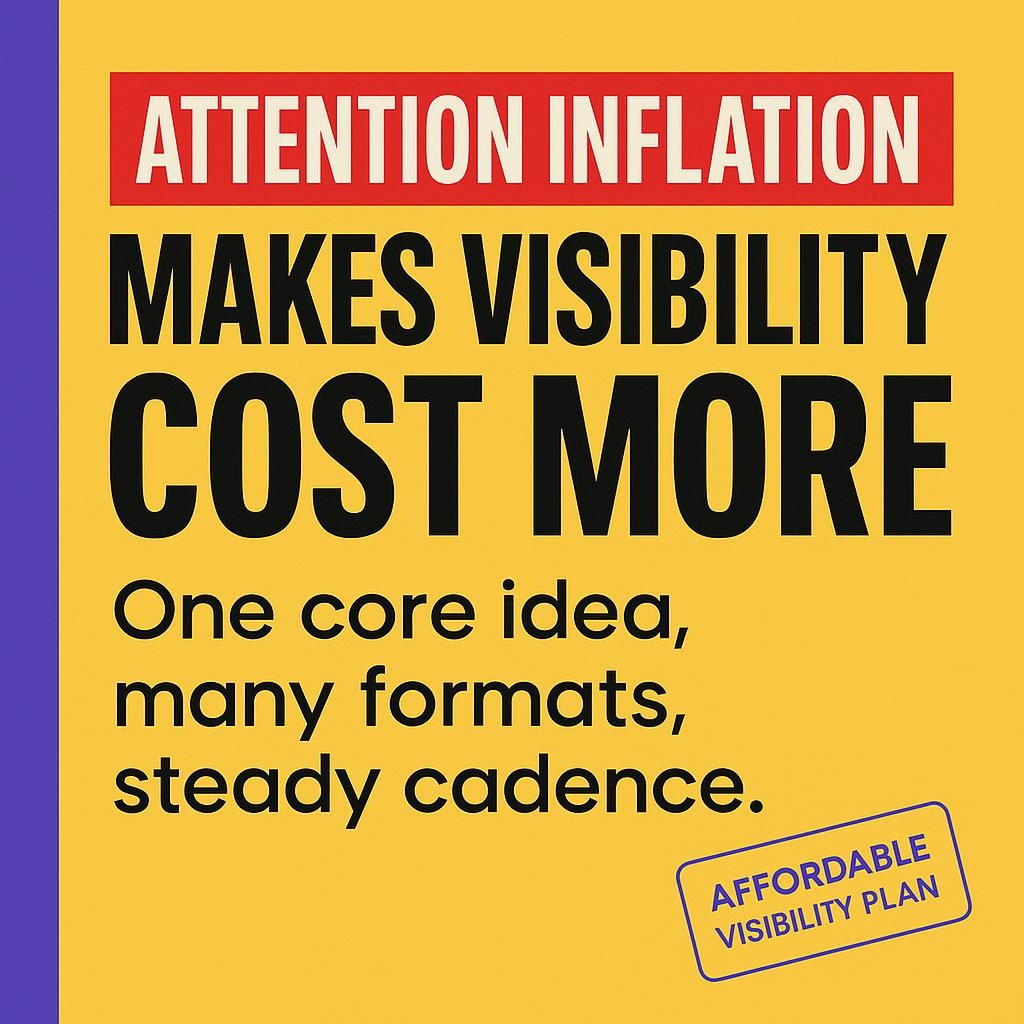
When everyone can publish, the fight is no longer about who can post once. It’s about who can show up with a steady pulse, across formats, across platforms, with a message that feels human.
Or said another way, your audience isn’t starving for more information.
They’re starving for a signal they can trust.
The hidden cost of visibility is not money, it’s rhythm
Most founders think their problem is content quality.
The real problem is the brand temperature dropping.
“A brand’s temperature rarely reflects its actual value. It reflects its visibility rhythm.”
You’ve felt this cycle before:
- You get inspired, you post consistently, things feel alive.
- Work gets heavy, you disappear for a week (or a month).
- You come back with guilt, you force a few posts, nothing hits.
- You freeze again.
The text is blunt about this, it’s not laziness. “This isn’t laziness. This is biology.”
So if being seen is getting “more expensive,” the real cost is paid in:
- consistency capacity
- emotional energy
- decision fatigue
- the ability to keep the room warm even when life gets busy
This is why Inkflare doesn’t treat marketing like a burst. We treat it like heat.
Why your best content still gets ignored (the “warmed room” problem)
Here’s the part founders miss, platforms have prerequisites.
“Every platform has its own invisible prerequisites.” And those prerequisites reward steady signals, not one-off brilliance.
The punchline is brutal and accurate: “Content doesn’t fail because it’s bad, it fails because there’s no audience prepared to receive it.”
So you can post a masterpiece and still get silence, because the conditions weren’t there.
Inkflare exists to build those conditions automatically, so your best ideas stop dying in the dark.
Diagnose your visibility budget (most brands are underfunding these 3 things)
If you want a content budget you can actually afford, start here. Not with more posts. With clearer spending.
1) You’re underfunding conditions (you’re posting without signals)
When you only post when you have time, the platform sees randomness.
But platforms trust rhythm.
The text spells out what a warmed room looks like, “daily multi-format posting,” “cross-platform distribution,” “psychological consistency,” “rituals that create familiarity,” “patterns that algorithms trust.”
This is the budget line item most teams skip, because it doesn’t feel creative. It feels like infrastructure.
It is.
2) You’re underfunding repetition (you’re afraid of sounding “redundant”)
Founders often hold back because they don’t want to repeat themselves.
But repetition is not a flaw. It’s how people learn you.
“Repetition does not bore people. Repetition teaches people.”
And the magic is how repetition stays fresh, the same core idea comes back through:
- a new story
- a new metaphor
- a new emotional angle
- a new platform
- a new format
That’s not spamming. That’s teaching.
3) You’re underfunding interconnection (you’re publishing fragments, not a world)
A post here. A clip there. A blog once every few months.
Disconnected.
Forgettable.
The text nails why this fails, “Humans remember universes. They forget fragments.”
When your content connects, your brand starts to feel like a place people can return to. And that changes how long they stay, how much they trust, and how ready they are when it’s time to buy.
Build an affordable visibility plan (simple, steady, and human)
You don’t need to become a content machine.
You need a system that makes your message recognizable.
The goal is not to “post more.” The goal is to create a pattern that builds familiarity, trust, and emotional warmth over time.
Here’s how to do it in a way you can afford.
Step 1: Pick one core truth you believe (meaning beats noise)
In a market flooded with shallow output, the differentiator is meaning.
“Meaning is the new differentiator.”
This is why the text pushes philosophy so hard. Not academic philosophy, your real conviction.
“People don’t follow content. People follow conviction.”
When you lead with a clear belief, your content stops feeling like decoration and starts feeling like identity.
And identity is what makes people stay.
Step 2: Turn that one truth into a “stream,” not a single post
Your audience doesn’t learn you through one perfect page.
“A page is a room. A feed is a river.”
They see pieces of you over time, and their understanding forms through, “a constellation of micro-moments, not one static page.”
So your affordable plan is not “create 30 new ideas.”
It’s “express the same idea in different forms,” consistently.
The text even lists what this looks like: posts, short videos, founder reflections, case studies, behind-the-scenes, FAQs, honest moments. Your story lived in public.
Step 3: Budget for daily presence (because compounding is real)
Founders understand compounding in money.
The text makes the case that content compounds too, when done correctly.
It explains the layers of trust plainly:
- Post 1, “Interesting.”
- Post 12, “They’re consistent.”
- Post 40, “I trust this brand.”
- Post 60, “I’m ready to act.”
That’s why sporadic posting feels like starting over.
And it’s why daily presence creates the “everywhere” effect people envy.
Step 4: Build for the audience you can’t see (silent followers)
A lot of founders quit because they think nobody is watching.
But the text flips that completely.
Your biggest audience is often the quiet one, “The silent followers.” The watchers. The readers. The people who never click like but remember your name.
They are often, “80 to 95 percent of your actual audience.”
They don’t need you to be viral.
They need you to be predictable.
Step 5: Replace agency dependence with a repeatable system
You don’t need a full creative department to stay visible.
“You don’t need a PR team,” or a giant budget. You need a coherent, mission-aligned presence.
The lean version is simple:
- Capture your truth
- Express it consistently
- Reinforce it across formats
- Keep the room warm, even when you’re busy
Inkflare was built to do exactly that, learning your mission and voice, turning it into a content system (not random posts), then publishing and interlinking so each piece strengthens the rest.
The real upgrade: stop trying to impress, start trying to be remembered
Most marketing tries to grab attention.
But the text hits a deeper goal: memory.
A strong voice builds memory, recognition, and trust. And trust isn’t built through polish.
“You don’t need to be perfect. You need to be present.”
So here’s the question we’ll leave you with, because it should shape every content decision you make:
If your mission is real, are you budgeting for one performance, or are you building the kind of steady presence that makes people feel, “this brand is alive,” even when you’re offline?