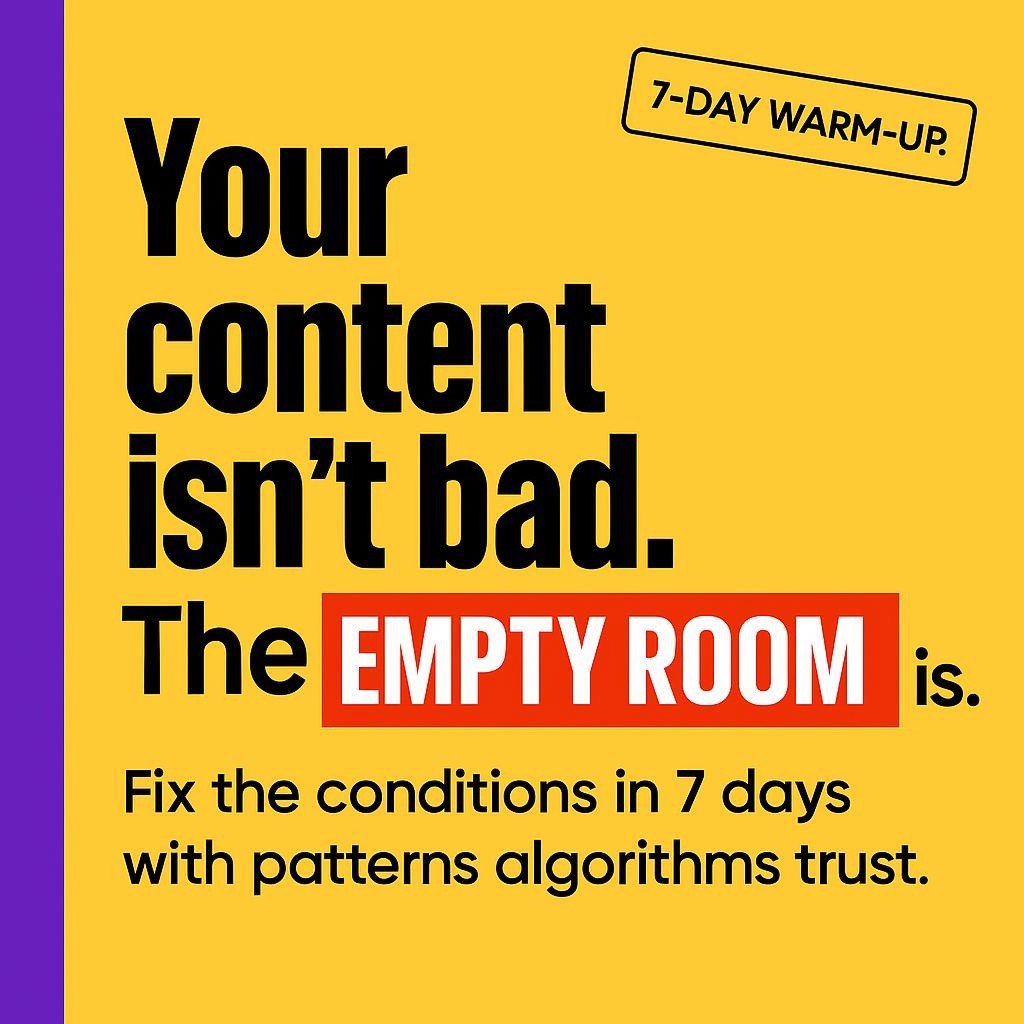
The “Empty Room” Problem: Why Your Content Feels Invisible (and the 7-Day Warm-Up Plan That Fixes It)
"Most brands are talking to an empty room."
If that line stings, good, it means you care. It also means you’ve probably done the thing every founder does when content feels quiet: you make it mean something about you.
You tell yourself you’re not good at this. That your industry is “too boring.” That you missed the wave.
But here’s the truth we build Inkflare around:
Content doesn’t fail because it’s bad. It fails because there’s no audience prepared to receive it.
Not a talent problem. A conditions problem.
Why your content feels invisible (even when it’s good)
Every platform has invisible prerequisites. If you don’t meet them, your post doesn’t get a fair shot.
The signals are different by platform, but the pattern is the same:
- To be seen on Instagram, you need recency, interaction loops, saves, shares, and aesthetic coherence.
- To be seen on LinkedIn, you need a steady posting rhythm, relevancy signals, and people lingering on your posts.
- To be seen on TikTok, you need consistent publishing and strong identity cues so the algorithm can test you with the right audience.
- To be seen on YouTube Shorts, you need volume, repetition, and early-watch retention.
What do these all have in common?
They require a warmed room.
That’s why we don’t obsess over “one perfect post.” We obsess over the environment that makes your posts land.
The real damage of the empty room (it messes with your mind)
Low engagement isn’t just a metric. It becomes a story.
And that story creates a spiral.
"Day 1: ‘I’m excited to post.’"
"Day 10: ‘Why is no one engaging?’"
"Day 30: ‘Maybe our business isn’t interesting enough.’"
"Day 60: Silence."
"Day 90: A single random post saying, ‘We’re back!’ (You’re not.)"
And then the worst part.
You start thinking the answer is to become a different person. A louder person. A “marketing” person.
But as we say inside Inkflare:
"This isn’t laziness."
You’re not wired to speak into a void forever. You need response, recognition, reciprocity.
So instead of trying to force more energy, we build a system that holds the energy steady.
Stop chasing perfection, start building predictability
The internet loves polish. But people don’t trust polish.
"Perfection doesn’t build trust. Predictability does."
And trust has two requirements:
- Competence (you know what you’re doing)
- Reliability (you do it consistently)
Most brands focus on competence. Very few build reliability.
That’s why the brands that win don’t “shine” once. They show up in a steady rhythm until the audience relaxes.
This is also why daily content has a hidden payoff most founders miss: it lowers anxiety, for your audience and for you.
When you disappear, people silently wonder:
"Are they still active?"
"Are they stable?"
"Should I trust them with my money?"
Consistency answers those questions without you having to convince anyone.
The 7-Day Room Warm-Up Plan (simple, steady, and built for real life)
This isn’t a creativity challenge. It’s a room-warming reset.
Inkflare describes what warms the room in plain terms:
- daily multi-format posting
- cross-platform distribution
- content linked back to deeper narratives
- psychological consistency
- brand voice clarity
- content loops that build anticipation
- rituals that create familiarity
- patterns that algorithms trust
Below is a seven-day way to activate those conditions fast, without trying to reinvent your personality.
Day 1: Post like you’re building momentum, not moments
Most founders treat marketing like “big pushes.”
But "marketing isn’t about moments. It’s about momentum."
Today’s move: publish one useful piece (post, video, carousel, or article) and let it be imperfect. You’re lighting the pilot flame.
Day 2: Say what you believe (your backbone is your advantage)
In a world flooded with content, meaning is the differentiator.
People follow worldview. People follow conviction.
Today’s move: write the line your brand stands on. The kind of line that says:
"Here’s what we believe, here’s why it matters, and here’s how the world changes through this lens."
Day 3: Mirror the person you’re here to serve
Most marketing fails because it sounds like marketing.
Mirror content sounds like real life.
Use language your people actually feel, like:
"You’re doing the job of five people."
"You’re growing a business nobody sees yet."
"You want to show up online, but you’re exhausted."
Today’s move: post something that makes the right person whisper, “That’s me.”
Day 4: Teach like a guide, not a performer
Your audience isn’t looking for a celebrity. They’re looking for a guide.
A guide teaches with humility and clarity.
And the fastest way to teach is story.
"They learn from narrative."
Today’s move: share one honest lesson, one mistake, one earned insight. Not a script. A real moment.
Day 5: Repeat on purpose (repetition builds authority)
If you’re scared of repeating yourself, hear this:
"Repetition does not bore people. Repetition teaches people."
Today’s move: take one idea and express it again, but through a new story, a new example, a new emotional angle, a new format.
Day 6: Distribute across platforms (same mission, different language)
If your competitors are posting daily and repurposing across platforms, a twice-a-month post becomes “a whisper in a stadium.”
Today’s move: publish the same core truth in multiple places. Not copy-paste. Translation.
Same mission, different language.
Day 7: Turn your content into a place people want to return to
Fragmented content creates no atmosphere. No continuity. No place.
And "humans remember universes. They forget fragments."
Today’s move: tie your posts back to a deeper narrative. Build a “brand-place,” a world with coherence, rituals, themes, and a steady emotional feel.
The Warm Room Checklist (use this weekly)
Cadence (the rhythm people trust)
- Daily presence, even when you’re busy or tired
- Stable rhythm, recognizable voice
- Predictability over perfection
Content mix (the multi-format signal stack)
- Posts, short videos, long-form insights, emotional reflections, brand stories
- Message repetition across formats
Cohesion (the “this feels like one universe” effect)
- Narrative cohesion and message continuity across platforms
- Rituals and weekly themes that people can anticipate
Prepared audience signals (what platforms reward)
- Instagram: recency, interaction loops, saves, shares, coherence
- LinkedIn: steady rhythm, relevancy signals, lingering
- TikTok: consistency, identity cues
- Shorts: volume, repetition, early retention
If you do this, something flips.
Your content stops feeling like random output and starts feeling like a living presence.
And then, over time, the market starts saying the only thing that matters:
"I see you everywhere."
You don’t need to scream. You don’t need to hustle. You don’t need to “act like a marketer.”
You need a room that’s warm enough to hold your message.
So here’s the question that should stick with you:
If your mission is real, why keep treating visibility like a performance, instead of building the conditions that make your presence inevitable?