
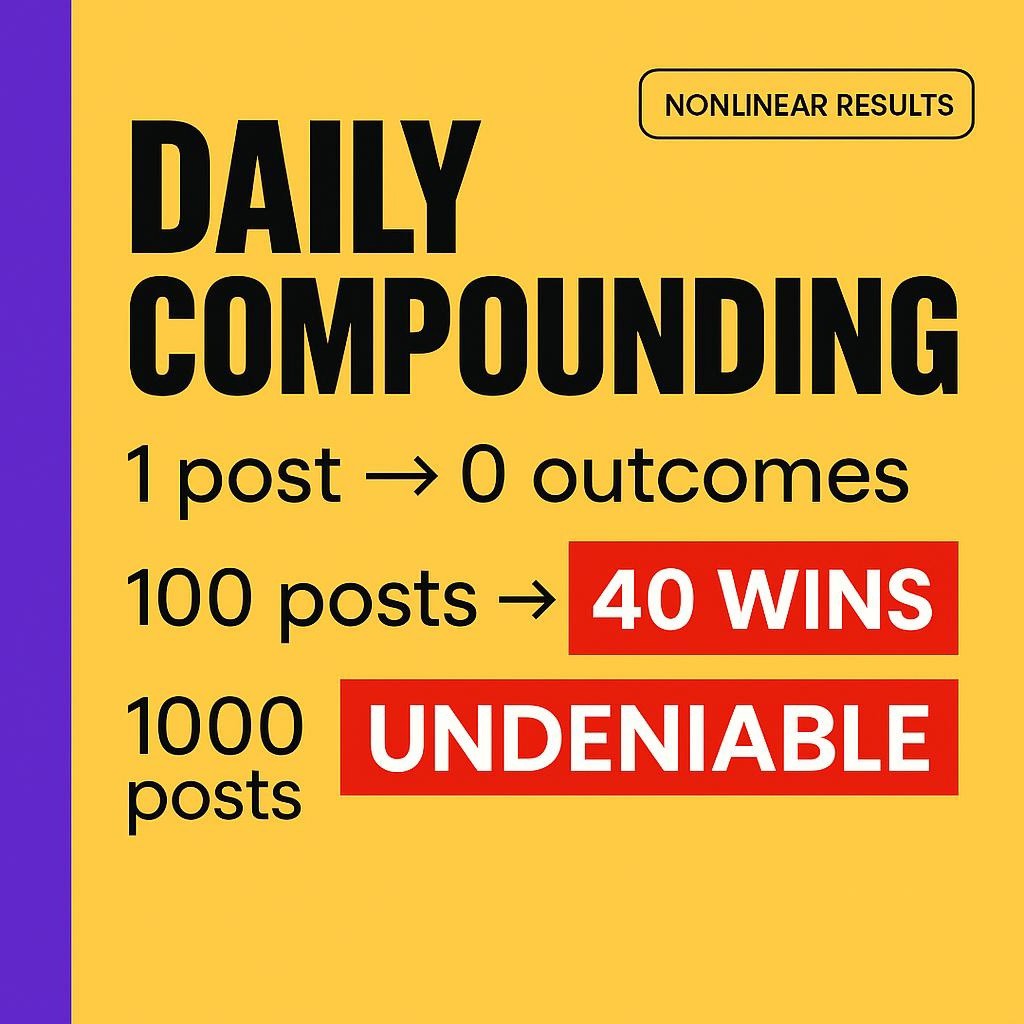
Daily Compounding: How One More Post Today Multiplies Into 40 Wins Later
Your next post is not a post, it’s a brick in a system that keeps working when you log off.
You’ve felt the worst version of this.
You fight for an hour of focus. You write something real. You hit publish. Then… nothing. No comments. No shares. No signal that it mattered.
That silence doesn’t mean your message is weak.
It usually means you’re speaking into an unwarmed room.
And when founders misread that silence, they quit right before the curve bends.
Why daily publishing feels “slow” at first (and why that’s normal)
Here’s the truth most people miss: content has more than one job.
"Every piece of content you publish has three forms of value:"
Immediate value (someone sees it today).
Delayed value (someone discovers it months later).
Compounding value (someone sees you repeatedly, becomes familiar, and becomes ready to buy).
That third layer is where the real payoff hides.
It’s also why your first posts can feel useless, even when they’re good. The compounding phase hasn’t kicked in yet.
Daily publishing isn’t a motivation trick. It’s how you build the conditions where your message can finally land.
The non-linear math of content (and the moment most people quit)
Most founders expect content results to stack like a scoreboard.
One post should do something. Ten posts should do ten somethings.
That’s not how audiences move.
They move in thresholds.
And the curve looks like this:
"1 post → 0 outcome
10 posts → 1 outcome
30 posts → 5 outcomes
100 posts → 40 outcomes
250 posts → your brand becomes a category voice
500 posts → your brand becomes an authority
1000 posts → your brand becomes undeniable"
That “100 posts → 40 outcomes” line stings because it exposes the trap.
Early effort is not wasted. It’s stored.
It’s stored as familiarity. As pattern. As memory. As, “Wait, I’ve seen this person before.”
Consistency is what turns “random” into “recognizable.”
If you want the deeper effect that happens when you cross that recognition line, read: Everywhere Effect: Daily Omnipresence Without Burnout
Trust is built in layers, not in one “perfect” post
People don’t trust a brand because it had one strong moment.
They trust what they see again and again.
"People trust what they see repeatedly."
And trust builds like layers of paint. Each post adds a coat.
Here’s the progression that shows up over time:
- Post 1 → “Interesting.”
- Post 5 → “I like their style.”
- Post 12 → “They’re consistent.”
- Post 25 → “I’m learning from them.”
- Post 40 → “I trust this brand.”
- Post 60 → “I’m ready to act.”
This is why daily compounding is so unfair (in a good way).
It keeps adding layers even when you don’t feel anything happening.
It also explains why “posting once in a while” feels like you’re starting over every time.
Silent followers are not passive, they’re deciding
There’s a whole audience watching you that never raises their hand.
They don’t like. They don’t comment. They don’t DM.
But they’re paying attention.
"Your most important audience is the one you never see."
Silent followers observe. They internalize. They evaluate. They compare.
And daily presence is what warms them.
One post won’t do it. Ten might not.
But at a certain point, the relationship forms before the first conversation ever happens.
That’s when they start thinking:
- “I already know this brand.”
- “Their worldview matches mine.”
- “Their content always helps.”
- “They’re stable.”
- “I trust them.”
This is also why chasing engagement can make you delusional.
You can be “quiet” in the comments and still be building future revenue, because the real relationship is happening in their mind.
Repetition is not annoying, it’s how authority becomes real
Most creators avoid repetition because they think it makes them look boring.
The opposite is true.
"Repetition does not bore people. Repetition teaches people."
You don’t repeat by copying and pasting.
You repeat the same truth through:
- a new story
- a new metaphor
- a new example
- a new emotional angle
- a new platform
- a new format
That’s how your message becomes recognizable.
And there’s one line we come back to constantly at Inkflare because it’s so clean and so true:
"Authority isn’t declared , it’s repeated into existence."
This is also where your content stops being random output and starts becoming identity.
If you don’t have a clear philosophy, your content turns into wallpaper
A lot of founders don’t need more ideas.
They need a backbone.
Because without a backbone, content becomes a grab bag: tips today, trends tomorrow, an announcement next week, silence for a month.
The result is forgettable, even if the product is great.
"Content without philosophy is just decoration."
A philosophy is what makes your content feel like it came from someone who believes something.
Not someone who is just trying to “say something.”
This is where Inkflare plays differently. We’re not trying to make you louder. We’re trying to make you clearer, consistent, and emotionally steady, across every format you show up in.
And in a world where everyone is producing more, meaning wins.
If you want to go deeper on staying visible when attention gets more expensive, read: Attention Inflation: Beat It With Daily Content Compounding
Don’t chase viral spikes, build the slow burn
A single viral hit can bring attention.
It rarely builds loyalty.
"Virality isn’t a growth strategy. It’s a mood swing."
The slow burn is the opposite. It’s steady presence that builds belief over time.
And the compounding timeline is brutally simple:
Day 1 content = invisible
Day 30 content = familiar
Day 100 content = recognizable
Day 200 content = trusted
Day 365 content = inevitable
This is why the brands that win long-term don’t feel frantic. They feel stable.
They don’t show up in bursts. They show up like a lighthouse.
A simple daily system you can keep (even when life gets busy)
Daily compounding needs time, structure, and consistency.
Most founders struggle with all three, not because they’re lazy, but because they’re running a company.
So here’s the clean path, grounded in what works:
1) Publish daily, even when you feel invisible
If you want compounding value, you need repeated touchpoints.
This is the core shift:
"You don’t need to be perfect. You need to be present."
2) Keep your voice steady
Voice doesn’t appear once. It forms through accumulated expression.
"Voice isn’t created once. Voice is created through accumulated expression."
Over time, your voice strengthens. It becomes unmistakable.
3) Repeat your worldview through many angles
The goal is not to say something new every day.
It’s to say something true, again and again, from different sides, until your audience can spot you in a crowd.
4) Turn daily posting into a recognizable rhythm
Random content doesn’t bond people.
Rhythm does.
Daily publishing with recognizable cadence and recurring themes makes your presence feel stable, familiar, and safe.
5) Build a web, not a line
A single message across platforms creates multiple discovery paths and warms audiences across channels.
This is how visibility becomes a system instead of a gamble.
This is also what Inkflare is built to do, daily publishing, consistent voice, multi-format output, cross-platform presence, and content that ties back into deeper narratives.
And it all comes down to one relieving idea:
"You’re running the business. Inkflare runs the rituals."
The real question isn’t whether one more post matters.
It’s this:
If trust often shows up around post 40, what would change in your business, and in your confidence, if you stayed present long enough to reach it?