
Designing Your Brand’s Psychological Identity
Your brand is not a logo. It is a world people choose to live in.
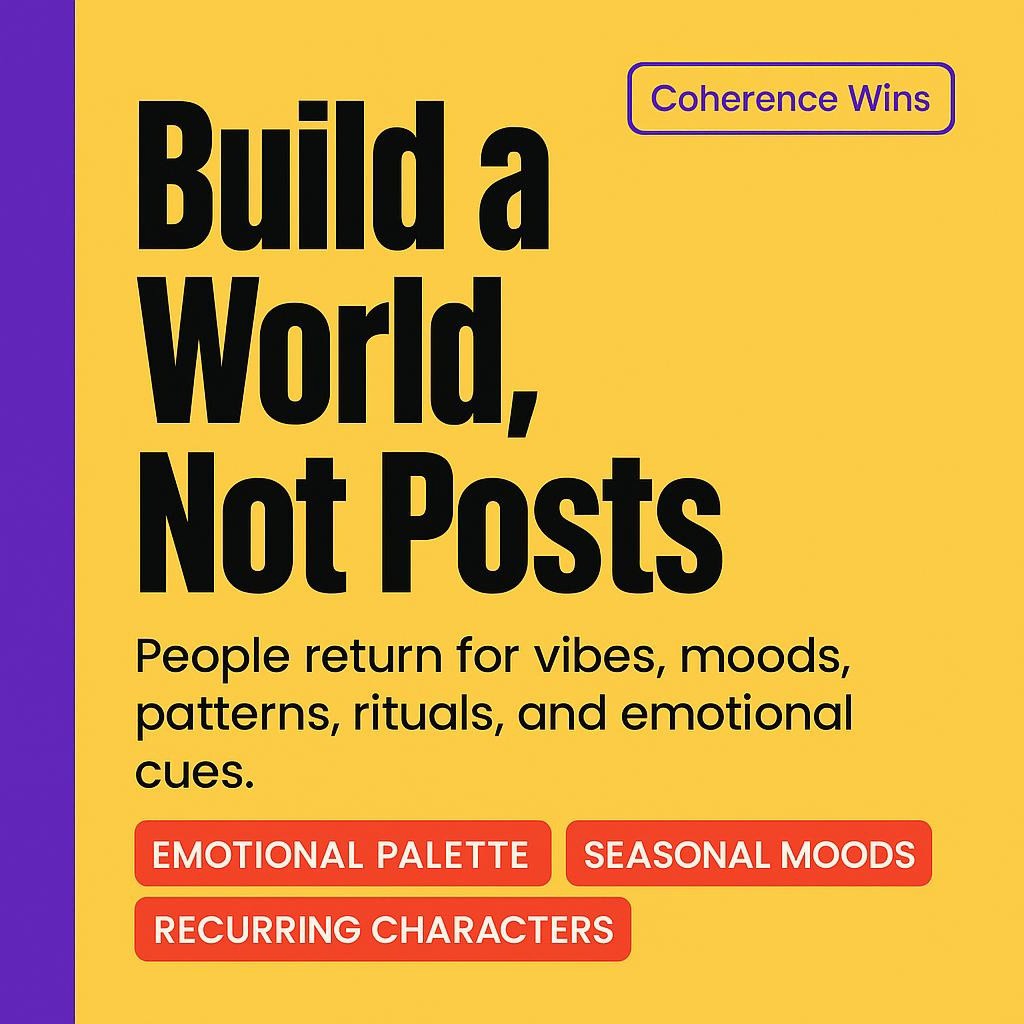
When someone discovers you, they are not collecting facts. They are testing how it feels to be in your orbit. They are reading the room, catching patterns, and deciding if your world is safe, clear, and worth returning to. People do not follow fragments. They enter worlds shaped by “vibes, atmospheres, moods, patterns, rituals, [and] emotional cues.” Build that world with intention, and isolated posts turn into an ecosystem. Browsing becomes binging, and binging becomes belief.
What This Work Is Really About
This is not aesthetic polish. It is coherence. The aim is a living system that feels the same across formats and seasons, a pattern language your audience learns and loves to repeat. The shift is simple and deep. You move from pushing content to pulling people into a story they want to continue.
- Ultimate goal: design a psychological identity people can sense in one scroll, then recognize everywhere.
- Golden nugget: consistency is emotional, not just visual. Your aura travels faster than your arguments. If the vibes are right, your message gets retained, repeated, and recommended.
A Quick Story
A coach we worked with had strong ideas and scattered output. Each post was good, but nothing connected. We set a simple playbook. Define an emotional palette, name seasonal moods, map recurring characters, then publish natively in each channel and interlink everything. The result was not just more posts. It was a world. Comments shifted from nice post to I feel seen. Sessions got longer. Bookings grew. That is the difference between speaking and being heard.
The Three Moves That Create Deep Coherence
1) Define Your Emotional Palette
Think of your brand like cinematography. Before you write, choose the energy you want people to feel. Your palette is a short list of emotions that repeat across posts, pages, and products.
- Choose three to five core emotions, for example conviction, relief, clarity, curiosity, momentum.
- Tag each asset with one primary emotion and one accent. Use this as a pre publish check.
- Codify rituals. Set recurring openings and closings, signature phrases, and micro behaviors that signal home base. Rituals reduce decision fatigue for you and speed recognition for your audience.
Ask yourself:
- What should someone feel 10 seconds into any asset?
- What should linger 10 minutes after they leave?
- What energy will you refuse to model, even when the algorithm tempts you?
2) Name the Moods of Each Season
Your audience experiences time emotionally. Plan for seasons that shift tone without breaking identity.
- Four seasons, four moods. For example, build, clarify, prove, expand. Keep the palette steady while adjusting the temperature of the message.
- Seasonal arcs, not resets. Introduce themes, deepen them, showcase outcomes, invite the next chapter. Same world, different weather.
- Seasonal rituals. Launch days, office hours, monthly recaps, community spotlights, and behind the scenes. Rituals build anticipation and teach your cadence.
Ask yourself:
- What mood does your audience need now, energy or calm?
- What proof do they need next, a result or a method?
- What ritual would they miss if you skipped it?
3) Map Recurring Characters Into Ongoing Arcs
People bond with characters. Give them a cast and a storyline to follow.
- The founder, the customer, the mission. Each has a clear desire, a recurring challenge, and visible growth.
- The founder arc shows conviction and craft. Share decisions, not just outcomes. Let people see your standards.
- The customer arc shows adoption and transformation. Highlight real before and after moments, questions, objections, and habit change.
- The mission arc shows momentum. Use milestones, partnerships, and community wins as plot points that prove your direction.
Ask yourself weekly:
- What changed for each character?
- Where did tension appear, and how did it resolve?
- What is the next decision the audience is invited into?
Turn Identity Into Infrastructure
A psychological identity is not a moodboard. It is a system that scales.
- “Native or nothing.” Publish where people are with content that feels built for that platform. Let the same emotional palette travel through short video, carousels, threads, newsletters, and search content.
- Interlink everything. Treat your content like an internal web, not a stack of posts. Each asset should link to two others, ideally in different formats. Interconnection compounds discovery, time on site, and trust.
- “Visibility equals authority times consistency times interconnection.” You do not need to post more. You need to connect better.
- Measure resonance, not vanity. Track saves, replies, completions, binge paths, and lead quality. These are signals of belief forming.
How Inkflare Operationalizes This
If you are a founder, coach, author, or small team with limited hours, leverage beats labor. Inkflare learns your voice once, then multiplies it across channels in your native tone, every day, without burnout. It keeps your emotional palette intact, your seasonal moods in sync, and your character arcs coherent across formats. Think of it as a “digital nervous system” that turns ideas into interlinked assets, so your presence, not just your posts, keeps working while you work on the business.
- “Machine-powered humanity.” Your voice stays human. The system handles the routing.
- “Distribution flywheel.” One idea becomes a thread, a short, a carousel, a blog, and a search piece, all cross linked and emotionally consistent.
- Results over vanity. The aim is belief that drives action, not metrics that merely flatter.
Your One Page Playbook
Use this weekly. Even if your team is one person, this will hold the line.
Emotional Palette
- Three to five core emotions defined
- Signature phrases and rituals documented
- Each asset tagged with primary and accent emotion
Seasonal Moods
- Current season mood named in one sentence
- Weekly theme chosen to express the mood
- One repeating ritual scheduled this week
Character Arcs
- Founder update, one decision and why it mattered
- Customer story, one obstacle and one outcome
- Mission momentum, one milestone and the next invite
Execution
- Native format selected per channel
- Each asset links to two others, different formats if possible
- Review signals of resonance, saves, replies, completions
Signs It Is Working
You will feel the shift. Comments move from cool to keep going. People repeat your phrases back to you. They explain your offer to others, often better than a landing page. Prospects arrive pre warmed because they did not just see your content. They lived in your world long enough to trust it.
Common Frictions, Clear Answers
- Worried this will box you in? Constraints create memory. An emotional palette is a compass, not a cage.
- Afraid automation will make you generic? The risk is losing voice, not using tools. Guard your palette, then let automation scale it.
- Think you need a big team? You need a tight system. A few strong rituals and interlinked assets beat a noisy calendar every time.
Make It Real Today
Design your psychological identity with the seriousness of product design. Choose your palette, name your seasons, map your characters. Then let the system do the heavy lifting. If you want help turning this into an always on presence, Inkflare exists to give you back your time, your visibility, and your voice. Your world, multiplied, interlinked, and discoverable everywhere that matters.
What world are you inviting people to live in, and what will they feel 10 seconds after they enter?