Why Good Content Doesn’t Get Chosen Without Expertise Legibility
Expertise legibility is the speed at which a real person, or an AI search surface, can understand what a business does, who it helps, and what it believes. It is not about how smart the content is. It is about how quickly the market can place that expertise, trust it, and remember it. When expertise isn’t legible, even excellent content becomes background noise.
That’s the uncomfortable truth behind so many “We’re posting, but nothing’s happening” seasons. The work is good. The ideas are real. The results are thin, because the market can’t connect the dots fast enough to choose with confidence.
Expertise legibility is what people buy before they buy
Expertise legibility is the difference between being impressive and being obvious. Not obvious as in simplistic, obvious as in instantly understandable.
When someone is researching, they are rarely reading with the patience of a book editor. They skim. They pattern-match. They look for signals that answer three silent questions: What is this about, is it for someone like me, and does it feel consistent enough to trust?
A business can be full of insight and still fail those questions, especially when research happens in fragments. A potential buyer might catch a single post, then see a profile headline, then land on a blog, then encounter an AI summary of a page, then see a second post weeks later. Those touchpoints are tiny, but the conclusion formed from them is huge.
A common example shows up with expertise-led services. Picture a buyer looking for help with positioning after a messy pivot. They land on a sharp post about messaging, click through to a website that talks mostly about “growth,” then find a blog article about leadership mindset, then see a pinned post about “building in public.” None of those are wrong topics. The problem is the experience. The buyer leaves without a clean sentence to repeat internally: “This business solves this for people like us.”
If the touchpoints connect, the market feels a steady narrative: “This business knows this space.” If they don’t connect, the market feels a different narrative: “This is probably fine, but it’s unclear.” And unclear is rarely chosen.
“Good content” doesn’t build authority, connection does
Authority doesn’t come from a great post floating alone in space. Authority comes from a sequence of ideas that reinforce each other until they feel inevitable.
This is why good content can fail so quietly. Each piece makes sense on its own, but collectively it creates a scattered impression. Different topics. Different language. Different promises. Different tone. The result is a presence that looks active but doesn’t feel anchored.
There’s also a human cost that doesn’t show up on analytics dashboards. When content doesn’t connect, the creator ends up reintroducing the business over and over, as if every piece has to do the whole job. Captions become resets. Articles become new origin stories. The profile starts carrying the weight of positioning because the body of work isn’t doing its share.
That cycle is exhausting, and it’s the opposite of compounding. The market never gets to the part where it says, “Of course. This is who they are.”
A simple way to see it is to watch what happens in a buying committee’s group chat. Someone drops a link and asks, “Thoughts?” If the content is part of a connected body of work, the reply is confident: “This is the person who’s been consistently clear about X, the thinking is solid.” If it’s disconnected, the reply turns into hedge language: “Seems smart, not totally sure what they specialize in.” The second reply doesn’t kill the deal, but it adds friction, and friction is where decisions stall.
Connection is also what makes a business easier to recognize beyond humans. Modern discovery surfaces reward patterns. A business that repeatedly covers related problems with consistent language is easier to classify, easier to surface, and easier to trust than a business that publishes a new identity every week.
Four signals that make expertise legible across any platform
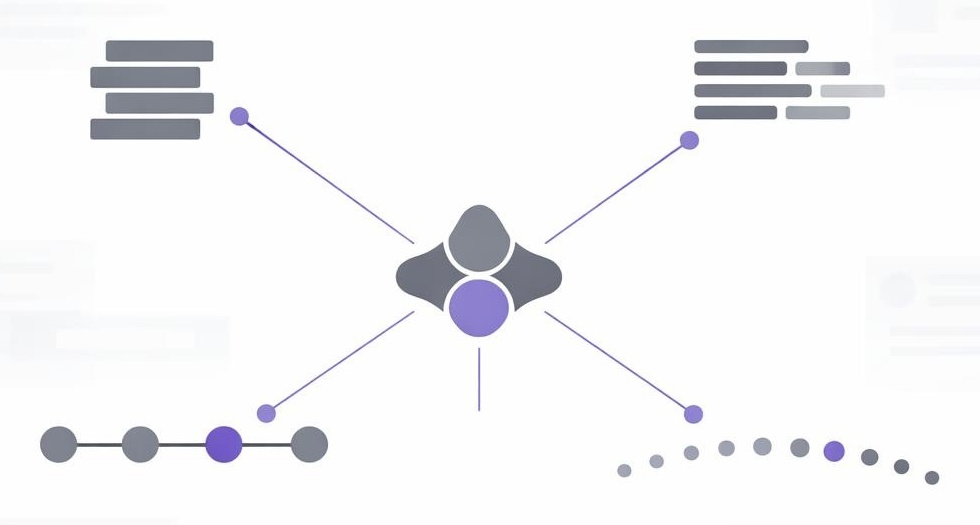
Expertise legibility is built through coherence, not volume. Coherence is what makes separate pieces of content feel like chapters in the same body of work.
The fastest way to diagnose coherence is to look for four signals.
- Core themes: a small set of problems and perspectives revisited often enough that the business becomes associated with them.
- Repeated language: consistent phrases for the audience, the enemy, the outcome, and the mechanism (the words used become a signature).
- Linked ideas: each piece references or builds on another idea, creating a visible chain of reasoning rather than isolated takes.
- Continuity over time: the same expertise shows up in multiple formats and contexts, so the market experiences a stable identity, not a series of reinventions.
These signals do something subtle but decisive. They reduce the cognitive load for the reader. Instead of asking them to do interpretive work, the content does the connecting for them.
And that’s where trust gets built, not through hype, but through clarity that repeats.
The goal isn’t to say more, it’s to be easier to understand in small moments
Most businesses try to fix visibility by adding content. More posts. More platforms. More activity.
But the real friction is often upstream. The market isn’t starving for information, it’s starving for orientation. It wants to know what box to put this expertise in, and whether that box matches the problem being solved.
That orientation is created in micro-moments, especially the ones that feel too small to matter. A LinkedIn headline doesn’t just list roles, it teaches the reader what to associate the business with in a single glance. A pinned post acts like a front door: it either frames the core themes and point of view, or it sends people wandering through random rooms hoping they’ll stumble onto the right one.
The same is true on a website. An about page isn’t “nice to have copy.” It quietly decides whether a visitor understands what the business believes and what kind of clients it is built for. Even a blog series can either build legibility or dilute it. When each article naturally leads to the next question the reader already has, it creates linked ideas and continuity. When every article tries to be a standalone universe, it forces the reader to keep reorienting.
When those moments share the same themes and language, even a quick skim starts to feel like familiarity.
This is also where AI-driven discovery rewards coherence. AI systems don’t “feel” inspiration, they detect patterns. When multiple pages, posts, and explanations reinforce the same expertise, it becomes easier for those systems to interpret what the business is about and when it should surface.
The practical takeaway is simple: the job is not to create more touchpoints, the job is to make touchpoints agree with each other.
Building a recognizable body of work without living inside the content calendar
A recognizable body of work is what happens when content stops behaving like output and starts behaving like infrastructure.
Infrastructure has three properties: it’s consistent, it’s connected, and it keeps working even when attention is elsewhere.
That matters because most coaches, founders, and solo experts don’t struggle due to a lack of expertise. The struggle is translation. The best thinking lives in client calls, strategy sessions, product decisions, and lived pattern recognition. Then the week gets full, content slips, and visibility starts over from zero.
A familiar scenario: a consultant has a genuinely sharp perspective on pricing, but the last month of content is a mix of “behind the scenes,” a motivational riff, a hot take on AI, and a single strong post on pricing. A buyer who needs pricing help doesn’t doubt the intelligence, they doubt the relevance. The buyer can’t see core themes, can’t spot repeated language, can’t follow linked ideas, and doesn’t feel continuity. So the buyer goes with the competitor whose content is less dazzling but unmistakably consistent.
This is the hinge point between theory and action. The four signals are not a creative preference, they are the mechanics of legibility. Core themes decide what the market should remember. Repeated language decides how quickly it can remember it. Linked ideas stop every post from being a restart. Continuity turns scattered impressions into a recognizable body of work, and that’s exactly why Inkflare exists: to turn real expertise into a connected, ongoing presence where those signals get reinforced on purpose.
Inkflare treats visibility as a system that turns expertise into connected presence across social, blogs, search, and AI discovery surfaces. Instead of relying on random posting, the goal is an interlinked ecosystem where a few clear themes stay consistent, language stays stable, ideas intentionally connect, and the rhythm across formats creates continuity instead of bursts.
The difference isn’t just efficiency. The difference is that the market stops seeing isolated content and starts seeing continuity.
That is what expertise legibility creates. Not louder marketing, but a presence that makes sense at a glance, and keeps making sense over time.
A strong next step is to audit the last 30 days of public touchpoints and ask one ruthless question: if a stranger saw only these fragments, would the business be instantly placeable, or would they have to work to understand what’s here?
When the answer becomes “instantly placeable,” being chosen stops feeling mysterious.