Operational Leverage for Expert Visibility and the 4-Part System That Makes Consistency Possible
Consistency is not a personality trait, it is an operations problem. Operational leverage for visibility means turning a few high-signal expert inputs (your real thinking, your real frameworks, your real proof) into a continuous presence across the places people discover authority. When the system works, the weekly commitment stays the same: ten minutes to review and approve.
Most experts are not inconsistent because they are undisciplined. They are inconsistent because they are trying to manufacture content from scratch, on demand, in public, every week. That is not marketing, it is a treadmill with a nicer font.
The unpopular truth is simple: visibility compounds when the work is reusable. If every post requires fresh inspiration, consistency will always be fragile. If each insight becomes a durable asset that can be repackaged, linked, refreshed, and redistributed, consistency becomes inevitable.
Consistency requires a system, not more motivation
Consistency fails for one predictable reason: the content workflow is built for bursts, not for weeks. Bursts are fueled by urgency, novelty, and occasional adrenaline. Weeks are fueled by a system that keeps moving even when attention is scarce.
A useful way to see it is this: intensity creates spikes, consistency creates gravity. Spikes look impressive on a calendar, then disappear. Gravity quietly pulls people back, because your ideas keep showing up where they search, scroll, and ask.
What “being consistent” actually requires in practice is not daily posting. It is a reliable conversion of expertise into outputs. That conversion has to survive busy weeks, travel, launches, client emergencies, and the natural cycles of focus. If the workflow depends on perfect conditions, it is not a workflow, it is a wish.
The goal is not to post more. The goal is to reduce the cost of posting to nearly zero without reducing signal. That is what operational leverage is for.
Operational leverage is what makes one strong idea travel farther than one platform
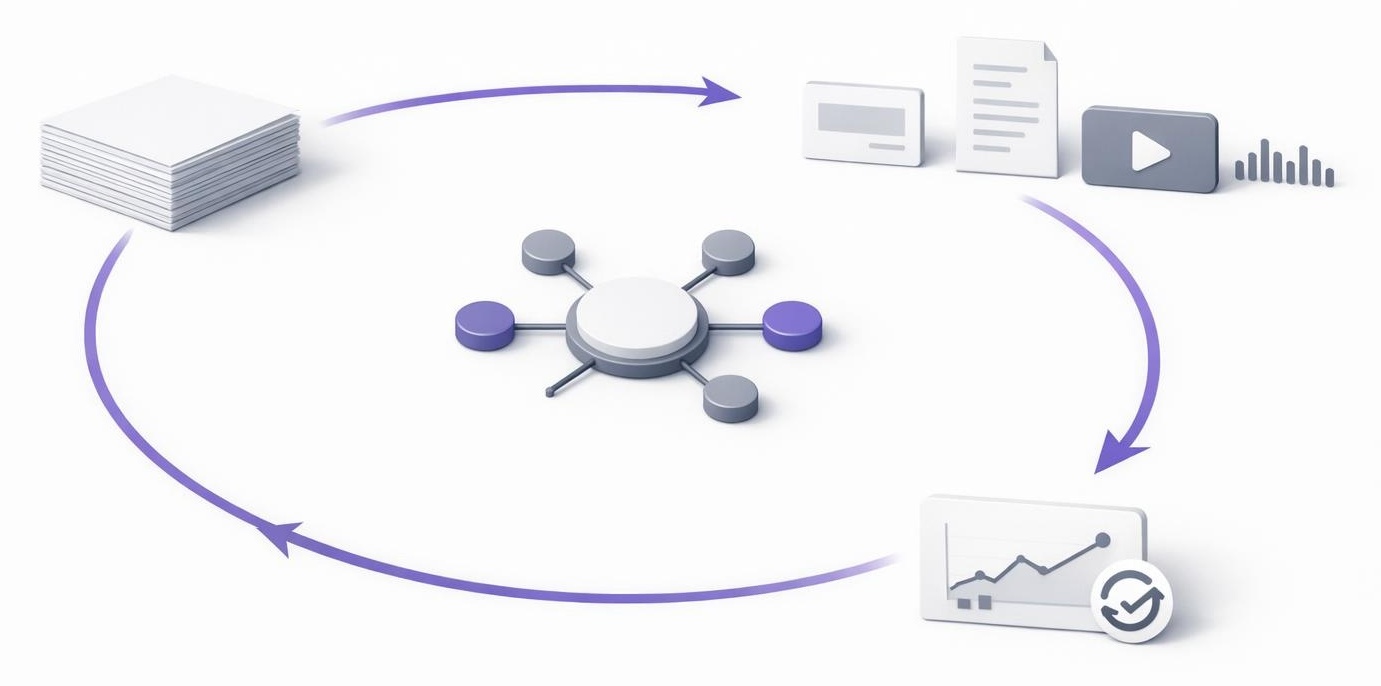
Leverage shows up when one strong idea does not produce one post, it produces a chain. A short social post earns attention, a longer blog earns search visibility, a video script earns trust, and an interlinked set of themes teaches the market what you stand for.
The reason this matters is how discovery actually works. People do not wake up and decide to hire an expert because of one brilliant tweet. They move through surfaces. They notice a post, then they Google, then they skim a site, then they ask an AI assistant, then they check whether your thinking shows up consistently across contexts. Authority is pattern recognition.
That is why Inkflare frames the promise in operational terms: your weekly commitment stays the same, ten minutes to review and approve. Not because quality should be automated away, but because the highest-leverage part of expert content is not typing. It is judgment. It is choosing what is true, what matters, and what should be emphasized.
Everything else is a candidate for systematization.
Part 1: Build a source of truth that your content can trust
If content is a factory, the source of truth is the supply chain. Without it, every piece of output becomes improvisation, and improvisation is expensive.
A source of truth is simply a curated set of inputs that represent what your expertise already contains. Think of it as the “canonical pile” your system pulls from: website pages, service descriptions, FAQs, client language, past posts that still hold up, internal docs, frameworks, transcripts, and the sharp opinions that keep resurfacing in conversations.
This is where most creators accidentally sabotage themselves. They treat each platform like a blank page. Then they wonder why the blank page keeps winning.
A working source of truth has two traits. First, it is specific enough to preserve your voice and your edge, not generic marketing mush. Second, it is organized enough that it can be reused without rereading everything every week. The point is not to archive your life, it is to capture your signal.
In practice, “signal” is not just a list of topics. It is the language and logic that only this expertise can produce: the recurring claims, the objections that always show up, the before-and-after transformations, the proofs that hold up under scrutiny, and the terms that should never be diluted. When those pieces are captured, the system can draft without drifting into blandness.
When the source of truth is real, the system can create content that sounds like an expert with a spine. When it is thin, the system produces filler, and filler cannot compound.
Part 2: Turn expertise into a topic strategy that can run for months
A strategy is what prevents “random posting.” It decides what your content ecosystem is teaching the market over time.
The simplest strategic mistake is chasing breadth. Posting about a different topic every week feels productive, but it resets the audience’s understanding of you every time. The smarter move is controlled repetition: a small set of themes that get explored from multiple angles, at multiple depths, in multiple formats.
A strong topic strategy behaves like a syllabus. It has core concepts, supporting ideas, and a clear through-line. Each post is not just “a post,” it is a lesson that fits into a larger body of work. That body of work is what makes you legible to humans and to machines.
This is also where cause-and-effect becomes visible. Topic selection drives distribution. Distribution drives discovery. Discovery drives trust. Trust drives pipeline. When topics are chosen because they are trendy, the chain breaks early. When topics are chosen because they express your point of view and match your buyers’ questions, the chain holds.
The hidden advantage is that strategy reduces decision fatigue. Instead of asking “What should be posted this week?”, the system asks “Which part of the syllabus should be reinforced next?”, then pulls from the source of truth to do it. Consistency stops being a weekly invention contest and becomes a planned sequence of proof.
Part 3: Multi-format production, one idea becomes many assets
Multi-format production is where operational leverage becomes tangible. The goal is not to be everywhere. The goal is to stop paying full price for every idea.
Most experts already have enough insight for a year of content, it is just trapped in one format. A great explanation gets said once on a call, then evaporates. A sharp framework sits inside a slide deck, then never reaches the people who need it.
The leverage move is to treat a single weekly input as the seed, then let the system translate it into the outputs that different surfaces prefer. One idea earns attention fast in short form, earns trust in spoken form, and earns longevity in long form. The same insight, different packaging, different job.
For example, one strong idea can become:
- a short social post that earns initial attention and tests what language lands
- a blog that captures search intent and becomes the canonical explanation people can reference
- a video script or talking outline that carries tone, conviction, and clarity without improvising every take
- an email-style narrative that deepens relationship with warm audiences and reconnects the idea to a lived problem
This is not content repurposing in the lazy sense. It is content translation. The idea stays the same, but the packaging changes to fit the medium.
This is also where automation is appropriate, with a clear boundary. Automate production, not thinking. Let the system draft, structure, and adapt. Keep the expert in charge of final truth, emphasis, and sharpness. That is what the ten-minute review protects.
Done correctly, the content stops being “a task.” It becomes a distribution layer for your expertise, and distribution is what makes authority visible.
Part 4: A lightweight control loop that keeps quality high and waste low
Most content systems fail in silence. They do not crash, they drift. Quality softens. Topics become less strategic. Outputs become disconnected. Then the creator blames the market when the real problem is feedback starvation.
A control loop solves this by creating a simple cadence for correction. It does not need dashboards and obsession. It needs a small set of signals that answer three questions.
First, what is resonating, meaning what themes consistently earn saves, replies, qualified site visits, or meaningful conversations. Second, what is building durable discovery, meaning what starts ranking, gets referenced, or shows up in AI-driven summaries and recommendations. Third, what is sharpening positioning, meaning what consistently attracts the right buyers and repels the wrong ones.
The control loop is also how consistency becomes sustainable. It prevents overproduction. It prevents underthinking. It keeps the system aligned with the real world instead of the imagined one.
Inkflare’s philosophy fits here: the goal is not to win the week, it is to build an interlinked content ecosystem that teaches, reinforces, and compounds. Noise is easy to produce. Signal requires a loop.
The real win: ten minutes of judgment, weeks of presence
The promise of operational leverage is not that content becomes effortless. The promise is that the highest-value work stays human, while the repetitive work becomes systematic.
When the four parts are in place, consistency stops being a moral battle. Source-of-truth inputs protect authenticity. Strategy protects direction. Multi-format production protects distribution. The control loop protects standards.
The end-state is simple and slightly rebellious: a visibility engine that does not require constant self-sacrifice. Ten minutes to review and approve, then your ideas keep showing up, teaching, and compounding.
The question is not whether consistency is possible. The question is whether the current workflow is designed for it, or designed to break the moment life gets real.