DIY vs Agency vs In House vs AI Content Engine Which Visibility Model Fits Your Business
As a decision rule: DIY wins when control matters more than speed, agencies win when coordination is easy and voice is already codified, in-house wins when leadership can run a people system, and an AI content engine wins when consistent multi-platform output is required without surrendering voice.
The real choice is not who writes, it is who carries the cognitive load
Every content model answers one question: where does the mental burden live?
That burden is bigger than writing. It includes deciding what to say, translating messy ideas into clear claims, keeping a consistent point of view, adapting to multiple platforms, tracking what is already published, and maintaining the thread of authority over months.
Most teams think they have a “content problem.” The hidden problem is systems debt. When content runs on inspiration and last-minute scrambling, it taxes the same mental bandwidth needed to coach clients, build product, sell, or lead. That is why so many smart operators end up with a feed full of abandoned experiments.
A clean operating model does something simple and rare: it makes consistency feel boring (in the best way). It moves visibility from heroic effort to routine execution.
The four operating models and their real tradeoffs
DIY, agency, in-house hiring, and AI systems all work, but each one breaks in a different way.
DIY content is maximum control, maximum cognitive load. The voice stays true because it is true. The tax shows up elsewhere: decision fatigue, inconsistent cadence, and a constant feeling of being “behind.” DIY also creates a quiet platform trap, because a single person can usually sustain one channel well, but multi-platform presence turns into context switching and fragmented thinking.
Agency content is delegated execution with coordination overhead. The best agencies bring editorial discipline and production reliability. The risk is voice drift, not because agencies are careless, but because they operate from external inference. Without deep access to thinking, the work often becomes plausible, polished, and slightly wrong. That “slightly wrong” is the killer, it erodes trust while looking like competence.
In-house hiring looks like the mature solution, and sometimes it is. A strong content hire can become a strategic partner, living close to the product, the customers, and the founder’s thinking. The real cost is not just salary, it is management. Hiring turns content into a people system: onboarding, feedback cycles, editorial leadership, performance expectations, and the ongoing work of keeping strategy crisp. If leadership bandwidth is already tight, a hire can increase pressure before it reduces it.
An AI content engine is leverage, but it is not autopilot. AI removes the blank page and scales distribution, yet it still requires inputs, guardrails, and approvals. The win is that the cognitive load shifts from “create from scratch” to “direct and refine.” The risk is that teams treat it like a content farm and end up with high output, low signal.
Used correctly, the AI system model is not about sounding robotic. It is about making authentic ideas shippable at the pace the internet rewards.
A no-hype decision filter that makes the right choice obvious
A good choice becomes obvious when the criteria are honest. Four questions decide most cases.
- Weekly time budget for visibility: not wishful thinking, the real hours that can be protected.
- Tolerance for coordination: meetings, briefs, reviews, approvals, and the emotional labor of “teaching” someone the voice.
- Need for authenticity: how much the market buys because of the thinking itself (high for coaches and founders), versus because of brand presence alone.
- Multi-platform scope: whether visibility must hold across social, search, and AI discovery surfaces, or whether one channel is enough for the next 90 days.
These criteria expose the cause-and-effect chain that most teams ignore.
Low time plus high authenticity requirements usually breaks DIY. High multi-platform scope plus low coordination tolerance usually breaks agencies. Hiring solves authenticity and coordination, but only if leadership has the bandwidth to run a people system.
The quiet pattern is this: the more an audience needs to trust the mind behind the message, the more dangerous voice drift becomes. Authority builders do not just publish content, they publish worldview. When the worldview blurs, the compounding effect collapses.
Matching the model to the stage and the reality on the calendar
The simplest way to choose is to stop asking, “Which option is best?” and start asking, “Which failure mode is acceptable right now?”
DIY is the right choice when the goal is clarity before scale. If messaging is still unstable, offers are shifting, or the market is not yet understood, DIY forces contact with reality. It is hard to outsource learning. DIY can also work when the scope is intentionally narrow, for example one primary platform, one strong content format, one repeatable theme.
Agency is the right choice when coordination is acceptable and the voice is already well-defined. Agencies struggle when they are expected to discover positioning. They can excel when the job is to operationalize a clear editorial thesis. The key is to judge the agency on their ability to extract thinking, not their ability to produce posts.
Hiring is the right choice when content is a strategic function, not a side quest. If consistent publishing is already proven to convert, if the business can afford the runway, and if leadership can provide strong direction, a hire can turn visibility into an internal capability. Without those conditions, hiring often becomes expensive confusion with a Slack channel.
An AI content engine is the right choice when the goal is multi-surface consistency without surrendering voice. This is where Inkflare is designed to sit: “You keep the voice, Inkflare handles the volume.” The model assumes something important, that authenticity is not a tone of voice, it is a traceable chain of ideas. When the system is built around an expert’s actual thinking, the output stops being random posting and becomes an interlinked authority ecosystem.
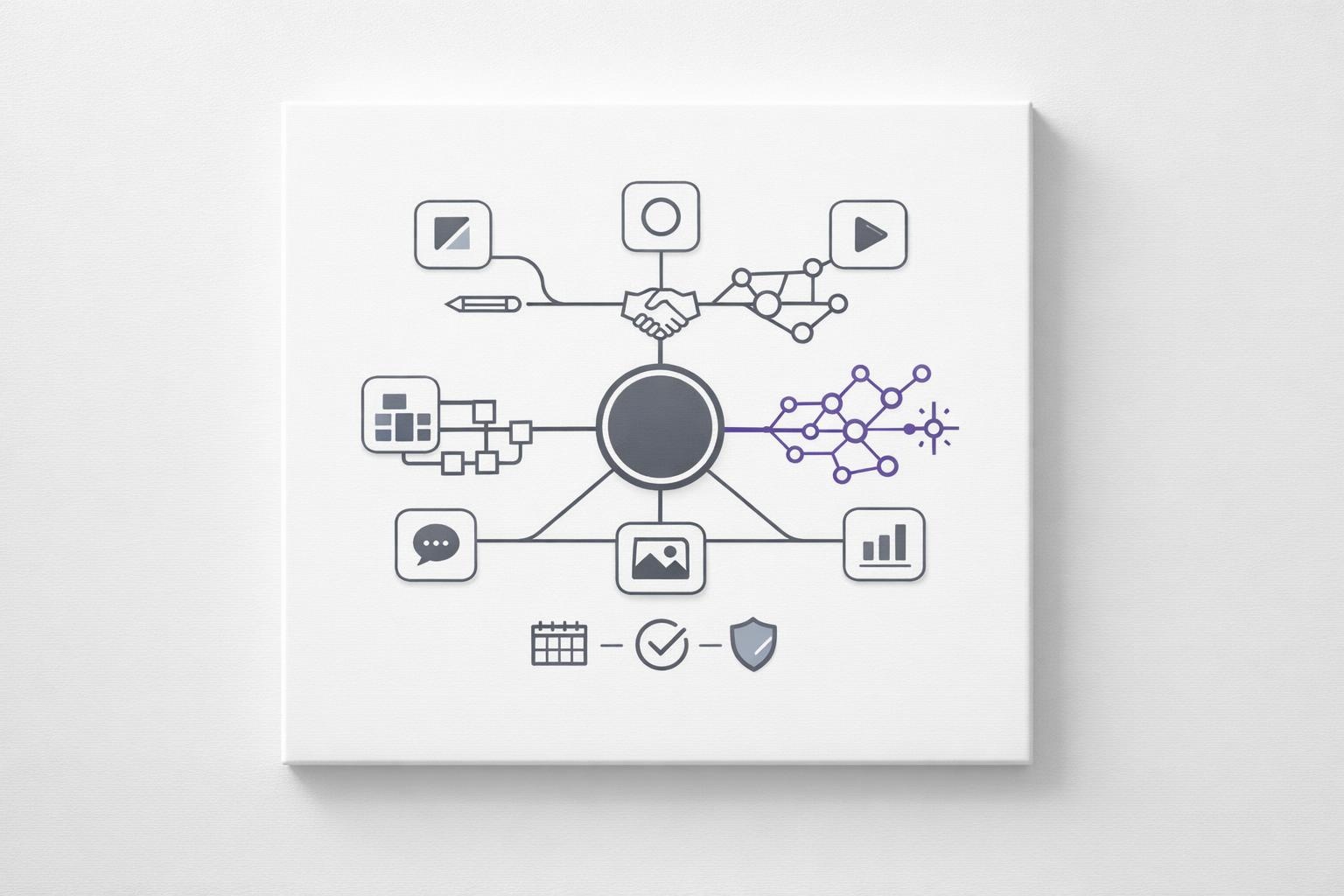
The practical advantage is not merely speed. It is continuity. A system can hold the thread across social content, search-friendly assets, and AI discovery surfaces without requiring a human to context switch all day. The approvals and inputs still matter, but they are concentrated into a smaller, more manageable set of decisions.
In other words, the work becomes directional instead of draining.
Do it now later or never for solopreneurs and small teams
The final decision is timing. Each model has a moment where it creates lift, and a moment where it creates drag.
“Do it now” applies when visibility is already a bottleneck, the business depends on trust in expertise, and consistency keeps breaking under real workload. In that reality, the winning model is usually the one that lowers cognitive load without blurring the signal. An AI system model tends to win because it concentrates effort into inputs and approvals instead of constant creation, while DIY can still be a smart “now” choice if the scope is ruthlessly constrained and the goal is learning.
“Do it later” fits when positioning is still unstable or the offer is not proven. At that stage, scaling distribution before the message is sharp does not build authority, it amplifies confusion. The highest-leverage move is to clarify the thesis, the audience pain, and the few signature ideas worth repeating until the market starts repeating them back.
“Do it never” is the uncomfortable category, but it saves years. If content is being used to avoid sales conversations, product decisions, or uncomfortable specificity, no operating model will fix the underlying issue. A content engine cannot rescue a business that will not choose a clear point of view.
A visibility operating model is a commitment to a kind of consistency. The question is which kind: consistency of effort, or consistency of signal. One burns out. One compounds. Which one is being built?