
Privacy as Positioning for AI Marketing Tools That Earn Trust
Privacy is not a legal footnote. It is a market signal.

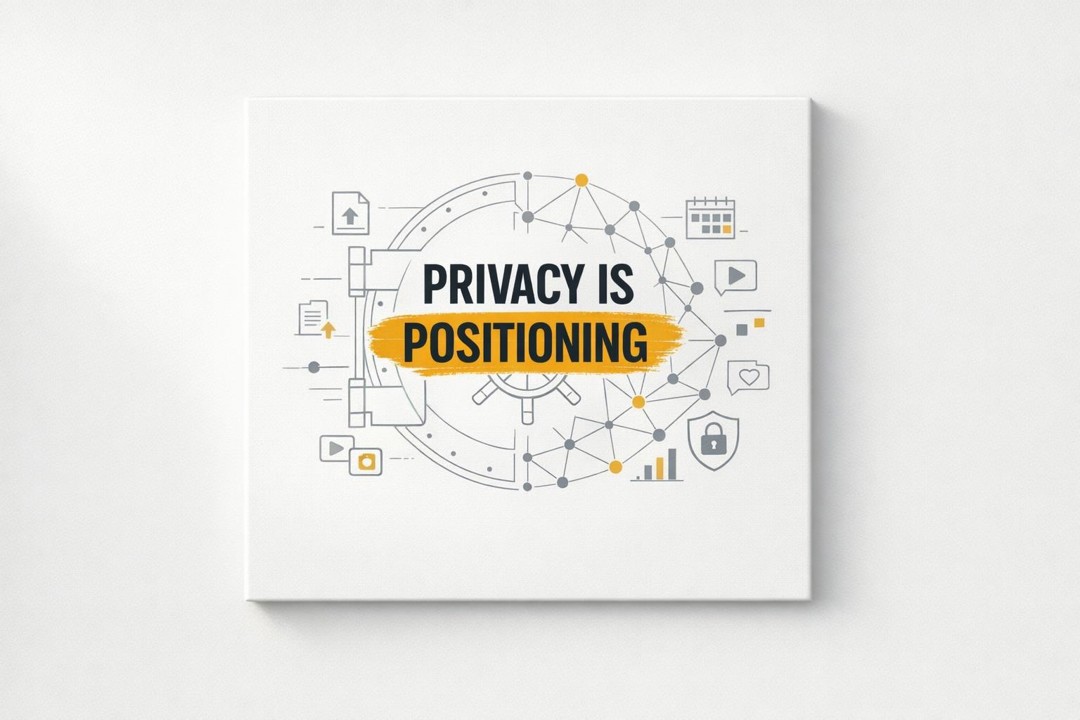
Privacy is not a legal footnote. It is a market signal.
In AI marketing, the tools that win are not always the ones with the longest feature list, they are the ones that feel safe enough to tell the truth inside. Because the moment a platform touches messaging, offers, and voice, it stops being “software” and starts being a vault.
That is where most AI marketing tools stumble. They treat privacy like a compliance checkbox while selling output quality. But output quality is downstream from input quality, and input quality is downstream from trust. This is why “compliant” tools still lose the market, they lose the moment a user hesitates before uploading the real materials.
Privacy is positioning because it changes buyer behavior before the first prompt is ever typed.
There are two kinds of AI marketing platforms in the wild. The first leads with features, templates, and velocity, and adds privacy as a badge in the footer. The second leads with boundaries and trust, and treats privacy like part of the value proposition, not part of the terms.
For coaches, founders, solo experts, and small teams, the most valuable marketing inputs are not public blog posts. They are proprietary documents and hard-won clarity, the offer notes that never made it to the site, the onboarding docs that explain why clients stay, the objections that only show up on sales calls, the frameworks refined across real engagements. That is the fuel.
When a tool feels even slightly unsafe, the user does not stop using it. The user stops feeding it. The market does not punish the weak privacy posture loudly, it punishes it quietly, through diluted inputs, generic outputs, and a slow bleed of trust.
Generic AI output is often a trust problem disguised as a model problem.
The failure mode is subtle and common. A platform asks for “brand documents” and “examples,” but the privacy story is fuzzy, or buried, or written in the careful language of loopholes. So users do what intelligent people do when the room does not feel secure, they self-censor.
They remove pricing and positioning, because it feels sensitive. They avoid proprietary docs, because they are unsure where those docs go next. They skip client specifics and real before-and-after context, because it feels identifiable. They paste the safest possible version of their business, the public version.
Then the tool produces the safest possible content. Bland hooks. Generic advice. Copy that could belong to anyone with a Wi-Fi connection and an opinion.
The cause-and-effect chain is brutal in its simplicity: weak privacy signal leads to cautious behavior, cautious behavior leads to low-quality inputs, low-quality inputs lead to generic outputs, generic outputs lead to disappointment, disappointment leads to churn. And on the way out, the blame lands on “AI content” as if the machine created mediocrity unprovoked.

Privacy is the gate that decides what quality of truth enters the system.
This is the mental model shift most teams miss. Privacy is not only about reducing risk, it is about increasing conversion, increasing retention, and increasing the quality of the relationship between the user and the platform. It works like lighting in a room, when it is harsh, people pose, when it is warm and controlled, people speak plainly.
AI marketing tools have a sameness problem. Models are accessible, prompts spread fast, “best practices” get copied into oblivion. The durable differentiator is not the algorithm, it is the uniqueness of the inputs, the voice, the perspective, the real examples, the internal frameworks, the unpolished truth that never shows up in public.
Strong privacy posture makes that truth shareable. It gives users permission to bring the real materials, not the sanitized brochure version. That is when the output stops sounding like “content” and starts sounding like a point of view.
This is where Inkflare’s promise matters. “Build real authority, not noise” is not a slogan, it is a standard. Authority requires specificity, and specificity requires trust. Strong privacy practices ensure user data and brand voice are secure and never resold or reused, not because that sounds nice, but because it changes what a user is willing to contribute. Better inputs are not a nice-to-have, they are the only path to defensible, on-brand visibility.
Strong privacy means clear boundaries that match the marketing, and controls that give users real leverage.
Most privacy pages are written like weather forecasts, technically accurate, emotionally useless. “May,” “might,” “from time to time,” and other phrases that translate to: nothing is promised. But users are not looking for poetry or legal gymnastics. They are looking for certainty in plain language.
A practical way to evaluate an AI marketing tool is to ask five questions that cut through the fog:
Notice what is missing from that list, jargon. Encryption and access control matter, but they are table stakes. The bigger issue is governance, the boundaries of use, and whether those boundaries are understandable enough to change behavior.
Red flags are usually written in soft focus. “May use your content to improve our services” is a classic, because it sounds harmless while leaving the door open. So is unclear training language, vague retention policies, and privacy promises on landing pages that quietly vanish inside the terms. The market has learned to read between the lines, especially experts whose brand voice is their business.
If the tool cannot say, in a single clean sentence, what it does and does not do with user data, then the trust gate stays half-closed. And when the gate stays half-closed, the best inputs never enter.

Privacy becomes positioning when it is framed as the enabler of better truth, not the avoidance of worst-case scenarios.
This starts with leading from the outcome, not the policy. The message is simple: better outputs come from better inputs, and better inputs require a safe place to put proprietary reality. Then state the boundary plainly, never resold, never reused. Then translate that boundary into a user benefit, the freedom to upload the real docs, the real voice notes, the real offer details, without performing for an invisible audience.
From there, connect the dots to authority. When users share specific materials, the system can produce content that is coherent across channels, anchored in the same worldview, and recognizable as a single mind at work. That is durable discoverability, not a burst of posts that evaporate after a week.
This is the quiet rebellion against mediocre AI marketing. Not more volume. Not more “content.” More truth, protected well enough to be used.
The final question is not whether a tool is compliant. The question is whether it makes it easier to tell the truth at scale, and whether it has earned the right to hold the raw materials that make that truth persuasive.
Published March 27, 2026
Your expertise, published
Inkflare turns what you already know into ready-to-approve posts across the platforms you care about. Review in minutes. Approve, tweak, or skip, and no content scramble.
Start your free trial