The shift: visibility isn’t just rankings or reach anymore (it’s references)
Clicks are optional. Being referenced is becoming mandatory.
Discovery used to be a bookshelf. You published a page, fought for a spot on the shelf (rankings), and hoped someone pulled the book out (a click). Now discovery is increasingly a librarian that answers the question directly, citing a few sources when the answer needs receipts. The competition is no longer only “Who ranks?” or “Who goes viral?” It’s also “Who gets understood well enough to be included?”
That’s the new stack lean teams are actually navigating:
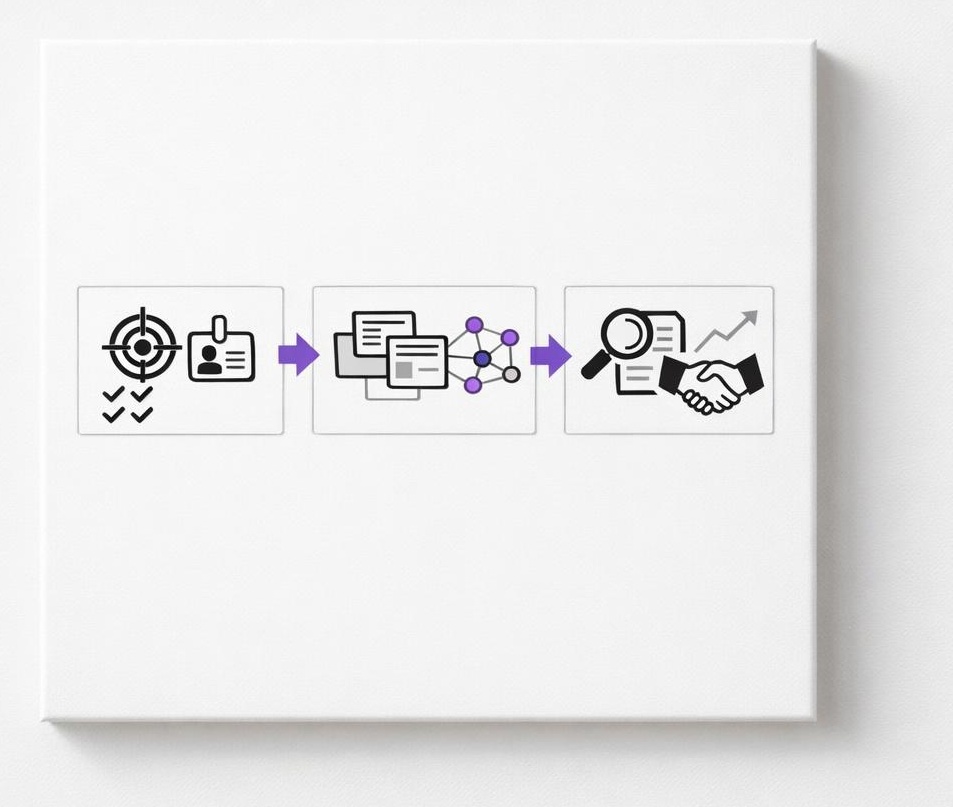
SEO is classic search visibility, winning rankings and capturing high-intent demand. GEO is visibility inside generative answers, where AI systems synthesize an explanation and pull supporting sources. Social is feed visibility, winning attention and relationship velocity. Partnerships are borrowed distribution, where someone else’s trust gives the message a runway.
What changed is the middle layer. More journeys now start with a synthesized answer, not a list of links. That shifts the unit of competition from “earning the click” to “earning the citation” and “earning the summary.” For lean teams, this is not a call to do everything. It’s a call to stop building on rented land without a plan.
Paid ads and agency dependency are the tempting alternative. They can buy speed. They also tend to buy fragility, because the moment spending pauses or the retainer ends, the demand graph flattens.
SEO vs GEO vs Social vs Partnerships: what each engine actually buys you
Each channel is a different machine. The mistake is judging them by vibes instead of outputs.
SEO is the demand-capture engine. It turns clear topics and consistent publishing into rankings, and rankings into inbound intent. The cost is patience and craft, because search rewards credibility over novelty. The risk is slow feedback loops and the temptation to publish disconnected pages that never become an authority system. The win condition is simple: the right pages rank for the right queries, and those pages lead to the right next step.
GEO is the reference engine. It’s the work of making a business machine-legible and quote-worthy, so generative systems can confidently use it to answer questions. This is not “SEO renamed.” SEO tries to win a slot in a list, GEO tries to become a trusted ingredient in the answer itself. The cost is clarity, consistency, and interlinking, because synthesis depends on stable signals (who this is for, what it does, what it believes, what proof supports it). The risk is treating GEO like a technical trick instead of an authority discipline. The win condition is showing up as a cited source or a recognizable viewpoint when prospects ask the category questions.
Social is the attention engine. It converts sharp ideas into reach, then reach into familiarity, then familiarity into trust, if it’s connected to something deeper than posting frequency. The cost is ongoing cadence, because feeds reward presence. The risk is volatility, because performance is often platform-shaped, not strategy-shaped. The win condition is repeatable resonance: the right people recognize the message quickly and seek more depth elsewhere.
Partnerships are the trust engine. They convert other people’s credibility into pre-warmed attention. The cost is relationship capital and alignment, because borrowed trust only works when the message fits the audience and the partner’s reputation. The risk is limited control over timing and distribution. The win condition is leverage: one appearance, one collaboration, one referral pipeline creates more qualified conversations than weeks of solitary posting.
Paid and agencies sit outside this set as accelerants. They can amplify a message, but they rarely create ownership by default. Without owned assets and a coherent point of view, the spend becomes a treadmill that never turns into a flywheel.
The Lean-Team Scorecard: 5 criteria that decide the channel for you
A lean team doesn’t need more opinions, it needs a scoring model that makes trade-offs visible.
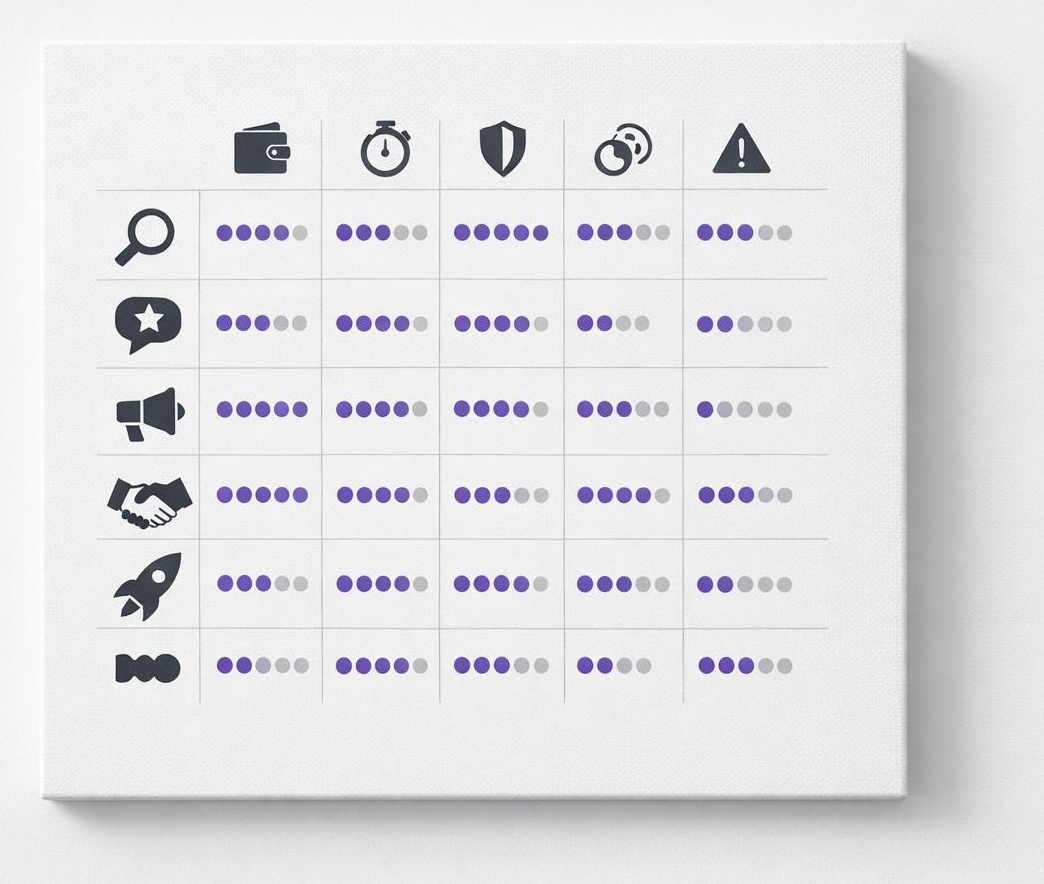
Score each engine from 1 to 5 across five criteria: cash required (how much money must be spent before results appear), time-to-signal (how quickly learning and leads show up), control (how much is owned versus rented), compounding (whether work gets more valuable over time), and risk (volatility and dependency).
Start with constraints. If cash is tight, anything that needs constant spend drops in priority. If time is tight, anything that requires daily output without leverage becomes suspicious. Then optimize for control and compounding, because those are the two forces that keep marketing from becoming a second full-time job. Finally, sanity-check risk, because the point of organic growth is stability, not adrenaline.
A sample baseline scorecard (not gospel, a starting point) looks like this:
| Engine | Cash required | Time-to-signal | Control | Compounding | Risk |
| (|) :| (:|) :| (:|) :|
| SEO | 3 | 2 | 5 | 5 | 2 |
| GEO | 3 | 3 | 4 | 4 | 3 |
| Social | 2 | 4 | 2 | 3 | 4 |
| Partnerships | 2 | 3 | 2 | 4 | 3 |
| Paid/Agency | 5 | 5 | 1 | 1 | 5 |
The trap is scoring based on aspiration instead of reality. A founder with one hour a day does not have the same “time budget” as a team with a content lead. A coach with a clear niche can turn SEO and GEO into a predictable pipeline, while a still-evolving offer may need social and partnerships to pressure-test messaging first.
As a reality-check example, a niche B2B consultant might score SEO lower on time-to-signal but higher on compounding, because one “best answer on the internet” page can bring qualified leads for years. The same consultant might score social high on time-to-signal but high on risk, because a week without posting can erase momentum that never became an owned asset.
Decision matrix: choose the best “now” channel (and the one to delay)
The right decision is conditional. The wrong decision is pretending it isn’t.
If the offer is new, positioning is still forming, and content is minimal, prioritize social plus partnerships for fast signal. Social reveals which ideas land, partnerships reveal which audiences convert. Delay heavy SEO until the message stops changing every week, otherwise the web presence becomes a museum of abandoned angles. Do this next: publish a small set of “category opinions” that explain what the market gets wrong, then borrow distribution through a handful of aligned podcasts, newsletters, or communities to test the narrative.
If the niche is clear and high-intent queries exist, prioritize SEO and GEO foundations together. SEO captures existing demand, GEO earns inclusion in the explanations people are already asking for. Delay the daily social grind if it forces shallow output, because consistency is only powerful when it’s consistent in meaning, not just frequency. Do this next: build two to four core pages that answer the category’s most searched questions with clear structure and proof, then interlink them so the site reads like a coherent system.
If the brand voice is strong but bandwidth is limited, prioritize a GEO-friendly content ecosystem with lightweight social distribution. This is the “one body of work, many surfaces” approach, where a few authoritative assets get repurposed into posts rather than reinvented daily. Delay bespoke long-form for every platform, because that turns marketing into an artisanal craft project. Do this next: standardize a repeatable content shape (problem, mechanism, example, implication) and reuse it across posts, pages, and answers.
If the offer is premium and trust is the main barrier, prioritize partnerships plus authority assets. Premium buyers do not just need information, they need belief, and belief transfers faster through trusted relationships than through cold traffic. Delay broad-reach virality plays, because mass attention is not the same as qualified intent. Do this next: create one definitive “why this approach works” piece, then collaborate with a small number of operators who already hold the audience’s trust.
If a team is tempted to choose paid ads because it feels decisive, treat that as a diagnostic: speed is being purchased because the system feels too slow. Paid can be useful, but only when it’s amplifying a message that already converts and a destination that already educates. Otherwise it’s gasoline on confusion.
What to ignore (for now) + the 90-day sequencing plan that builds durable demand
Overwhelm is rarely caused by too many platforms. It’s caused by too many unconnected bets.
For now, ignore:
- Platform-hopping when a single message hasn’t been proven yet
- Trend-chasing that trains the market to see a brand as entertainment, not expertise
- Vanity metrics that reward noise instead of qualified attention
- Over-optimizing tactics before the message and offer are stable
- Chasing virality as a strategy (instead of using reach to point toward owned assets)
- Outsourcing the brain of the business to an agency
- Publishing standalone content that never links to anything meaningful
Those behaviors look like work. They don’t behave like a system.
A lean 90-day sequence builds control first, then reach.
In weeks 1 to 2, clarify the entities: who this is for, what problem is solved, what category language the audience uses, and what proof backs the claim. This is where GEO begins, because generative answers reward stable identity and repeatable explanations.
In weeks 3 to 8, publish a small set of interlinked authority assets designed for humans and for synthesis. Think fewer pieces with more internal coherence. Each asset should make a claim, explain the mechanism, and include a concrete example, then link to the next concept so the ecosystem teaches, not just broadcasts. Social becomes distribution, pulling moments from those assets rather than inventing new topics every day.
In weeks 9 to 12, layer in light SEO optimization and partnership outreach anchored to the assets. SEO is not just keywords, it’s alignment between what the audience searches, what the site explains, and what the business offers. Partnerships become easier when there’s a clear “this is the viewpoint” resource to send, not just a social profile and hope.
Inkflare exists for this exact style of visibility, not more output, but more leverage. A coherent content ecosystem that compounds across search, social, and AI discovery is what makes consistency feel like momentum instead of maintenance.
The decision is not which channel is best. The decision is which engine gets built first so the rest become multipliers. What would change if the next 90 days were spent owning the narrative, not chasing it?