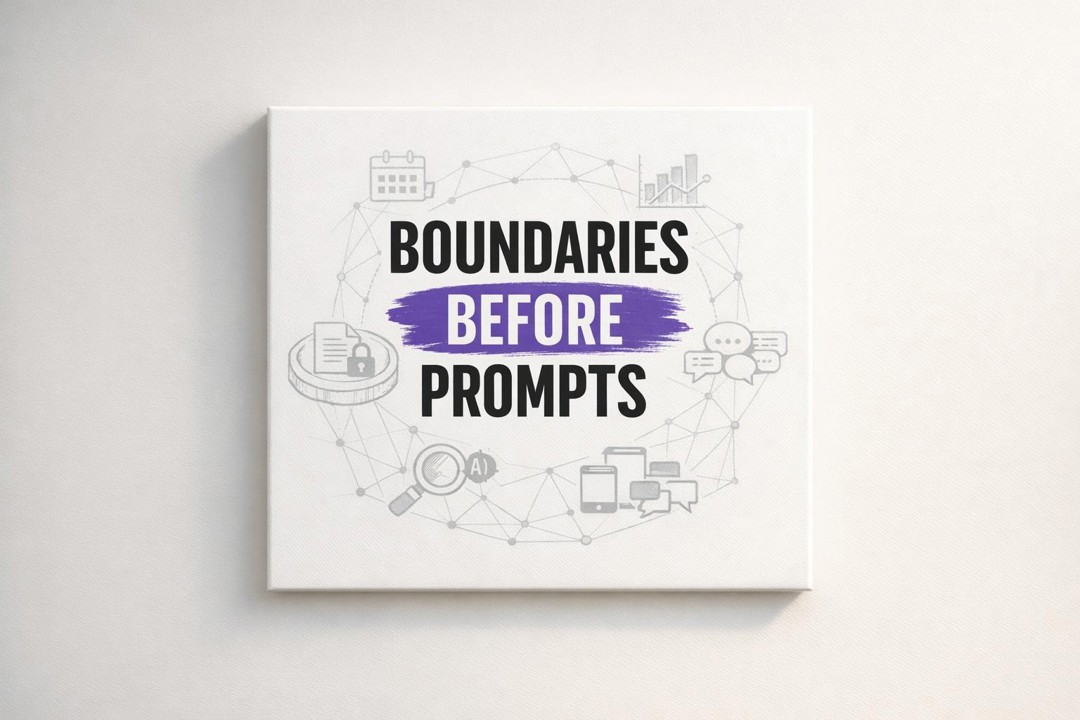
Privacy diligence is not a compliance flex. It is an authority move. Trust is a visibility multiplier, and one mishandled document can quietly erase the hidden compounding effect of consistent publishing.
This playbook follows a Tactical Playbook structure: set clear boundaries for what enters the tool, enforce redaction defaults, pressure-test vendors against real failure modes, request evidence, then lock the whole thing into an SOP that survives busy weeks.
Most privacy mistakes happen before a vendor is even chosen. The real decision is not “Which AI tool?”, it is “Which information is allowed to touch external systems?”. Without that boundary, every prompt becomes improvisation.
A fast, workable classification uses three buckets. Public information is anything already published, such as website copy, public posts, public talks, and press mentions. Proprietary information is internal strategy and operating detail, such as drafts, roadmaps, pricing experiments, customer lists, partner terms, and internal analytics. Regulated or sensitive information is anything tied to a person or a protected category, such as health details, payment information, government IDs, passwords, private messages, legal documents, or confidential client notes.
This classification is the non-negotiable foundation. Public data can usually be used freely. Proprietary data demands boundaries and vendor clarity. Regulated or sensitive data should be treated as “do not paste” unless there is a formal, verified pathway and a strong operational reason.
A useful mental model is “prompt = export.” The moment text is pasted into an AI tool, it has left the controlled environment where it was created. Whether it stays contained depends on policies, architecture, and access controls that are rarely visible from the marketing page. Systems start here, not in the settings menu.
Redaction rules should remove temptation, not just reduce risk
Redaction is not about paranoia. It is about designing a workflow that stays safe on rushed days.
A strong redaction rule is specific enough to follow automatically. “Remove sensitive info” fails because it requires judgment every time. Better rules sound like operating instructions, the kind that still work when attention is split.
A reliable default is simple: anything in the regulated or sensitive bucket does not get pasted, summarized, or paraphrased into third-party tools. Proprietary material can be used, but only after stripping identifiers and converting specifics into abstractions.
In practice, that means replacing client names with roles, replacing exact numbers with ranges, and removing unique markers that could identify a person or a business. “$83,420 MRR from 312 customers in a niche community” becomes “mid five-figures monthly revenue from a few hundred customers.” The strategic point stays intact, the fingerprint disappears.
The non-obvious risk is not only data leakage. It is voice leakage. The same raw material that makes marketing effective, such as messaging frameworks, positioning language, signature narratives, is also the material competitors would love to reverse engineer. Inkflare’s stance is simple: strong privacy practices ensure user data and brand voice are secure and never resold or reused.
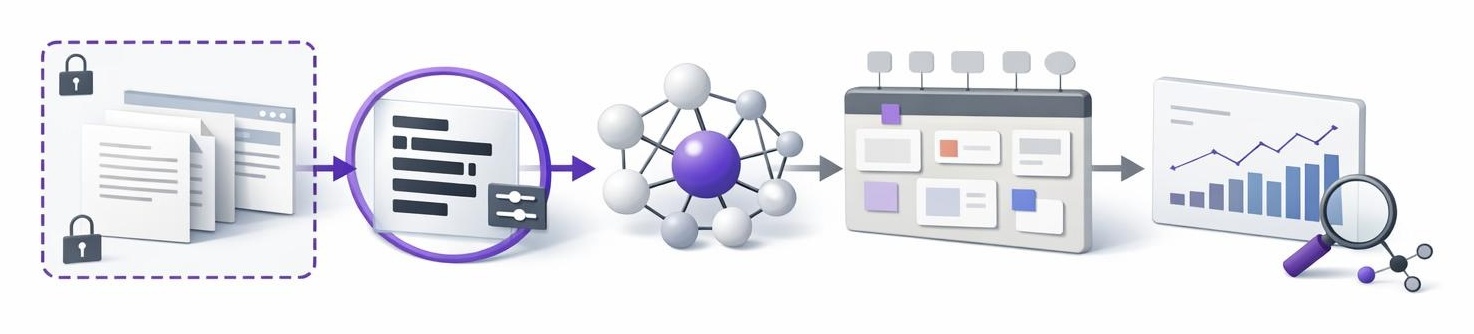
Vendor questions should map to failure modes, not marketing claims
Vendor pages talk about features. Due diligence must talk about failure modes. The right questions are the ones that predict what happens when something goes wrong, not what happens when everything works.
Keep the interrogation tight and operational. The goal is not to win a debate, it is to learn where the boundaries are, because boundaries are what make speed safe.
Start with training use. Ask whether customer inputs or outputs are used to train models, improve services, or build datasets, and whether that behavior is opt-in or opt-out. If the answer is vague, treat it like a warning label written in invisible ink.
Then press on retention and deletion. How long is customer content retained by default, can retention be configured, and what does deletion actually mean across backups and logs? “Deleted” can mean “not visible in the UI,” which is not the same as “gone.”
Next, security controls. Confirm encryption in transit and at rest, who can access customer data internally, and what least-privilege enforcement exists. A tool can be marketed to solo operators and still be operated like a shared office key under the mat.
Finally, incident response and subprocessors. Ask for the breach notification timeline and escalation process, and request a current list of subprocessors, where data is processed, and how changes are communicated. When more vendors touch the data, the risk surface grows, even if each vendor is competent.
Notice what is not being asked: “Are you secure?”. Every vendor says yes. Specific questions force specific answers, and vague answers are themselves an answer. This is what everyone gets wrong, trust is assumed, then borrowed time gets spent rebuilding it.
Artifacts turn trust into evidence and protect compounding authority
Due diligence without artifacts is just optimism with better vocabulary.
Two items do most of the heavy lifting.
A SOC 2 report (or equivalent) is not a magical shield, but it signals that controls exist, that they were audited, and that the vendor has a mature security posture. A vendor that cannot discuss security controls at all is not “early-stage,” it is under-instrumented.
A Data Processing Agreement (DPA) clarifies roles, responsibilities, and deletion expectations. It also tends to reveal how seriously a vendor treats data boundaries.
If artifacts are unavailable, ask what exists instead. Some smaller vendors can provide a security overview, encryption details, retention policies, and a subprocessor list, even if they are not audited yet. The point is to reduce unknowns before sensitive workflows are built on top.
This is where privacy connects directly to visibility. Authority is a long game. Long games require risk management. A breach is not only a legal and financial event, it is a narrative event. It changes how prospects interpret future content, future emails, and future promises, and that narrative drag is the opposite of compounding.
Internal SOPs make privacy consistent when founder energy is not
The best privacy posture is one that survives fatigue.
An internal SOP does not need to be a binder. It needs to be a short, repeatable set of defaults that makes consistency beat intensity, because most damage happens in the messy middle, not in the carefully planned moments.
Start with least privilege. Only the accounts that must access sensitive work should access it, and shared logins should be treated as an anti-pattern. One compromised password should not become a company-wide event.
Then create a document vault habit. Keep originals and sensitive sources in a controlled storage system, and treat AI tools as processing layers, not long-term archives. This reduces the sprawl of copies across platforms and makes “where did that file go?” a solvable question.
Finally, set a review cadence. Tools change policies, add subprocessors, and evolve retention settings. A quarterly check is usually enough for small teams, and it turns privacy diligence into routine maintenance instead of a post-incident scramble.
To make the vendor conversation effortless, use a copy-paste email that reads like an operator, not a hobbyist.
Copy-paste vendor email script
text
Subject: Privacy and security questions before adopting [Tool Name]
Hi [Vendor Team],
[Business Name] is evaluating [Tool Name] for AI-assisted marketing workflows. Before adoption, please confirm: whether customer inputs/outputs are used to train models or improve services (and whether that is opt-in/opt-out), the default retention period for customer content (and whether it is configurable), what deletion covers (including backups/logs and timelines), whether data is encrypted in transit and at rest, what internal access controls and least-privilege practices exist, your incident/breach notification timeline and escalation process, and a current list of subprocessors (roles and where data is processed).
If available, please share a SOC 2 report (or equivalent) and your DPA.
Thanks,
[Name]
[Role]
[Business Name]
Strong privacy does not slow down marketing. It prevents rework, protects trust, and keeps brand voice from becoming collateral damage. The real question is not whether AI belongs in the workflow. It is whether the workflow is engineered to protect what makes the business valuable.
What would change in the next 90 days if every tool decision was treated like an authority decision, not just a productivity decision?