Your “About Us” Page Isn’t Your First Impression Anymore, Your Feed Is
Your feed isn’t “content.” It’s your reputation archive.
“The feed is your permanence. Your truth record.”
If that feels intense, good, it’s also freeing. Because it explains why you can have a gorgeous website, a thoughtful About page, a real product, and still feel like strangers don’t trust you yet.
They’re not waiting to read your story.
They’re watching your pattern.
People don’t learn through pages anymore, they learn through streams
“A page is a room. A feed is a river.”
A room has a door. A river doesn’t.
Your audience enters the river with no map. They see whatever the algorithm shows them, a snippet of your story, a post about your mission, a carousel explaining a concept, a clip of your founder speaking, a customer testimonial buried between a meme and a trending reel.
And their understanding of you forms through “a constellation of micro-moments” over time, not one polished paragraph.
Here’s the line most brands need to tattoo on their marketing brain:
“You aren’t judged by a page. You’re judged by a pattern.”
Your About page isn’t dead, it’s just not the first stop
The About page still matters. It’s just not where trust starts.
“Your ‘About’ Page Isn’t Dead, but it’s no longer first impression.”
Today it’s “supporting documentation.”
The first impression happens where people can observe you in motion, not where you describe yourself once and hope they believe it.
The feed is now your public ledger (and people check it like one)
The shift is simple and brutal:
“The Feed Is Now Your Public Ledger.”
That means your content history becomes a living record of who you are. And buyers do not just check if you’re “smart.” They check if you’re stable. If you’re consistent. If you’re real.
They scroll and look for signals like:
- how often you show up
- what tone you use
- how you treat customers
- how you teach
- what you emphasize
- what you repeat
- what you avoid
- what you stand for
- what you know
This is why “random posting” quietly kills trust. Not because any one post is bad, but because the ledger looks messy.
What your feed must prove (or people feel uneasy)
A trust-building feed doesn’t scream. It proves.
It turns content into evidence.
1) Stability, because silence creates anxiety
When a brand goes quiet, people may never say it out loud, but they feel it:
- “Are they still active?”
- “Did something happen?”
- “Are they stable?”
- “Should I trust them with my money?”
That’s not “overthinking.” It’s human.
And it’s why Inkflare cares so much about consistent presence. Daily content isn’t just reach, it’s emotional stability.
2) Competence, shown without ego
In the river of a feed, “one video becomes proof of competence.”
Not a claim. Not “we’re experts.” Proof.
But competence alone isn’t enough anymore. Modern audiences resist forced authority. They reject “superiority” and “unearned confidence,” and gravitate toward transparency and sincerity.
That’s why the most trustworthy posture isn’t guru energy. It’s guide energy.
“You become a guide, not a guru.”
And a guide doesn’t preach. A guide teaches through stories, lessons, and lived experience, with “humility with authority, clarity with empathy, and expertise with humanity.”
3) Values, because consistency reveals what you actually care about
This is where most brands accidentally lie.
Not with words, with patterns.
“People don’t trust what a brand claims to care about. They trust what the brand consistently talks about.”
When your feed repeats your values through multiple angles, your audience stops treating it as marketing.
They treat it as truth.
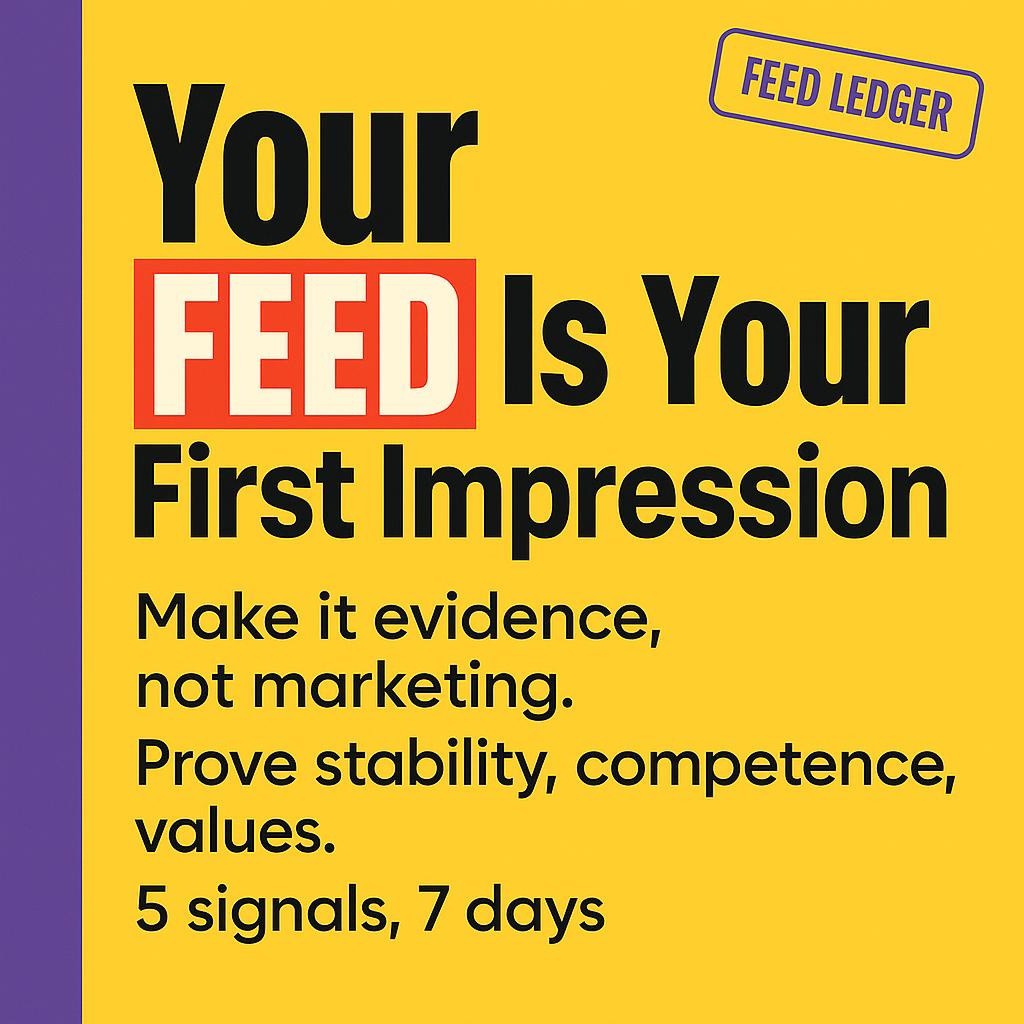
“Your feed becomes proof. Not marketing. Evidence.”
Perfection doesn’t build trust, predictability does (and this should calm you down)
If you’ve been waiting to “get it right” before you show up again, you’re not alone. Most founders feel that pressure.
But here’s the rule that changes everything:
“Perfection doesn’t build trust. Predictability does.”
Trust has two requirements:
- Competence, you know what you’re doing.
- Reliability, you do it consistently.
“People don’t trust those who ‘can.’ They trust those who ‘do.’”
This is why the brands that win long-term aren’t built on random spikes. They’re built on the slow burn, steady presence, clear voice, repeated interactions, and emotional resonance.
Ritual is how you build a feed people return to
Consistency alone is not the full goal. The goal is consistency with meaning.
“Posting daily with recognizable cadence, tone, and thematic throughlines is ritual.”
Ritual creates emotional safety. It reduces uncertainty. It makes your brand feel alive.
And it kills a hidden enemy: decision fatigue, for you and your audience.
If you want simple examples of what “ritual” looks like in the real world, the book calls out identity cues like:
- “Taco Tuesday”
- “Monday Motivation”
- “Founders Friday”
These aren’t gimmicks. They’re patterns people recognize and emotionally invest in.
The 5-signal checklist: what your feed is communicating right now
If your feed is your public ledger, audit it like one. Here are five signals your audience is already scanning for.
1) Tone
Do you feel grounded and human, or like “safe professionalism” and committee-speak?
2) Frequency
Can someone scroll and see a steady presence, or do they feel gaps, drops, and restarts?
3) Beliefs
Is your worldview obvious? Can people tell “what you stand for” and what you refuse to do?
4) Teaching
Are you helping people learn in ways they can absorb, or are you just posting updates about you?
5) Customer empathy
Does your content reflect your audience’s inner world, or does it read like feature lists and marketing jargon?
The hard truth: if these signals are weak, your About page can’t compensate. It can only explain after trust has already started.
If you’ve been inconsistent, here’s why (and why it’s not a character flaw)
The book names a cycle almost every founder has lived:
- Creative burst, you post, you’re excited
- Operational overload, you disappear
- Guilt and pressure, you force a few posts
- Freeze mode, you stop again
“This isn’t laziness. This is biology.”
And it creates what Inkflare calls the thermostat problem: your brand heats up, cools down, panics, burns out, then disappears.
Your audience feels that temperature shift. They don’t translate it into “posting strategy.” They translate it into trust.
The simplest restart: stop performing, start showing up as a guide
The best part of this entire worldview is the relief.
You don’t need to become a marketing genius founder. You need infrastructure that keeps your voice alive when you’re busy building the business.
You don’t need to pretend. You don’t need to craft every sentence perfectly.
You need a system that captures your truth and expresses it consistently, in rhythm, with care.
That’s what we built Inkflare to do: maintain daily presence, reinforce your worldview, keep your brand warm, and turn your content into a steady pattern people trust.
Because the brands people buy from are rarely the loudest.
They’re the ones that feel familiar.
So here’s the real question your feed answers every day:
When someone meets your brand in the river, do they feel a pulse, or do they feel a pause?