
Predictability Builds Trust: No-Burnout Cadence for Founders
Perfection gets you admired, predictability gets you trusted, and trust is what keeps people coming back when they’re ready to buy.

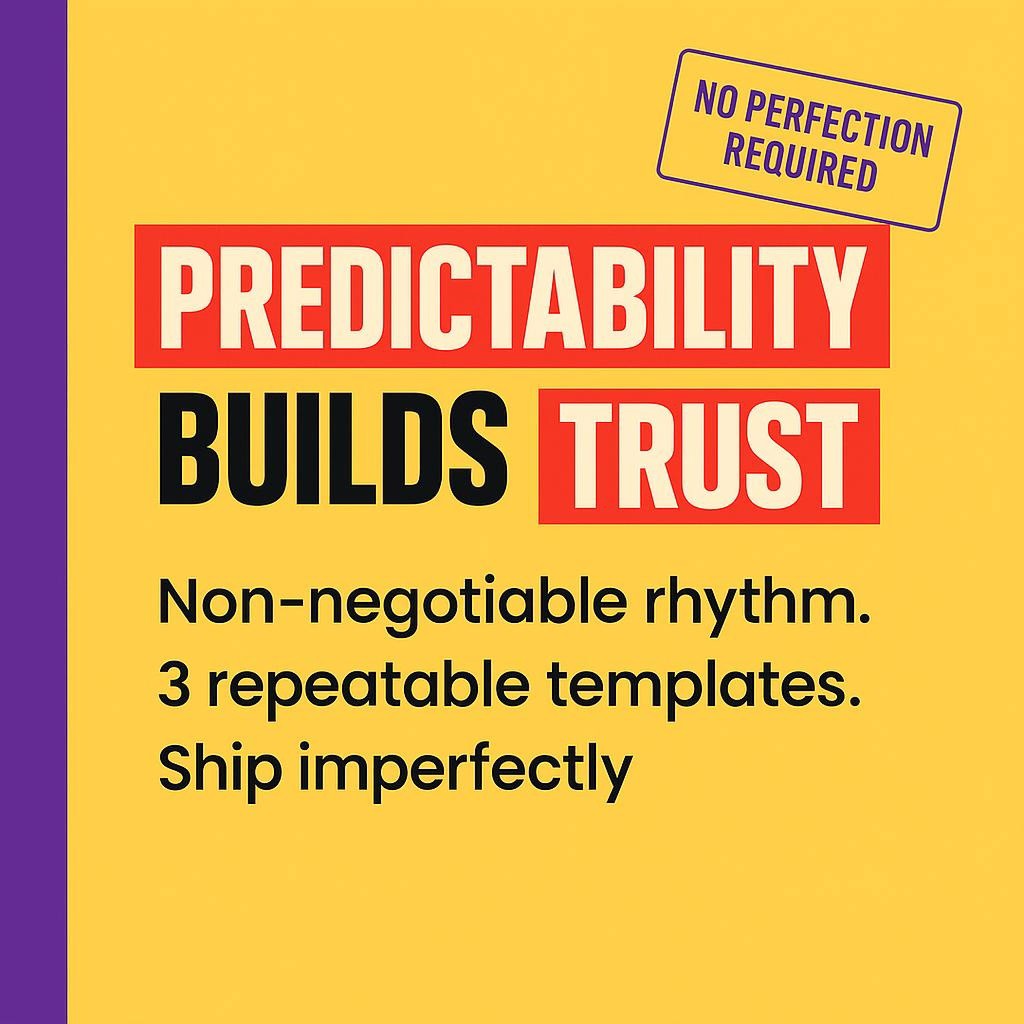
Perfection gets you admired, predictability gets you trusted, and trust is what keeps people coming back when they’re ready to buy.
Predictability Beats Perfection: The Quiet Trust-Builder Hiding in Plain Sight
You’ve seen this pattern (maybe you’ve lived it): you put out something polished, sharp, “finally worthy,” then the week gets heavy. Customers. Product. Life. The posting stops. Not because you don’t care, but because content starts to feel like a performance you have to nail.
Here’s the line we build everything around at Inkflare, because it’s true and it’s freeing: “Perfection doesn’t build trust. Predictability does.”
Perfection looks impressive. Predictability feels safe.
And safety is what trust is made of.
That’s why this hits so hard: “Perfect content may wow someone once. Predictable content warms someone forever.”
Warming someone forever doesn’t mean you entertain them nonstop. It means your presence becomes familiar. It becomes steady. It becomes the thing they can count on in a chaotic feed.
Over time, your audience stops thinking, “Is this good?” and starts thinking, “This is them.”
Most founders think consistency is about reach, impressions, and conversions.
But there’s an invisible return most brands ignore, and it’s the real reason daily presence wins: emotional stability.
When a brand goes quiet, people may not comment, but their brain starts asking questions:
Human beings crave consistency. It signals safety, reliability, competence, and maturity.
And the wild part is this, the anxiety isn’t only on their side. Founders carry their own quiet pressure:
That “should” energy drains you. It turns content into guilt, then avoidance, then silence.
Predictability flips the emotional math. Your audience relaxes because your brand becomes emotionally steady, and you breathe because the daily pressure disappears.
Consistency is showing up. Ritual is showing up in a way people can recognize.
This is the deeper move: “Customers don’t bond with randomness.” They bond with:
That’s why the simple idea of a recurring series works. It’s not a gimmick. It’s identity.
Think of the examples that already prove the point: “Taco Tuesday,” “Monday Motivation,” “Founders Friday,” seasonal drops, playoff seasons, even the way fans look for “Easter eggs.” These aren’t just tactics. They’re identity cues. They let people say, “This is part of my routine.”
A ritual gives your brand a heartbeat. When your audience can feel that rhythm, they show up for it, even when they’re not consciously thinking about it.
If you want a deeper companion read on keeping your presence warm and steady without burning out, this connects directly: Marketing Thermostat: Stay Warm Without Burnout Daily
A lot of creators blame themselves when a post flops: “My content isn’t good enough.”
But there’s a harder, calmer truth: most brands are talking to an empty room.
Content often fails for a structural reason, not a talent reason. Platforms have invisible prerequisites. They look for signals that you are a brand worth introducing to more people.
If those signals aren’t present, you can drop a masterpiece and the algorithm whispers, “Cute. Anyway, next.”
This is why Inkflare doesn’t just help creators write. We help prepare the room through daily, multi-format posting, cross-platform distribution, psychological consistency, rituals that build familiarity, and patterns that algorithms learn to trust.
Because a warmed room makes decent content powerful, and a thriving room makes great content unstoppable.
If you’re feeling unseen and want a clear structure that builds momentum fast, read this next: Empty Room Problem: 7-Day Plan to Make Content Seen
Trust has two requirements:
Most brands focus on competence. They polish, tweak, rewrite, and delay.
But reliability is the quieter trust-builder, and it compounds.
This line is worth printing out: people don’t trust those who “can.” They trust those who “do.”
When you publish consistently, your tone becomes familiar, your worldview becomes clear, your style becomes recognizable, your presence becomes part of people’s daily rhythm.
That’s how a brand becomes a reference point, not a random account in the feed.
You don’t need to turn into a “personal brand performer.” Your audience isn’t looking for a celebrity. They’re looking for a guide.
And here’s the relief: “You don’t need perfect content to win.” You need:
So let’s make this practical.
The goal is not posting when inspiration randomly strikes.
The goal is stable presence, the kind that still happens when you’re busy, tired, traveling, parenting, or deep in real work.
A rhythm is how you stop starting over.
Ritual reduces uncertainty. It creates emotional safety.
Choose a small set of recurring patterns your audience can learn, like weekly segments and predictable formats. Build recognition through repetition, signature phrases, and recurring themes.
This also kills decision fatigue, because you stop asking every day, “What should we post?”
Performance creates distance. Transparency creates intimacy.
A guide can be human, imperfect, curious, honest. A guide can explore. A guide can admit mistakes and turn them into lessons.
That’s what modern audiences trust. Not hype, not loud certainty, not forced authority.
When your voice becomes predictable, it becomes a stable presence in people’s lives, like a lighthouse. And when people feel that steady presence long enough, they don’t need to be convinced. They already know who you are.
Inkflare exists to turn your mission into daily, predictable presence, with human warmth and machine-level consistency.
We don’t chase hype. We build trust.
We don’t build chaos. We build rhythm.
Because your brand isn’t just a product. It becomes a place. And people return to places that feel grounded, wise, human, uplifting, and mission-driven.
So here’s the question to sit with (and it’s a good one):
If someone discovered you today, would your content feel like a one-time performance, or like a steady place they can come back to tomorrow?
Published January 24, 2026
Your expertise, published
Inkflare turns what you already know into ready-to-approve posts across the platforms you care about. Review in minutes. Approve, tweak, or skip, and no content scramble.
Start your free trial