Tone Isn’t Voice: A 9-Question “Unmistakable Brand Voice” Audit (So You Stop Sounding Like Everyone Else)
If people can’t recognize you when your logo is nowhere in sight, you don’t have a brand voice yet.
Most founders don’t lose because their ideas are weak. They lose because their message shows up like a stranger every time.
It usually looks like this:
Day 1: “I’m excited to post.”
Day 10: “Why is no one engaging?”
Day 30: “Maybe our business isn’t interesting enough.”
Day 60: Silence.
Day 90: A random post saying, “We’re back!” (You’re not.)
That spiral isn’t laziness. It’s what happens when your content doesn’t feel like you, and it doesn’t build a place people want to return to.
So let’s fix the root problem.
Tone vs. voice: the one sentence most brands miss
Here’s the difference that changes everything:
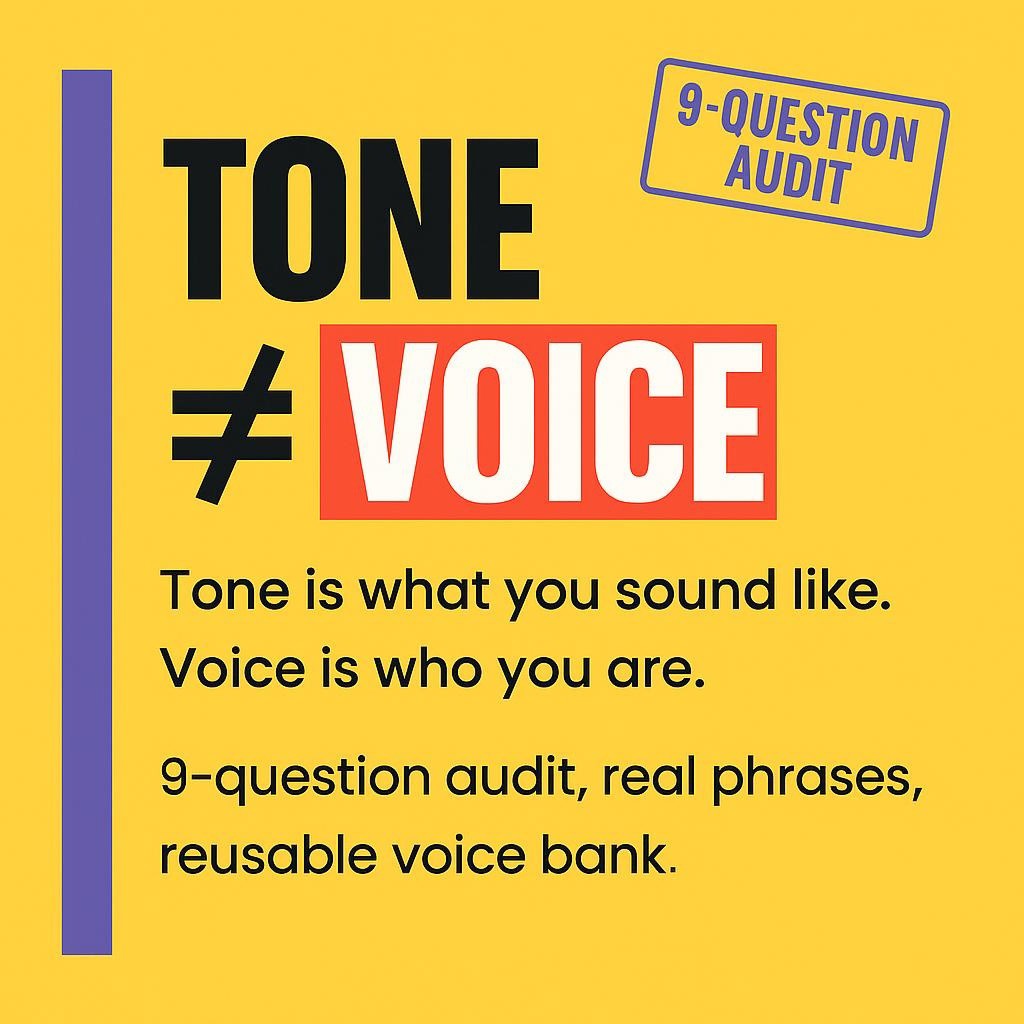
"Tone is what you sound like. Voice is who you are."
Tone is a mood. Friendly. Bold. Casual. Authoritative.
Voice is a personality. Consistent, layered, recognizable across time.
When brands only pick tone words, their content still reads like everyone else’s. Because tone is surface. Voice is identity expressed through language.
Why “tone words” fail, even when they’re true
A lot of brands do this:
- “Empathetic.”
- “Professional.”
- “Confident.”
- “Playful.”
Then they wonder why they still sound like templates.
Because most of the market is stuck in “safe professionalism.” Brands flatten their personality. They try to please everybody. They start speaking like committees instead of humans.
And the result is brutal: invisible, replaceable, forgettable.
Your voice comes from depth, not clever wording
There’s an uncomfortable truth here:
Most companies don’t know what they believe deeply enough to sound unique. Their content stays safe, surface-level, predictable, algorithm-chasing, and buzzword-heavy.
Brands without depth cannot develop voice.
A strong voice comes from what you actually believe:
- your mission
- your contrarian beliefs
- your philosophical backbone
- your lived experience
- your emotional truth
- your industry insights
- your personal stories
- your internal frameworks
This is why voice is not something you “create” on demand. It’s something you discover, then express consistently.
"Voice isn’t created, it’s uncovered."
What makes a brand voice recognizable (even without your logo)
A real voice has more than a tone. It has:
- tone, texture, rhythm
- worldview
- emotional nuance
- psychological depth
That’s also why a strong voice can be subtly contrarian. It doesn’t need to shout. It needs to be clear. It sounds like:
- “Here’s the truth as we see it.”
- “Here’s what actually matters.”
- “Here’s what people get wrong.”
- “Here’s what we stand for.”
- “Here’s what we don’t do.”
- “Here’s the nuance no one talks about.”
That kind of clarity creates memory. Memory is when people think:
- “This sounds like them.”
- “I knew this was their content before I saw the name.”
That’s the real goal. Not attention, recognition.
The voice map most brands skip
If your brand voice feels fuzzy, it’s usually because you’re trying to write without mapping the deeper parts of identity.
A clear voice gets built by mapping:
- personal philosophy
- leadership style
- mission energy
- values
- worldview
- emotional cadence
- psychological positioning
- founder personality
- linguistic preferences
- identity markers
Once these are clear, your content stops being random posts. It becomes identity in motion.
Now let’s make this practical.
The 9-question “Unmistakable Brand Voice” audit
These aren’t “marketing prompts.” They’re the questions that expose whether you’re speaking from conviction and identity, or just publishing noise.
How to do it (simple rules)
- Answer fast. Don’t polish.
- Use your real words, not your “brand voice” voice.
- If a question makes you uncomfortable, don’t skip it. That’s usually the point.
1) Philosophy: what you stand for (not what you sell)
When a brand has no philosophical backbone, every post feels like a performance. With philosophy, every post becomes an expression.
Answer these:
- “What should I talk about today?”
- “What do I even stand for?”
- “Do people understand what we’re building?”
- “Is there a deeper story I’m not expressing?”
If you feel resistance here, that’s normal. These questions often show up when a founder is tired, overwhelmed, or unsure how to translate what they believe into daily language.
2) Leadership: how you lead without turning into a guru
People want leadership, but they resist forced authority. They reject condescension, inflated claims, superiority, and unearned confidence. They gravitate toward transparency, sincerity, and expertise grounded in experience.
Answer these:
- “So how do you lead without preaching?”
- “How do you show knowledge without ego?”
- “How do you build trust without building a pedestal?”
Here’s the mindset shift:
"You become a guide, not a guru."
Guides don’t demand followers. They create leaders. They speak with humility and authority at the same time.
3) Rhythm: how your voice becomes predictable (and trusted)
Voice becomes valuable when it becomes predictable. Not perfect. Predictable.
Answer these:
- “What should we post?”
- “Does this align with our brand?”
If those questions cause instant decision fatigue, your team will default to randomness. And randomness is the enemy of recognition.
After the audit: what to extract (this is where voice becomes real)
You’re not looking for “better writing.” You’re looking for patterns.
1) Collect your real phrases (the ones you’d actually say)
Your voice is already inside you, in how you think, speak, teach, joke, question, reflect, and lead.
So pull out the raw material:
- your real phrases
- your natural writing style
- your thought patterns
- your emotional register
- your rhythm and cadence
This is the language that feels alive, grounded, human, honest, textured, rhythmic.
2) Find your conviction lines (what you stand for, and what you don’t)
Your strongest posts usually come from conviction, not cleverness.
Look back at your answers and underline the sentences that sound like:
- “Here’s what actually matters.”
- “Here’s what people get wrong.”
- “Here’s what we don’t do.”
This is how a worldview becomes clear.
And a clear worldview becomes a filter. It attracts the right people, and repels the wrong ones. That’s not a bug. That’s loyalty.
3) Name the rhythms your audience can feel
People don’t bond with randomness. They bond with rhythm.
"Customers don’t bond with randomness. They bond with: Weekly segments, predictable formats, recurring characters or themes, signature phrases, signature visuals, patterns they can anticipate and emotionally invest in."
That rhythm becomes a heartbeat.
When your audience can feel it, they return. Even if they never comment. Even if they never like. Silent followers are still watching, and they often become the fastest buyers when the time is right.
The hidden win: predictability beats perfection
Most founders think trust comes from polish. It doesn’t.
Trust has two requirements:
- Competence (you know what you’re doing)
- Reliability (you do it consistently)
Most brands try to prove competence. Very few prove reliability.
But people don’t trust those who “can.” They trust those who “do.”
And this is where content gets lighter, not heavier.
When your voice is aligned and consistent, you need less pushing, less pitching, less “marketing energy.” Your voice becomes an anchor, a home, a stable presence.
Where Inkflare fits (if you want this to scale without losing your humanity)
Inkflare was built for one job: keep your voice alive at scale, without sanding off what makes it human.
Not robotic output. Not generic “AI content.” Not a polished persona.
"We’re here to automate your humanity, your insights, your philosophy, your emotional intelligence, your mission."
That means capturing what’s already true in you, then expressing it consistently across formats and platforms, so your brand becomes familiar, warm, and recognizable over time.
Because voice isn’t a one-time exercise. It’s built through accumulated expression.
And when you finally have it, you stop chasing attention.
You build memory.
So here’s the question worth ending on, and it’s not a branding question, it’s an identity question:
If someone reads a paragraph of your content with the logo removed, do they recognize who you are, and do they recognize what you believe?