Tone Isn’t Voice: The Identity Mistake That Makes AI Content Feel Soulless
If your content sounds “professional” but people still forget you, you’re probably polishing tone while starving voice.
We see this all the time. A founder ships a smart product, opens an AI tool, and asks for a LinkedIn post. The result looks “right.” Clean. Polished. Safe.
And somehow it still feels like talking to an empty room.
That’s not because you lack ideas. It’s because you’re asking for a mood when what you need is a personality.
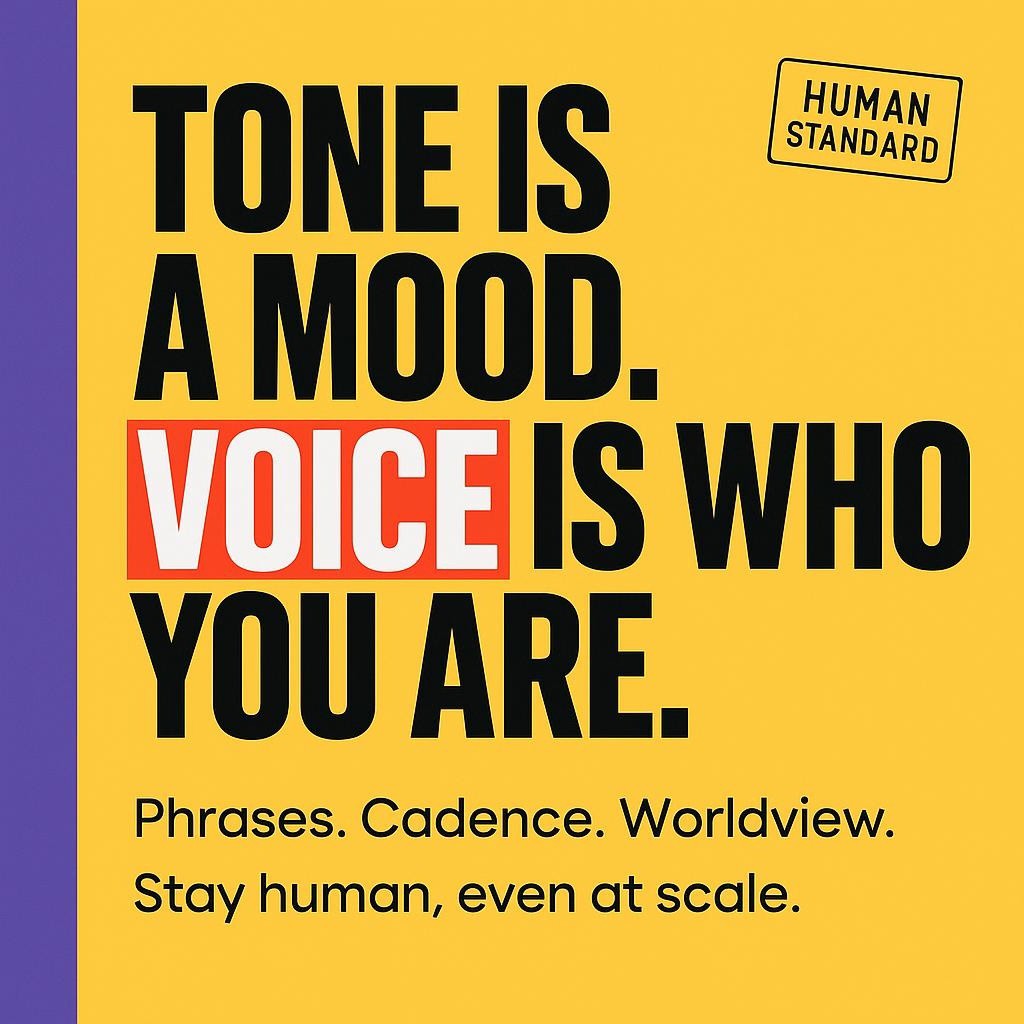
Here’s the distinction we build everything on at Inkflare: “Tone is what you sound like. Voice is who you are.”
Tone vs. Voice: One changes, one stays
Tone is a mood:
- friendly
- authoritative
- casual
- bold
Voice is a personality, something “consistent, layered, and recognizable across time.”
This is why tone guidelines don’t save AI content.
AI can mimic tone words easily. It can sound confident. It can sound empathetic. It can sound playful.
But without identity behind the words, the result becomes what it really is, “digital wallpaper.” Technically fine, emotionally forgettable.
And yes, your audience can feel the difference.
Why AI content feels soulless (and why it’s not AI’s fault)
There’s a reason so much AI output lands flat. The common failure isn’t grammar. It’s lifelessness.
Most AI content ends up:
- generic
- soulless
- overly polished
- emotionless
- predictable
But content with a real voice feels:
- alive
- grounded
- human
- honest
- textured
- rhythmic
- wise
- relatable
- emotionally resonant
So the fix is not “use less AI.”
The fix is to stop asking AI to invent your identity.
Because the real differentiator in a world full of AI content is still the same thing it’s always been: a human voice people recognize even when your logo is nowhere in sight.
The real problem: most brands confuse “tone words” for “voice”
Most brands do this backwards.
They pick a handful of tone words, like:
- “Empathetic.”
- “Professional.”
- “Confident.”
- “Playful.”
Then they wonder why they still sound like everyone else.
Because tone is not identity.
Voice is.
And voice isn’t just style. Voice has:
- tone
- texture
- rhythm
- worldview
- emotional nuance
- psychological depth
That’s why voice sticks.
A real voice makes people think: “This sounds like them.”
Why voice requires depth (and why shallow content can’t stand out)
Here’s the uncomfortable truth: brands without depth cannot develop voice.
When a company doesn’t know what it believes deeply enough to sound unique, content defaults to:
- safe statements
- surface-level messaging
- predictable ideas
- algorithm-chasing
- buzzword-heavy phrasing
It’s not offensive. It’s just invisible.
And it gets worse when you’re busy.
Because without depth, posting starts to feel like performance. You get stuck in the mental loop:
- What should I talk about today?
- What do I even stand for?
- Is there a deeper story I’m not expressing?
This is why we say: “Content without philosophy is just decoration.”
Great visuals, great formatting, great production value, none of it saves you if your message has no backbone.
Depth is what creates voice.
The hidden lever: voice is a belief system you can hear
A strong voice isn’t loud. It’s clear.
It doesn’t shout. It speaks with conviction.
You can hear it in phrases like:
- “Here’s the truth as we see it.”
- “Here’s what actually matters.”
- “Here’s what people get wrong.”
- “Here’s what we stand for.”
- “Here’s what we don’t do.”
- “Here’s the nuance no one talks about.”
That’s not “being edgy.” That’s being anchored.
This is the subtle contrarian edge great brands have. Not drama. Not hot takes. Just clarity.
And clarity is rare, which is why it’s memorable.
Voice isn’t created, it’s uncovered
Here’s the best part: you don’t need to manufacture a persona.
You don’t need to “act like a marketer.”
Because “voice isn’t created, it’s uncovered.”
It’s already inside the founder, in how they:
- think
- speak
- teach
- joke
- question
- reflect
- lead
At Inkflare, we don’t try to invent a voice for you. We extract what’s already true, then we systemize it so it stays consistent, even when you’re not the one writing the content.
Because you have a business to run.
What makes a voice recognizable (and how to stop sounding like a committee)
A recognizable voice is not one perfect post.
It’s accumulated expression.
It’s patterns that repeat:
- linguistic preferences
- emotional cadence
- rhythm and cadence
- worldview
- mission energy
- identity markers
- brand-specific metaphors
- narrative repetition
That last part matters more than people expect.
Most marketing tries to grab attention. A strong voice builds memory.
Memory is what creates the moment where someone says:
- “I knew this was their content before I saw the name.”
That’s the holy grail of organic marketing, and it comes from consistency, not fireworks.
Predictability beats perfection (this is where trust comes from)
Most founders chase polish. Perfect posts. Perfect captions. Perfect lighting. Perfect “authenticity.”
But “perfection doesn’t build trust. Predictability does.”
Your audience isn’t waiting for a masterpiece. They’re waiting for your presence.
When you disappear, even if no one says it out loud, it creates subtle tension:
- Are they still active?
- Are they stable?
- Should I trust them with my money?
Consistency signals safety, reliability, competence, maturity.
This is why your voice becomes powerful when it becomes predictable.
Ritual is how your voice becomes a “place” people return to
People don’t bond with randomness. They bond with rhythm.
That’s why ritual matters.
Ritual looks like:
- weekly segments
- predictable formats
- recurring characters or themes
- signature phrases
- patterns your audience can anticipate and emotionally invest in
A ritual gives your brand a heartbeat.
And when your audience can feel that rhythm, they show up for it, even when they’re not consciously aware it’s happening.
This is how a brand stops feeling like scattered posts and starts feeling like a world.
Because people don’t follow brands, they enter worlds.
And one of the clearest lines we live by is this: “Content without atmosphere is noise. Content with atmosphere is a home.”
How to build voice that stays human (even when you scale)
If you want your content to stay alive, these are the moves that matter.
1) Stop picking tone words and start naming identity
Ask yourself:
- What do we believe?
- What do we stand for?
- What do we refuse to do?
- What do people keep getting wrong?
- What nuance do we keep repeating because it matters?
A strong voice doesn’t try to please everybody. It speaks like a human, not a committee.
2) Capture your real phrases
Your voice is already in your language.
Pay attention to how you naturally speak when you’re:
- teaching
- explaining
- encouraging
- drawing boundaries
- telling the truth “as you see it”
Those phrases become signature cues your audience recognizes over time.
3) Repeat your worldview until it becomes familiar
This is where most founders get scared. They think repetition will bore people.
But “repetition does not bore people. Repetition teaches people.”
Each repeat can come through a new story, a new metaphor, a new emotional angle, a new format.
That’s how your message compounds without feeling redundant.
4) Show up like a guide, not a guru
Forced authority pushes people away.
Guide energy builds trust because it blends humility with clarity.
It sounds like:
- “Here’s what I’ve learned.”
- “Here’s what might help.”
- “Here’s what I’ve seen in the field.”
- “Here’s a perspective, use what resonates.”
That’s how you lead without preaching and show knowledge without ego.
Your content doesn’t need more polish, it needs more you
If you take one idea from this, let it be this:
Tone can make you sound good today. Voice makes you unforgettable over time.
So here’s the question worth sitting with before you publish your next piece:
When someone reads your words without your name attached, will it sound like a tone you selected, or a voice you actually live by?