
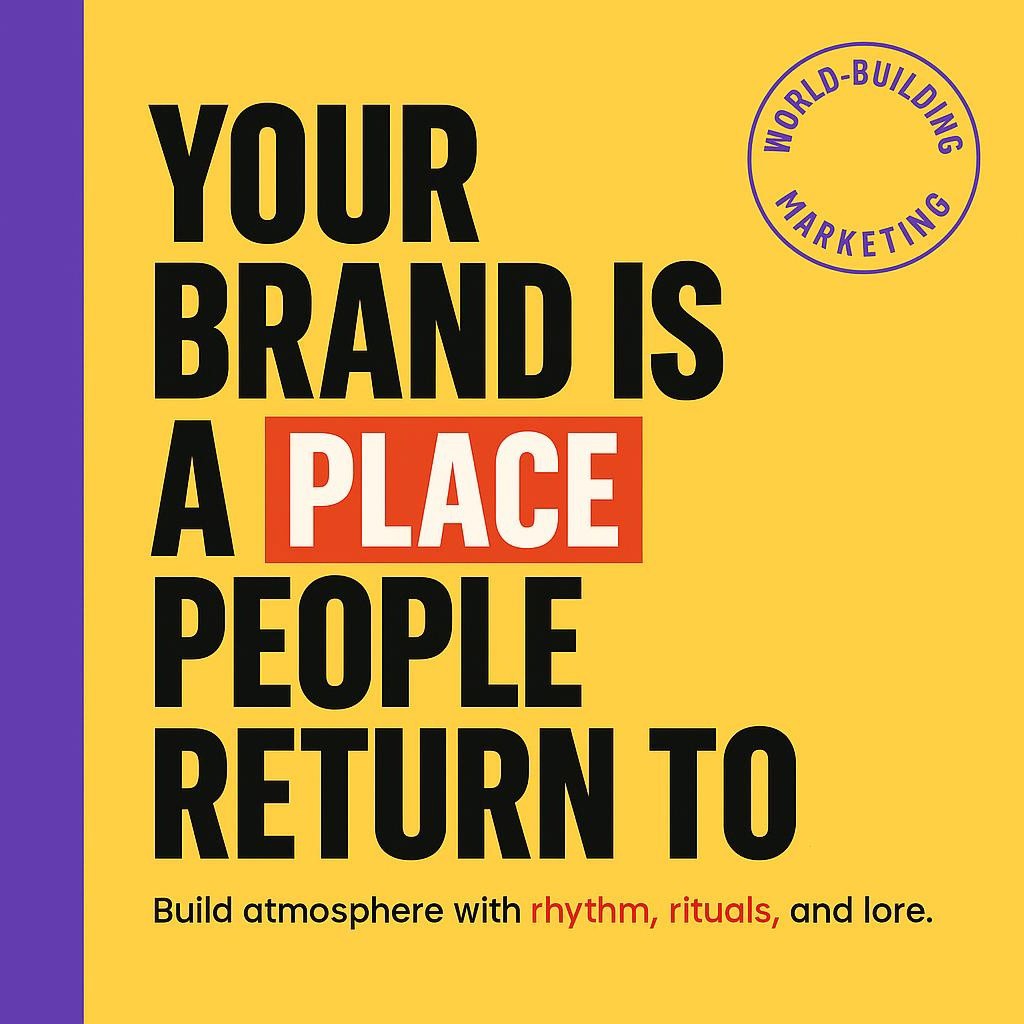
World-Building Marketing: Why Your Brand Isn’t a Product, It’s a Place People Return To
Most brands are talking to an empty room.
Not metaphorically. Literally.
It’s "the digital equivalent of walking onto a stage, delivering your best speech, and realizing the theater is pitch black because the audience never showed up."
And when that happens, founders do what founders always do.
They blame themselves.
"I guess my content isn’t good enough."
"I guess we need to post more."
"I guess we’re too late."
Here’s the truth, the problem is rarely your talent.
It’s the room.
Or more precisely, it’s that you never built one.
World-building marketing (the real kind) starts with one line
"Your Brand Is Not a Product. It’s a Place."
That sentence flips everything.
Because now the goal is not to publish more.
The goal is to build a place your audience wants to step into, stay in, and come back to.
And the question stops being “How do we post more?”
It becomes: "How do we create a world where our audience feels understood, supported, and inspired?"
People don’t follow brands, they enter worlds
We are wired for environments.
We don’t just consume information. We fall into “vibes, atmospheres, moods, patterns, rituals, emotional cues.”
So when your content feels random, it doesn’t feel like freedom.
It feels like static.
That’s why this line hits so hard:
"Content without atmosphere is noise. Content with atmosphere is a home."
When your brand becomes a home, people stop treating your posts like scroll-filler.
They start treating them like a place they trust.
Why “good content” still fails (and it’s not your fault)
A TikTok here. A LinkedIn post there. A blog once every few months.
No narrative thread. No emotional stability. No psychological continuity.
And then we wonder why no one remembers us.
Here’s the brutal reason:
"Humans remember universes. They forget fragments."
You do not need to become louder.
You need to become more recognizable.
More stable.
More like yourself, every time.
Your brand can become an emotional sanctuary (not a loud vendor)
People are tired. Overwhelmed. Pulled in ten directions.
So what do they want?
A place that feels grounded, wise, human, uplifting, inspiring, thoughtful, encouraging, mission-driven.
A place they can return to and feel clearer.
And it’s not built with “better hooks.”
It’s built with consistency in the parts most brands ignore:
- tone
- rhythm
- narrative flow
- message cohesion
- philosophical anchoring
Because when those stay steady, something big happens:
"You become a feeling, not just a logo."
The four parts of a brand-world that people return to
A real “brand-place” has structure. Like any place people love.
Not fancy structure. Human structure.
Here’s what makes it feel alive:
1) A philosophy (so you stop sounding like everyone else)
This is non-negotiable.
Because "Content Without Philosophy Is Just Decoration."
Without a philosophy, content turns into safe statements, recycled ideas, interchangeable posts.
In the book’s words: "It’s digital wallpaper."
With philosophy, your content stops trying to “say something.”
It starts saying something true.
And people can feel the difference.
2) A voice (so people know it’s you before they see your name)
A tone is a mood.
A voice is a personality.
The book says it plainly: "Tone is what you sound like. Voice is who you are."
Voice comes from depth. From what you believe. From what you stand for.
When your voice is strong, you don’t need to chase attention.
People remember you.
3) Rituals (so your brand has a heartbeat)
Ritual is not “posting a lot.”
Ritual is meaningful repetition.
"Posting daily with recognizable cadence, tone, and thematic throughlines is ritual."
And people bond with it because it’s familiar.
They bond with:
- weekly segments
- predictable formats
- recurring characters or themes
- signature phrases
- signature visuals
- patterns they can anticipate and emotionally invest in
"A ritual gives your brand a kind of heartbeat."
4) Lore (so your ideas become unforgettable)
Lore is the set of frameworks, beliefs, inside jokes, narratives, and themes that repeat.
This is how your brand becomes a universe instead of a pile of posts.
The secret is simple and timeless:
"Repetition does not bore people. Repetition teaches people."
And the payoff is bigger than likes:
"Authority isn’t declared, it’s repeated into existence."
A simple, honest blueprint to build your brand-world
No hype. No hustle cosplay.
Just the steps the book lays out, in plain language.
Step 1: Pull your philosophy out of your head and give it shape
If you built something because you saw a problem, felt a calling, or believed in a better version of your industry, you already have a philosophy.
The book even says it straight: "Congratulations, you have a philosophy."
Here’s how Inkflare works with that philosophy:
- Extract it
- Name it
- Structure it
- Reinforce it daily
This matters because: "Consistency = belief clarity. Belief clarity = brand memorability."
Step 2: Stop trying to be a marketer, start showing up as a guide
Most founders don’t actually want to perform online.
They want to teach. Help. Lead. Build.
So stop trying to “sound like marketing.”
Because most marketing fails when it’s written like marketing. It becomes “corporate wallpaper.”
The better move is guide energy.
And the book gives the whole answer in one line:
"You become a guide, not a guru."
Guides don’t shout.
Guides help people see themselves, and move forward.
Step 3: Make your content a mirror, not a stage
This is where trust gets built.
The book calls out the common mistake:
Most companies treat content like a stage and say: “Here’s what we do.”
But the deeper truth is:
"People don’t fall in love with brands that talk about themselves. People fall in love with brands that talk about them."
Their struggles. Their dreams. Their fears. Their questions.
And when someone feels seen, the book says, “their defenses dissolve.”
That is why “mirror content” turns followers into community, because it creates belonging.
Step 4: Warm the room with rhythm, not random bursts
Here’s the hard part nobody wants to hear:
Platforms don’t reward brilliance. They reward signals.
And signals come from rhythm.
The book puts it like this:
"An empty room makes great content invisible. A warmed room makes decent content powerful. A thriving room makes great content unstoppable."
That’s why Inkflare focuses on a steady presence, not big dramatic pushes.
The book says it clearly:
"Perfection doesn’t build trust. Predictability does."
And when your audience feels that predictability, something emotional happens.
They relax.
They trust.
They come back.
The simplest test: does your brand feel like a place?
Imagine someone scrolls through your last 30 posts.
Do they feel continuity, or confusion?
Do they sense a world, or a pile of fragments?
Because when your brand becomes a place, your content stops being “output.”
It becomes a relationship arc.
It becomes a steady voice people feel like they already know.
And that is the whole point.
So here’s the question worth sitting with:
If your brand were a place someone could walk into today, what would they feel, and would they want to come back tomorrow?