
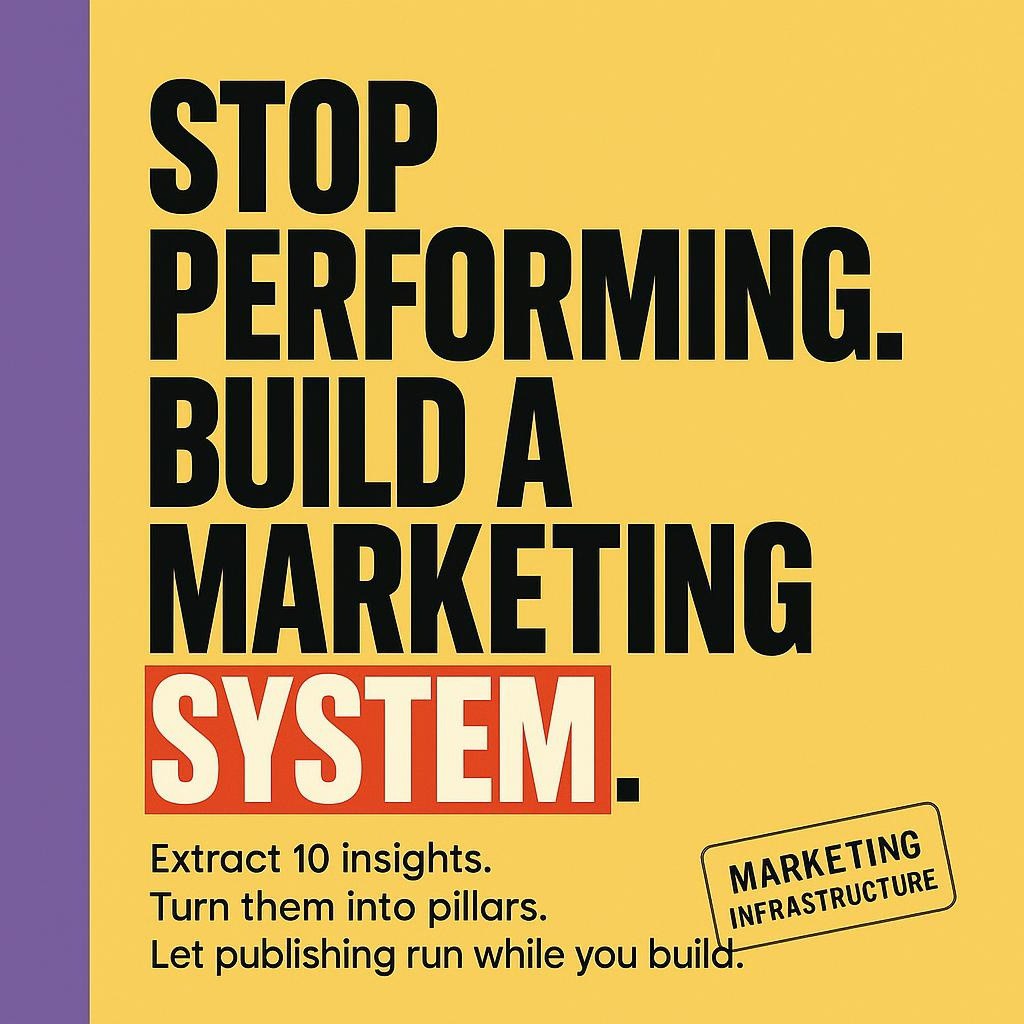
The End of the “Marketing Genius Founder”: Build Infrastructure So You Can Stop Performing
“This is not the era of the marketing genius founder.”
It’s the era of builders who refuse to burn out just to stay visible.
If you’re a founder, you already know the loop.
First comes the creative burst. You’re inspired. You post. Your brand heats up. Then reality hits, customers, product, hiring, life. You disappear. The brand cools off. Guilt shows up. You force a few posts. Then you freeze again.
That cycle is not laziness. “This isn’t laziness. This is biology.”
So let’s stop pretending the solution is “try harder.”
The real fix is structural. Build marketing infrastructure so your brand stays warm and human, even when you’re deep in real work.
The myth that drains founders, and makes brands feel fake
The old model quietly demands you become a performer.
Be charismatic. Be everywhere. Be the face.
Then wonder why you feel tired, resentful, and oddly disconnected from your own message.
Because performance creates distance. And your audience can feel it.
“Performance says: ‘Look at me.’ Transparency says: ‘I see you.’”
When your marketing becomes a stage, people don’t feel supported. They feel sold.
And when you don’t have a deeper backbone (a clear belief system under your content), it gets even worse. The author calls it out plainly:
“Without philosophy, every post feels like a performance. With philosophy, every post feels like an expression.”
That’s the shift. You don’t need more content. You need something true underneath it.
You don’t need to be a marketing genius, you need a system
Here’s the line we come back to constantly at Inkflare because it’s a relief sentence:
“You don’t need to be a marketing genius. You need an amplifier.”
Not more hustle. Not more hacks. Not a bigger personality.
A system that captures what’s real about your mission and expresses it consistently, across platforms, without you needing to “turn it on” every day.
Or said even more directly:
“Build a system that expresses your identity even when you’re sleeping, traveling, parenting, or solving actual business problems.”
That’s what infrastructure is. It’s marketing that doesn’t depend on your mood.
Stop chasing virality, build the slow burn that wins
The internet sells founders a fantasy: one viral hit and everything changes.
But the book calls this what it is:
“Virality isn’t a growth strategy. It’s a mood swing.”
And building a company on mood swings is a fast way to end up exhausted and invisible.
The alternative is calmer and stronger:
- Viral content gets viewers
- Slow burn content gets believers
The slow burn is a lantern. Steady. Reliable. Always lighting the way forward.
And it compounds like clockwork:
Day 1 = invisible
Day 30 = familiar
Day 100 = recognizable
Day 200 = trusted
Day 365 = inevitable
If you want a brand that lasts, that’s the path.
The golden nugget: your brand needs a philosophy, not just posts
A lot of founders feel “content fatigue” because they’re trying to create output without meaning.
The book doesn’t say you need prettier content. It says you need depth.
“Most companies flood the internet with content but remain strangely forgettable.”
Why? Because “they have no underlying philosophy.”
Without that backbone, your content collapses into safe statements and recycled advice. The author’s phrase is brutal and accurate:
“It’s digital wallpaper.”
But with philosophy, you stop scrambling. You stop asking:
- “What should I talk about today?”
- “What do I even stand for?”
- “Is there a deeper story I’m not expressing?”
And your marketing shifts from exhausting to natural.
Because now you’re not “coming up with content.” You’re expressing what you already believe.
How to build a marketing system from what’s already inside you
If you’re thinking, “I’m not a philosopher,” good. The book answers that too:
“We don’t ask you to ‘become a philosopher.’ You already are.”
If you built something because you saw a problem, felt a calling, or believed your industry could be better, you already have a worldview.
Here’s the practical build the book lays out, simple and repeatable:
Step 1: Extract what you believe
“Inkflare’s job is to extract the truth inside your mission.”
Start by capturing the raw material:
- your mission
- your lived experience
- what you think people get wrong
- what you refuse to do
- the lessons you had to learn the hard way
Step 2: Name it
The book is clear: “Giving shape to a worldview gives it power.”
When you name what you believe, you stop sounding like everyone else.
Step 3: Structure it into pillars
“We break your philosophy down into content pillars, sub-themes, emotional arcs, and teaching formats.”
This is where marketing becomes infrastructure. You’re no longer guessing.
Step 4: Reinforce it daily
“Everything your audience sees ties back to the same backbone.”
Not because repetition is boring, but because repetition teaches.
Be a guide, not a guru (this is how trust is built now)
A lot of founders think they need to sound bigger to be taken seriously. But people today are skeptical. They reject inflated claims and forced authority.
So the book offers a better role:
“You become a guide, not a guru.”
Gurus tell people what to think. Guides help people discover. Guides don’t posture. They teach with humility and real experience.
And the payoff is massive:
“Audiences want a guide because guides provide: clarity without ego, direction without control, insight without intimidation.”
If you’ve been stuck performing, try this question before you publish anything:
Are you trying to impress your audience, or are you trying to help them feel seen and steady?
Content that converts feels like a mirror, not a stage
Most companies treat content like a stage and announce features.
But the book flips it:
“Your audience shouldn’t feel like they’re watching your performance. They should feel like they’re looking into a mirror.”
People don’t bond with explanation. “They engage with recognition.”
That means your content should sound like your customer’s inner voice:
- “I’m tired.”
- “I’m overwhelmed.”
- “I’m behind.”
- “I can’t hire a full marketing team.”
- “I feel invisible online.”
- “I need to stay consistent, but I can’t keep up.”
That’s not manipulation. The book says it plainly:
“This is not manipulation. It’s connection.”
Ritual beats motivation (and kills decision fatigue)
If your content depends on motivation, it will disappear the moment life gets real.
That’s why the book goes hard on ritual.
“Ritual isn’t repetition, it’s meaningful repetition.”
And: “Decision fatigue is the enemy of visibility.”
A ritual gives your brand a heartbeat.
The book gives examples of what rituals look like:
- weekly segments
- predictable formats
- recurring themes
- signature phrases
- patterns people can anticipate and emotionally invest in
When your audience can feel that rhythm, they start to rely on you. And when they rely on you, they trust you.
The compounding effect: why your content finally starts working after you stop quitting
Founders understand compounding in finance, but almost no one respects it in content.
The book makes it simple:
“Content works like interest, it grows while you sleep.”
It also explains why one great post doesn’t change your business. Trust builds through layers:
Post 1 → “Interesting.”
Post 5 → “I like their style.”
Post 12 → “They’re consistent.”
Post 25 → “I’m learning from them.”
Post 40 → “I trust this brand.”
Post 60 → “I’m ready to act.”
Most founders never reach the later layers because they keep restarting.
Infrastructure removes that reset button.
The silent majority is watching (even when nobody clicks)
If you’ve ever posted something you cared about and heard nothing, you’re not alone.
But the book points out the hidden truth:
Your most important audience is often invisible.
“The silent followers… are often 80 to 95 percent of your actual audience.”
They don’t engage. They observe. They evaluate. They binge quietly. And when they’re ready, they buy.
That’s why consistency matters even when it feels like no one is listening.
Your feed is your reputation archive, build it on purpose
Founders still think of content as “posting.”
The book calls it something else:
“The feed is your permanence. Your truth record.”
People check:
- how often you show up
- what you repeat
- what you stand for
- how you teach
- what tone you carry
- whether your message feels stable
So here’s a cleaner question than “What should we post today?”
What do you want your truth record to say about you a year from now?
A final reminder from the Inkflare team
You’re not here to become a louder version of yourself. You’re here to endure, to stay visible, to keep the light on, to let people slowly understand what you’re building.
Or as the book says:
“You don’t need to perform.”
“You don’t need to pretend.”
“You just need a system that captures your truth, expresses it consistently, amplifies it intelligently, protects your authenticity.”
So let’s end with the only question that matters:
If your mission is real, why should it depend on your energy to be heard?