
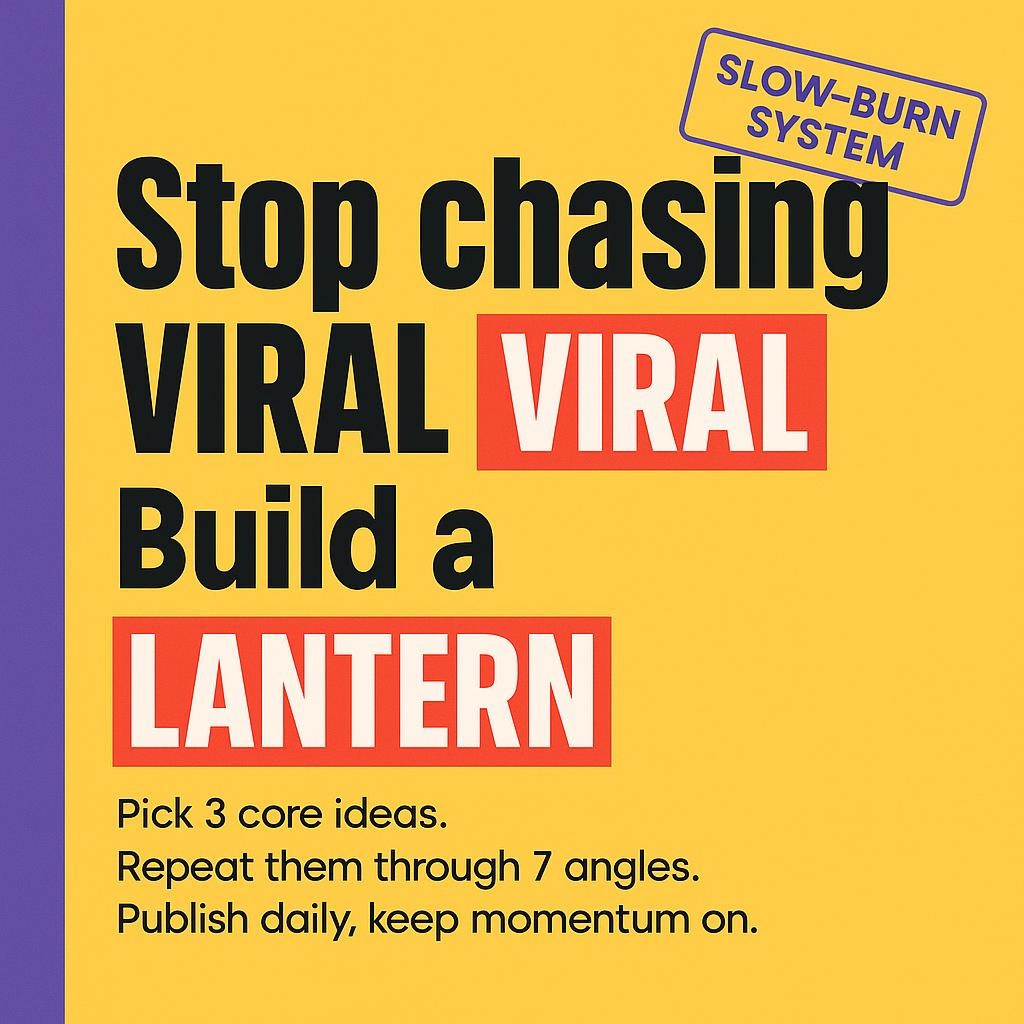
From Fireworks to Lanterns: The Slow-Burn Content Engine That Compounds While You Sleep
"Virality isn’t a growth strategy. It’s a mood swing."
If your marketing plan depends on mood swings, you already know how this story goes: a burst of posting, a burst of hope, then silence, guilt, and the slow fear that you’re becoming invisible.
We’ve watched this loop swallow smart founders, great coaches, and brilliant educators. Not because their work isn’t valuable, but because their visibility has no steady heat.
There’s a better way. It’s quieter. It’s not sexy. It works.
The moment most founders don’t admit: the refresh spiral
You open your phone to “check one thing.” Then you check again.
Likes. Comments. Shares. DMs.
It starts to feel like those numbers are proof your business is alive.
And when the numbers dip, your confidence dips with them.
The book calls this what it is: "building a business on mood swings is a fast way to end up exhausted, invisible, and emotionally depleted." The pain isn’t just marketing pain. It’s emotional pain.
The real trap is not that you want results.
The trap is the fantasy that one big hit will solve the whole marketing problem forever.
Fireworks vs. lanterns: why most content plans collapse
Here’s the clearest metaphor you’ll ever hear for modern content:
- "Virality is like fireworks: Spectacular, exciting, and completely useless for long-term illumination."
- "The slow burn is like a lantern: Steady, reliable, and always lighting the way forward."
Fireworks create a moment.
Lanterns create a path.
And the difference matters because it changes what you build in your audience:
- Viral content gets viewers.
- Slow-burn content gets believers.
Believers turn into customers, advocates, loyal supporters, and long-term partners. They stay. They refer. They trust.
At Inkflare, we’re not interested in “winning the week.” We’re here to build brands that become inevitable.
The real payoff of the slow burn: emotional peace
Most founders think the prize is growth. The book is aiming for something deeper first: emotional peace.
A slow-burn strategy gives you what most marketing hacks never will:
- You know what your brand stands for.
- You know what your voice sounds like.
- You know what you’re teaching.
- You know your audience is growing steadily.
- You know you’re not starting over every 90 days.
That last one is the killer.
Because most founders aren’t lazy. They’re overloaded.
The book names the cycle that steals your momentum:
- The Creative Burst
- Operational Overload
- Guilt + Pressure
- Freeze Mode
If you’ve lived that, you don’t need motivation. You need a system that holds steady when life gets real.
Content compounding: why daily visibility grows while you sleep
The book makes a blunt point: founders understand compounding in finance, but almost no one respects compounding in content.
Yet content behaves the same way when it’s done with structure.
Every piece of content has three kinds of value:
- Immediate Value (someone sees it today)
- Delayed Value (someone finds it months later)
- Compounding Value (someone sees multiple pieces over time and becomes ready to buy)
That last one is why content can feel “slow” at first. The compounding phase has not kicked in yet.
And the curve is not linear:
- 1 post → 0 outcome
- 10 posts → 1 outcome
- 30 posts → 5 outcomes
- 100 posts → 40 outcomes
- 250 posts → category voice
- 500 posts → authority
- 1000 posts → undeniable
This is why some brands feel “everywhere,” even when their content isn’t perfect. It’s not charisma. It’s not luck. It’s accumulated presence.
The golden nugget: authority is built by repetition, not novelty
Most creators fear repetition. They think repeating a message will make people tune out.
The book flips that belief:
"Repetition does not bore people. Repetition teaches people."
Then it lands the line that should change how you market forever:
"Authority isn’t declared, it’s repeated into existence."
Repetition works because you’re not repeating the same post. You’re repeating the same truth, through fresh expression.
The book gives clear ways to do that. Each time you share your core ideas, you can use:
- a new story
- a new metaphor
- a new example
- a new emotional angle
- a new platform
- a new format
Your message becomes recognizable. Your voice becomes familiar. Your brand becomes a reference point.
Why philosophy beats posting (and why “safe” content makes you invisible)
The book is ruthless here: content without philosophy becomes “digital wallpaper.”
It can look polished and still be forgettable.
A philosophy gives your content a backbone. It makes you stand for something, and standing for something builds loyalty.
It also removes the daily mental drag of, “What should I post today?”
With philosophy, content stops feeling like performance and starts feeling like expression.
This is why Inkflare doesn’t just help people “post more.” We help knowledge creators build a clear worldview that becomes the gravitational center of everything they publish.
Silent followers: the audience funding your future (without telling you)
The book points out the audience almost everyone ignores: the silent followers.
The lurkers. The watchers. The readers who never interact.
They might be 80 to 95 percent of your audience. They are often decision-makers, thinkers, and serious buyers.
They don’t want hype. They want stability. They want emotional maturity. They want a brand that feels human, wise, and steady.
And they convert through compounding.
One post won’t do it. Ten might not. But after weeks of consistent presence, they start thinking:
- “I already know this brand.”
- “Their worldview matches mine.”
- “They’re stable.”
- “I trust them.”
Predictability beats perfection (and it makes people feel safe)
The internet worships polish. But trust is built differently:
"Perfection doesn’t build trust. Predictability does."
Predictability signals safety. Reliability. Emotional stability.
The book says people don’t bond with random interactions. They bond with rhythm.
When your brand shows up with steady cadence, familiar voice, and clear worldview, your audience stops “re-learning” who you are. Your presence becomes a psychological anchor.
And the benefit isn’t just business. It’s emotional.
Consistency lowers anxiety for your audience, and for you.
The slow-burn playbook: build the lantern (and keep it lit)
This is the part founders love because it removes decision fatigue.
Step 1: Choose your core beliefs
Your content needs a backbone. The book’s process is simple:
- Extract the beliefs already inside your mission
- Name them (shape gives power)
- Structure them (pillars, sub-themes, teaching formats)
- Reinforce them daily
You don’t need to “become a philosopher.” If you built something because you saw a problem and believed in a better way, you already have a philosophy.
Step 2: Turn consistency into ritual
Posting daily is repetition. Ritual is meaningful repetition.
Ritual is what makes a brand feel alive. The book describes what ritual can look like:
- weekly segments
- predictable formats
- recurring characters or themes
- signature phrases
- signature visuals
- patterns people can anticipate
It even gives cultural examples like “Taco Tuesday,” “Monday Motivation,” “Founders Friday,” seasonal drops, and recurring moments people look forward to.
A ritual gives your brand a heartbeat.
Step 3: Publish daily across formats (so you warm the room)
The book calls out a brutal problem: most brands are talking to an empty room.
Great content fails when the room is cold.
A warmed room makes decent content powerful. A thriving room makes great content unstoppable.
This is why the system insists on daily presence, multi-format adaptation, and multi-platform distribution. Not to “game” anything, but to build stable signals, stable trust, and stable growth.
Inkflare exists to run that engine when you’re sleeping, traveling, parenting, or deep in the real work of your business.
Because the truth is simple: you can’t control outcomes. You can only control visibility.
And visibility, done with rhythm and meaning, compounds.
If your work is mission-driven, if you’re here to endure and leave a mark, not just explode for a week, ask yourself this:
Are you building fireworks, or are you lighting a lantern that people can follow home?