The Founder Projection Trap: Why People Still Don’t “Get It” (No Matter How Many Times You Explain)
You’re not failing at messaging, you’re failing at remembering what your audience has actually seen.
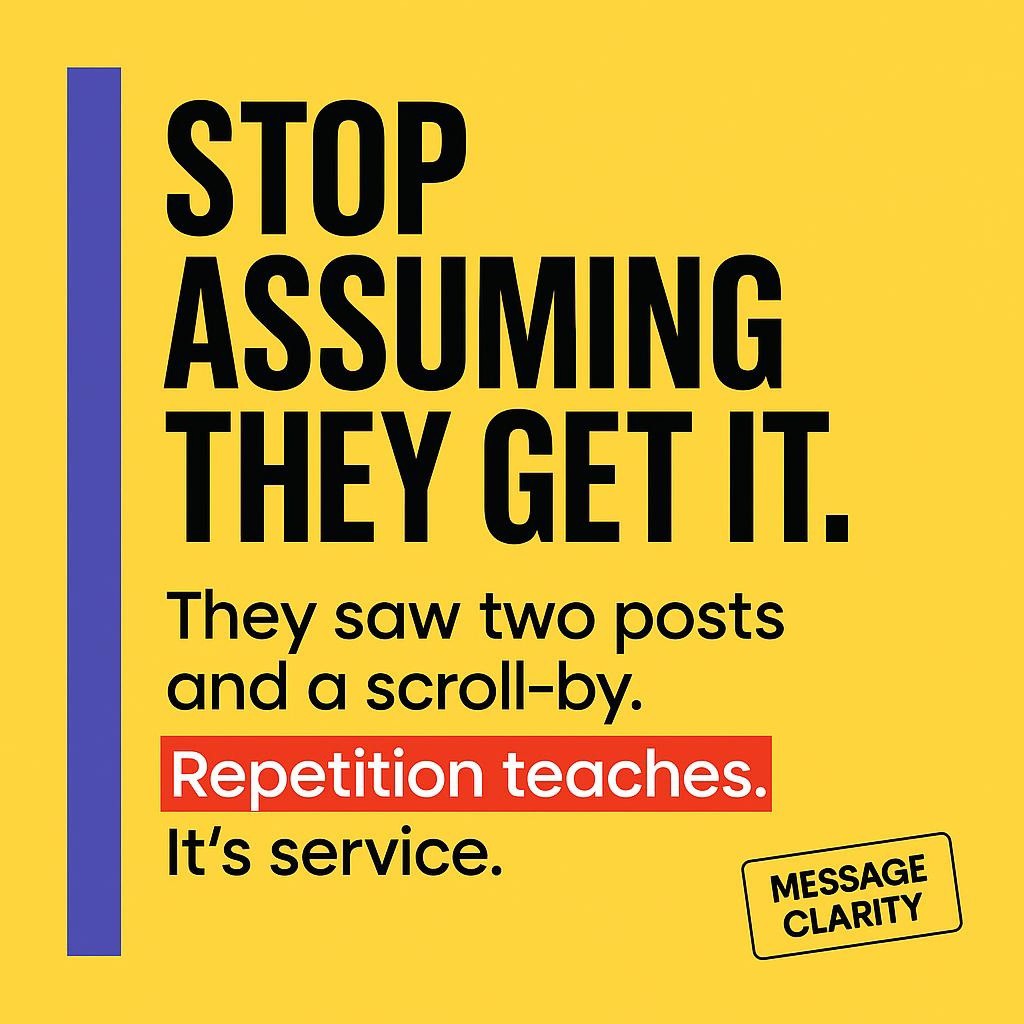
Because you’re living inside the full picture, the roadmap, the mission, the five-year arc, the deeper “why” under every decision. Your audience is not. They’ve seen two Instagram posts, one LinkedIn update, a three-second scroll past your website, maybe a podcast clip if you’re lucky.
And then you post one carousel and wonder why people still don’t get it.
What the Founder Projection Trap is (and why it’s so common)
The Founder Projection Trap is simple: because you see the full picture, you unconsciously assume your audience does too.
So you start thinking:
- Why are they still asking basic questions?
- Why does it feel like nobody connects the dots?
- Why do I keep repeating myself?
Then you fall into the most expensive illusion in modern marketing:
"Yes. You did. Once. On a Tuesday. At 11:13 a.m. To 3 percent of your audience."
From your perspective, you’re being repetitive.
From theirs, they’re still trying to understand what you even are.
The hidden reason repetition feels embarrassing
Founders don’t avoid repetition because it’s ineffective.
They avoid it because it feels like it says something about them.
Repetition can trigger a quiet fear:
- “I’m annoying.”
- “I sound obsessed.”
- “People will think I don’t have anything new to say.”
- “I’m turning into a marketer.”
But the reality online is blunt:
"Online, repetition is not annoying. It is necessary."
Not because your audience is slow, but because the internet is a river. People don’t arrive on your “About” page first. They arrive through fragments.
And understanding is built from fragments stacked over time.
The line that changes everything
If there’s one sentence we want every founder to tattoo onto their content strategy, it’s this:
"Repetition does not bore people. Repetition teaches people."
That’s the shift.
Repetition isn’t ego. It’s service.
It’s how you teach a market that didn’t wake up thinking about you, didn’t bookmark your last post, and definitely didn’t download your worldview into their brain after one scroll.
Repetition is how you stop being “a random post” and become a reference point.
Why your audience learns in streams, not pages
Here’s the most useful mental model for modern attention:
"A page is a room. A feed is a river."
A page is static. A feed is chaotic.
Your audience enters the river with no map. They see whatever the algorithm drops in front of them: a snippet of your story, a post about your mission, a carousel explaining a concept, a clip of you speaking passionately, a customer example buried between a meme and a trending reel.
This is why one perfect explanation rarely works.
As the book puts it:
"You aren’t judged by a page. You’re judged by a pattern."
A brand becomes clear when its message becomes a pattern people can recognize.
The compounding truth founders underestimate
Most founders assume marketing works like math:
- 1 post → 1 outcome
- 10 posts → 10 outcomes
- 100 posts → 100 outcomes
But content doesn’t grow additively. It grows exponentially when done correctly.
Trust is layered through repeated touchpoints. The book even maps what those layers can look like over time:
- Post 1 → “Interesting.”
- Post 5 → “I like their style.”
- Post 12 → “They’re consistent.”
- Post 25 → “I’m learning from them.”
- Post 40 → “I trust this brand.”
- Post 60 → “I’m ready to act.”
If you quit early because “I already said this,” you never reach the later layers, the ones where trust turns into action.
This is also why so many founders feel like they’re talking to nobody.
They’re not always bad at content. They’re often speaking into the wrong conditions.
The “empty room” problem (and why it’s not your fault)
The book describes a hard truth about content marketing:
Most brands are talking to an empty room.
It’s “the digital equivalent of walking onto a stage, delivering your best speech, and realizing the theater is pitch black because the audience never showed up.”
Founders blame themselves:
- “I guess my content isn’t good enough.”
- “I guess people don’t like my message.”
- “I guess we need to post more.”
But the book is clear: this problem is structural.
Platforms require a warmed room, meaning ongoing signals that you’re worth showing to more people. If those signals aren’t present, you can drop a masterpiece and the algorithm will quietly whisper:
"Cute. Anyway, next."
The solution is not more perfection. It’s more pattern.
Repetition only works if it’s varied
Here’s the part most people miss:
Repetition doesn’t mean saying the same sentence forever.
The book lays out what makes repetition actually work:
It must be:
- Varied in format (video, text, carousels, short posts, long posts)
- Delivered in different emotional tones (serious, playful, personal, analytical)
- Placed in different contexts (FAQ, story, analogy, customer example)
This is why the same core truth can fall flat one week, then hit hard the next.
You didn’t “finally find the perfect wording.”
You finally reached someone in the way they needed to hear it.
If you want a tight companion piece that reinforces this exact idea, read Founder Projection Trap: Repeat Your Message, Finally Clicks.
Your audience isn’t just listening, they’re looking for a guide
A lot of founders think the job is to sound bigger.
But the book flips that:
Your audience is not looking for a celebrity, they’re looking for a guide.
And there’s a big difference between performing and guiding.
Performance says: “Look at me.”
Transparency says: “I see you.”
The book nails it in one line:
"Performance creates distance. Transparency creates intimacy."
This matters because modern audiences resist forced authority. They reject condescension, inflated claims, superiority, unearned confidence. They gravitate toward transparency, sincerity, expertise grounded in experience.
This is why message repetition is not just marketing. It’s leadership without ego.
A simple way to build repetition that doesn’t burn you out
You do not need to manually reinvent your message every day.
You need a rhythm that turns your mission into a predictable presence.
Here’s a simple, founder-friendly approach that stays true to the book’s principles.
Step 1: Choose one core belief to reinforce
The book is blunt: people don’t follow noise, they follow worldview. They follow conviction.
Pick one truth you want to be known for. The thing you believe so strongly you’d defend it on a bad day.
Step 2: Repeat it through different angles
Use variation so repetition teaches instead of droning.
Run the same belief through:
- a story
- a metaphor
- a short educational post
- an FAQ answer
- a customer example
Same backbone, different doorway.
Step 3: Make it predictable
The book calls this ritual: recognizable cadence, tone, and thematic throughlines.
“Customers don’t bond with randomness.” They bond with weekly segments, predictable formats, signature phrases, and patterns they can anticipate and emotionally invest in.
When your audience can feel that rhythm, they show up for it, even when they’re not consciously aware it’s happening.
Step 4: Keep showing up for the audience you can’t see
The book reminds founders of a segment that quietly determines your future revenue: silent followers.
They don’t click, but they watch. They internalize. They evaluate. They’re often the majority.
One post won’t convert them. Ten might not. But repeated presence over time is what makes them feel:
- “I already know this brand.”
- “Their worldview matches mine.”
- “I trust them.”
Step 5: Let the pattern do the selling
The book gives a powerful paradox:
The more your audience recognizes your voice, the less effort you need to sell.
Why?
Because your voice becomes an anchor, a home, a stable presence.
Where Inkflare fits (and why we care so much about this)
At Inkflare, we don’t just help you post.
We help you build the pattern.
The book describes it clearly: you’re not judged by a page, you’re judged by a pattern. And most founders don’t have the time or mental space to repeat their message with enough variation across formats, tones, and contexts.
That’s why Inkflare is built to translate the truth that’s already inside you, then express it consistently, intelligently, and in your real voice, so your message compounds instead of staying locked in your head.
You don’t need to become a marketing genius.
You need an amplifier.
So here’s the question worth sitting with, honestly:
If someone only caught two posts and a three-second scroll-by, what would you want them to believe about you after the next 60 touchpoints?