
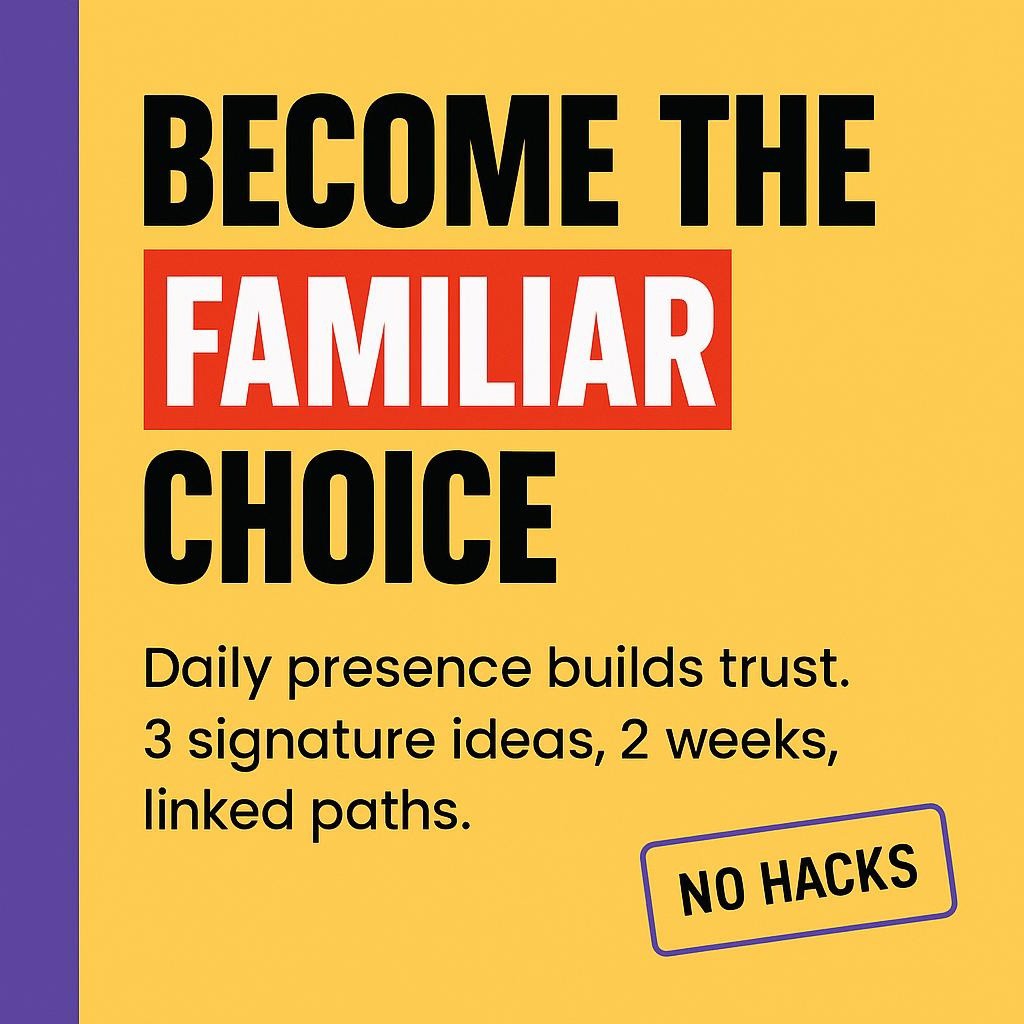
The “Familiar Stranger” Funnel: How to Become the Default Choice Without Engagement Hacks
You can publish your best idea, hit post, and hear… nothing.
No comments. No shares. No proof anyone cared.
It feels personal, but it isn’t. It’s structural.
As the book says, "Most brands are talking to an empty room." The hard part is this: you can be brilliant and still be invisible, because the room was never warmed.
So the fix is not louder content.
The fix is familiar content.
At Inkflare, we call this the Familiar Stranger funnel, the long-game relationship arc where your audience sees you consistently, with a steady voice and emotional coherence, until you stop feeling like a stranger to them. Then one day, they reach out already warm.
No frantic tactics. No engagement stunts. Just calm, repeatable presence.
What a “familiar stranger” is (and why they are your most profitable audience)
A familiar stranger is someone who has been around your work for weeks or months.
They don’t comment. They don’t DM. They rarely hit like.
But they watch.
The book names this clearly: silent followers are often 80 to 95 percent of your audience. They are the lurkers, the busy professionals, the decision-makers, the serious buyers who don’t perform online, but do remember what they’ve seen.
And they are not passive. They are deliberate.
They’re building a picture of you:
- how you think
- what you repeat
- what you stand for
- whether your tone is stable
- whether your mission feels real
Your content becomes their evidence.
The core truth: buyers choose what feels most familiar
Here’s the sentence that changes everything:
"When buyers trust multiple options, the one they feel most familiar with wins."
Not the cheapest.
Not the flashiest.
Not the loudest.
The most familiar.
That’s why “more viral” is not the same as “more trusted.” The book draws a sharp line between visibility and relationship. Visibility is a moment. Relationship is accumulated meaning.
And familiar strangers are built through accumulation.
Why engagement hacks feel tempting (and why they burn you out)
If you’ve ever refreshed your post 12 times in an hour, welcome to the club.
Engagement metrics are loud. They’re visible. They make you feel like something is happening.
But the book calls out a misconception: you don’t need giant comment threads or endless DMs to build community. "You need a relationship arc, not a viral moment."
Engagement hacks push you toward performance.
The familiar stranger funnel pulls you toward presence.
And for mission-driven founders, that matters. The book says it plainly: you don’t need aggression, you need presence.
How familiarity is built: repetition, coherence, and emotional consistency
Familiarity is not magic. It’s mechanics.
The book gives the psychological driver in one clean line:
"People trust what they see repeatedly."
Not once. Repeatedly.
This is why daily publishing creates compounding results. The book explains that content has immediate value, delayed value, and compounding value, when someone sees enough of you over time to become warm and ready.
It’s also why the “everywhere” feeling happens without you doing anything flashy. You crossed a threshold. Your message stacked.
The “everywhere” engine: ritual (not random posting)
Most founders think consistency means frequency.
The book goes deeper: people bond with rhythm.
They bond with:
- weekly segments
- predictable formats
- recurring themes
- signature phrases
- patterns they can anticipate and emotionally invest in
That’s a ritual. And ritual does something powerful in a noisy feed: it reduces uncertainty.
Your brand becomes a steady emotional touchpoint. A familiar anchor.
This is why the book can say, without blinking:
"Perfection doesn’t build trust. Predictability does."
Predictability lowers friction. Lower friction increases trust. And trust makes buying feel safe.
How to build the Familiar Stranger funnel (a calm, two-week setup you can repeat forever)
You do not need a 90-day content plan, a new brand voice guide, and a seven-tool tech stack.
You need a simple structure that creates familiarity on purpose.
Step 1: Choose 3 signature ideas you will repeat until you’re known for them
The book warns that content without philosophy turns into generic advice and interchangeable posts. It calls it forgettable.
The fix is a backbone, a clear worldview that your content keeps returning to.
It even names what this produces: principles, weekly themes, teaching formats, and signature ideas.
Your job here is simple:
Pick 3 ideas you believe deeply, and that your audience needs to hear from multiple angles.
Not 30. Three.
If you’re stuck, use this filter from the book’s spirit: your ideas should sound like conviction, not decoration.
Step 2: Repeat those ideas across 2 weeks, in varied formats
Founders avoid repetition because they think it makes them boring.
The book flips that fear:
"Repetition does not bore people. Repetition teaches people."
And it explains why repetition works when done right, each repeat comes with a new story, a new metaphor, a new emotional angle, a new platform, a new format.
So for two weeks, rotate your 3 ideas through:
- short, punchy posts
- deeper teaching posts
- stories and reflections
- simple frameworks and reminders
Same truth. Different doorway.
This is how your voice becomes recognizable.
Step 3: Turn your posting into a ritual your audience can feel
Ritual is meaningful repetition, not random output.
The book gives identity cue examples like “Taco Tuesday” and “Founders Friday,” not as tactics, but as signals people attach to.
The goal is for your audience to think:
- “This is part of my routine.”
- “This aligns with who I am.”
When your content becomes part of someone’s week, you stop competing for attention. You become a habit.
Step 4: Keep your tone emotionally consistent (so your brand feels safe)
The book makes a point most marketing advice skips: consistency reduces anxiety, for your audience and for you.
When your brand shows up with a stable voice and steady mission, your audience doesn’t have to “re-learn” who you are each time. They build a shortcut in their mind.
That shortcut becomes trust.
And trust becomes inbound.
Step 5: Interlink your ideas so your content becomes a world, not fragments
The book says most brands feel fragmented, a post here, a video there, nothing connected. That’s why they don’t stick.
Then it drops a line worth taping to your desk:
"Humans remember universes. They forget fragments."
So build a universe.
Make it easy for someone to go from one idea to the next:
- refer back to your earlier post
- continue a theme tomorrow
- connect a teaching post to a story post
- keep your message coherent across platforms
This is how discovery pathways stack. This is how “everywhere” happens calmly.
Where Inkflare fits (and why this is built for small teams)
Inkflare exists to operationalize this exact long game: daily presence, consistent voice, repeated core beliefs through multiple angles, and ritualized rhythms that build familiarity without burnout.
Because you’re not trying to “look smart once.”
You’re trying to become the trusted presence people feel like they already know.
Or, in the book’s blunt, freeing words:
"You don’t need to scream."
"You don’t need to hustle."
"You don’t need to trend-chase."
You need to show up in a way that feels human, consistent, intelligent, helpful, and mission-aligned, until strangers turn familiar.
So here’s the question that matters more than your next hook:
If you stopped chasing engagement and started building familiarity on purpose, what would your audience finally feel safe enough to do?