The Trust Ladder: Why Your 12th Post Matters More Than Your 1st (and How to Keep Going)
You can post something brilliant and still feel like you’re talking to nobody.
That’s the most common pain we see from founders, coaches, authors, and small teams. You show up with real ideas, real care, and real effort, then the feed gives you silence. No comments. No spike. No “proof” it mattered.
The hard truth is simple: content often doesn’t fail because it’s bad, it fails because the room isn’t warmed yet.
And most people quit right before the room finally starts to fill.
The trust ladder most founders never plan for (and why they burn out early)
Trust is not built in one post. It’s built through repeated exposure over time. As the line goes: “People trust what they see repeatedly.”
That’s why one-off content feels so unfair. The real game is accumulation. Every post adds a layer:
- Post 1 → “Interesting.”
- Post 5 → “I like their style.”
- Post 12 → “They’re consistent.”
- Post 25 → “I’m learning from them.”
- Post 40 → “I trust this brand.”
- Post 60 → “I’m ready to act.”
That’s the ladder.
So when we say “your 12th post matters more than your 1st,” we mean this:
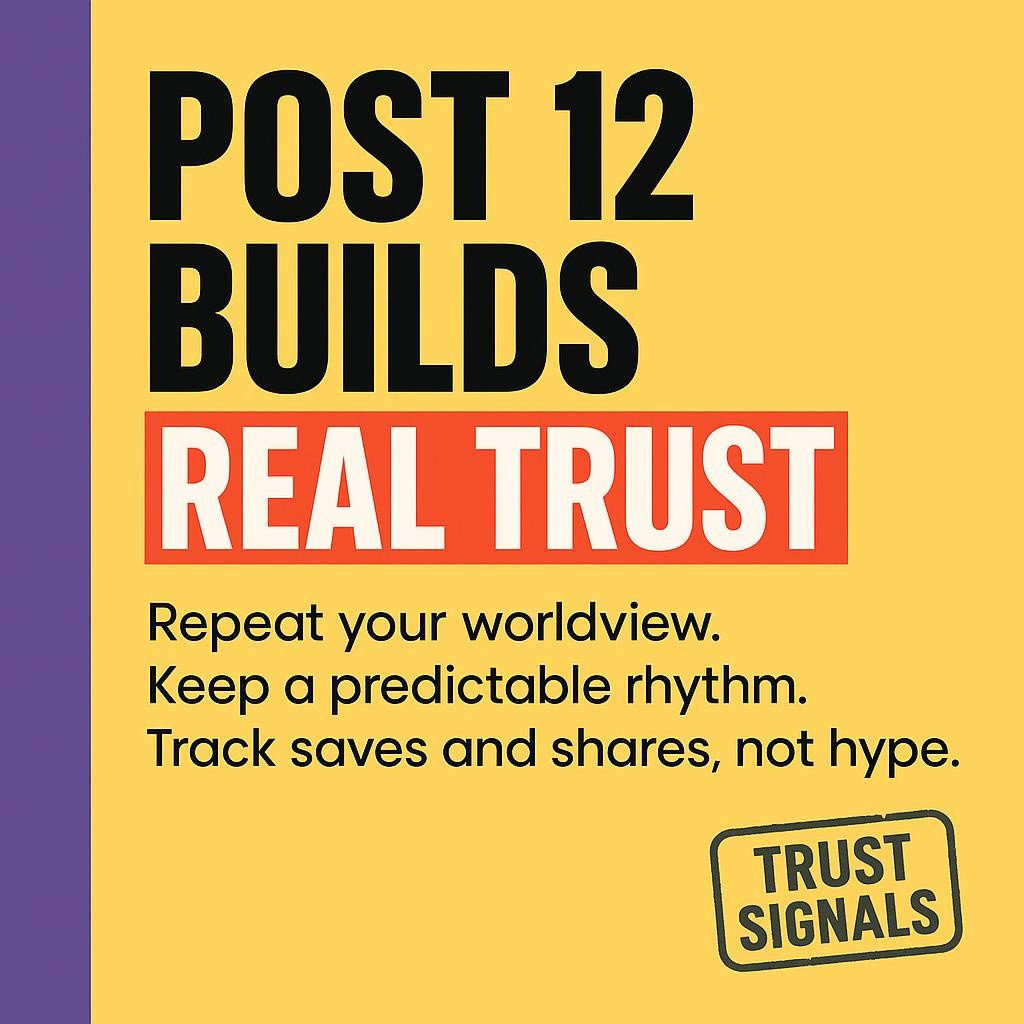
Post #12 is often the first moment your audience can feel reliability. Not because the 12th post is magic, but because consistency becomes visible.
And visible reliability is the first real step toward trust.
A quick gut-check question
If your audience needs repeated touchpoints to trust you, why are you judging your future based on Post #3?
Why your early posts feel invisible (even when they’re good)
Most founders expect content to grow like math.
1 post → 1 outcome
10 posts → 10 outcomes
But the curve isn’t linear. It’s nonlinear. It can feel like nothing is happening until suddenly, it is.
Here’s the pattern spelled out:
- 1 post → 0 outcome
- 10 posts → 1 outcome
- 30 posts → 5 outcomes
- 100 posts → 40 outcomes
- 250 posts → your brand becomes a category voice
- 500 posts → your brand becomes an authority
- 1000 posts → your brand becomes undeniable
That “slow start” is not a sign you’re failing. It’s the compounding phase warming up.
And compounding has a simple engine behind it. Every piece of content carries three kinds of value:
- Immediate value (someone sees it today)
- Delayed value (someone discovers it months later)
- Compounding value (someone sees multiple posts over time and becomes warm, familiar, and ready to buy)
If you only judge content by immediate value, you’ll quit before compounding value ever shows up.
Your most valuable audience is often silent (and they’re watching)
Here’s another reason early content feels pointless: you’re looking for loud feedback from quiet people.
Silent followers are real. They’re often the majority, 80 to 95 percent of your audience. They don’t comment. They don’t “like.” They don’t announce themselves.
But they do observe.
They internalize, evaluate, and take you seriously. They’re often decision-makers, busy professionals, and serious buyers.
So when your brain says, “Nobody cares,” what’s usually true is: nobody is performing caring in public.
And that changes how you measure progress.
Because compounding is what turns silent followers into ready buyers. One post won’t do it. Ten might not. But later layers do. That’s when people start thinking:
- “I already know this brand.”
- “Their worldview matches mine.”
- “Their content always helps.”
- “They’re stable.”
- “I trust them.”
Predictability builds trust faster than perfection
Most brands obsess over competence. Very few build reliability.
But trust has two requirements: competence and reliability. People don’t trust those who “can,” they trust those who “do.”
This is why we repeat the line so often at Inkflare: “Perfection doesn’t build trust. Predictability does.”
Predictability does a few powerful things at once:
- it makes your voice recognizable
- it makes your worldview clear
- it makes your presence part of someone’s daily rhythm
And it frees you from the trap that kills most creators: perfection anxiety.
Because “The world isn’t waiting for perfection. The world is waiting for your consistency.”
What predictability looks like in real content
It’s not posting the same thing every day.
It’s building a recognizable cadence with recurring patterns your audience can emotionally rely on, things like weekly segments, predictable formats, recurring themes, signature phrases, and patterns people can anticipate and invest in.
That’s what makes content feel grounding. That’s what makes a brand feel stable.
If you want a deeper read on staying warm without burning out, this pairs well with our related post: Marketing Thermostat: Stay Warm with Micro-Consistency.
Meaningful repetition is how authority is built
Founders often whisper, “I already said this.”
Yes. Once. To a tiny fraction of your audience. And online, repetition is not annoying, it’s necessary.
But it only works when it’s expressed in different ways: different formats, different emotional tones, different contexts.
That’s why this line matters so much: “Repetition does not bore people. Repetition teaches people.”
And it leads to a bigger truth most people miss: “Authority isn’t declared, it’s repeated into existence.”
You don’t become trusted because you posted one “perfect” thread.
You become trusted because your worldview shows up again and again, through stories, metaphors, examples, angles, and formats, until it becomes familiar.
Stop chasing spikes, start tracking trust signals
Virality is unreliable. In plain language: “Virality isn’t a growth strategy. It’s a mood swing.”
Trust-building content plays a different game. It aims for longevity, rhythm, and return visits, not fireworks.
So instead of obsessing over dopamine metrics, watch for signals that match trust behavior.
For example, platforms don’t just care about “good content,” they look for conditions and signals. On Instagram, that includes recency, interaction loops, saves, shares, and aesthetic coherence. On LinkedIn, steady posting rhythm and people lingering. On TikTok, consistent publishing and strong identity cues.
The biggest shift for most founders is simple:
Measure the behaviors that suggest someone wants to keep you.
- Saves (this mattered enough to keep)
- Shares (this represented me enough to pass along)
- Returns (I came back because your voice feels familiar)
Those are not vanity metrics. They’re trust signals.
A simple plan to reach the later layers (without burning out)
If Post 40 is where trust often clicks, and Post 60 is where people are “ready to act,” the goal is not to “try content.”
The goal is to reach the later layers without disappearing.
Here’s the simplest, most reliable approach, built from the principles above:
1) Make Post #60 the commitment
Treat it like a real relationship arc. Not a test. Not a fling. A decision.
2) Build a predictable rhythm your audience can feel
Use recurring segments and consistent cadence. Predictability becomes your emotional signature.
3) Repeat your worldview in varied ways
Different formats, different tones, different contexts, same core truth.
4) Publish in a way that compounds across platforms
A single message expressed across multiple platforms creates more discovery pathways, more impressions, and more warm familiarity over time.
Why Inkflare cares so much about staying in it
Because mission-driven brands don’t need a flash. They need longevity.
As the line puts it: “If your work is here to make the world better… then your job isn’t to explode. Your job is to endure.”
That’s the heart of what we build at Inkflare. A system that keeps your presence steady, your voice consistent, and your message repeating in meaningful ways, even when you’re busy running the business.
Or said even more simply: “Stories build connection. Connection builds trust. Trust drives action.”
So if you’re somewhere between Post #1 and Post #12 right now, don’t renegotiate your mission based on early silence.
Keep going.
Your audience may be quiet, but they’re learning your rhythm.
And once they feel it, trust starts to stick.
Reflective question: What would change this month if you stopped treating content like a performance, and started treating it like proof that you don’t disappear?