5 Content Rituals That Make You Unforgettable (and Save You From Decision Fatigue)
You can publish something brilliant and still feel like you’re talking to nobody.
Not metaphorically. Literally.
It’s like walking onto a stage, delivering your best speech, and realizing the theater is dark because the audience never showed up. The painful part is what comes next: you blame yourself. “I guess my content isn’t good enough.” “I guess people don’t like my message.” “I guess we need to post more.”
But the real problem usually isn’t your talent. It’s your structure.
A warmed room makes decent content powerful. A thriving room makes great content unstoppable.
That’s why we’re obsessed with one idea at Inkflare: ritual. Not hustle. Not trend-chasing. Not “post more.”
Because “A brand without ritual fades. A brand with ritual becomes part of people’s lives.”
Why content feels exhausting (and why it’s not your fault)
Decision fatigue is the enemy of visibility. It shows up like this:
- “What should we post?”
- “What format should we use?”
- “What angle haven’t we done yet?”
- “Does this align with our brand?”
Then the guilt piles on. The quiet pressure you carry around all day:
- “I should be posting.”
- “I should be doing more.”
- “I should stay visible.”
- “I should explain our philosophy.”
That “should” energy drains your brain. It creates avoidance. It creates paralysis.
Ritual fixes this, not by forcing you to work harder, but by removing the daily decision.
What a “content ritual” actually is (and why it works)
Let’s clear up the biggest misconception.
“Posting daily is repetition. Posting daily with recognizable cadence, tone, and thematic throughlines is ritual.”
Ritual isn’t you repeating yourself louder.
Ritual is meaningful repetition, delivered in a way people can anticipate and emotionally invest in. Your audience doesn’t bond with randomness. They bond with:
- Weekly segments
- Predictable formats
- Signature phrases
- Signature visuals
- Patterns they can anticipate and invest in
This is why rituals are timeless. Platforms change. Trends fade. New apps rise and die. Ritual lasts because it’s human.
Why rituals make you unforgettable (even if you never go “viral”)
Here’s what rituals do that most content strategies miss.
1) They give your brand a heartbeat
“A ritual gives your brand a kind of heartbeat.”
When people feel that rhythm, they show up for it, even when they can’t explain why.
2) They create emotional safety
Ritual reduces uncertainty. In a chaotic feed, your brand becomes a steady anchor.
Your audience may not call it “ritual.” They’ll call it:
- “Your content always feels grounding.”
- “Your brand just feels clear.”
- “Your tone feels trustworthy.”
3) They turn content into identity cues
“Taco Tuesday.” “Founders Friday.” Apple’s keynote season. Starbucks’ seasonal drops. These aren’t just tactics. They are identity cues.
They let people say, “This is part of my routine.”
4) They make your brand feel alive
Static brands feel dead. Ritual makes them breathe. A living brand has cycles, moods, recurring themes, and ongoing storylines.
Over time, your brand starts to feel less like marketing and more like a familiar presence.
5) They reduce decision fatigue for both sides
For you: fewer daily decisions, less second-guessing, less “what do we post” chaos.
For your audience: less cognitive load. They don’t have to re-learn who you are every time you show up. Consistency builds shortcuts in their mind, and predictable things are easier to trust.
And that’s the hidden win: trust isn’t built through perfection. It’s built through predictable presence.
The real “gold nugget”: ritual creates belonging, not just engagement
Most founders think they need more content.
What they really need is meaningful repetition that builds belonging. That’s ritual.
When your content reflects people, you’re not “doing engagement.” You’re creating belonging.
And belonging is what turns followers into:
- customers
- advocates
- long-term supporters
So let’s make this practical.
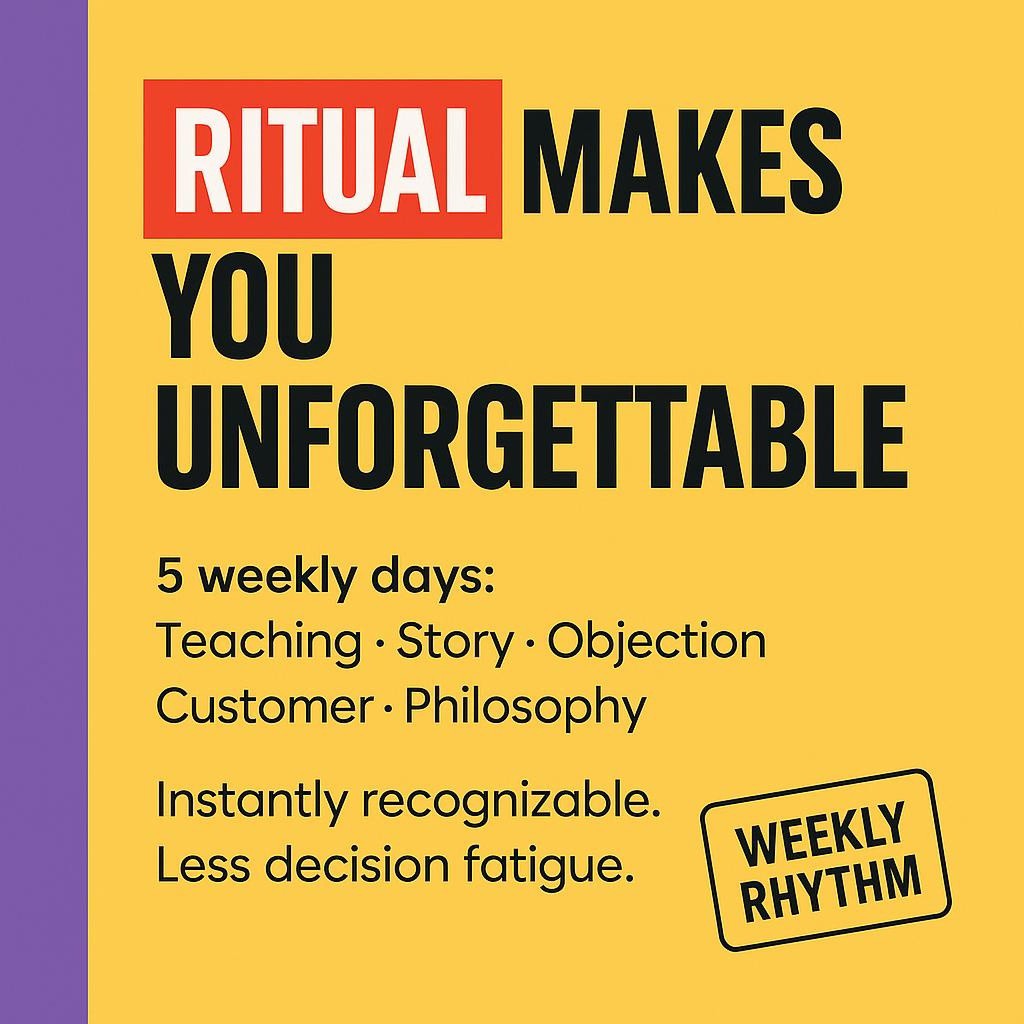
The 5 weekly content rituals (the simple rhythm people remember)
A ritual works best when it’s predictable. Same days, same themes, same “feel.”
Below are five weekly rituals we use constantly at Inkflare because they map to what actually builds familiarity: teaching, stories, objections, customers, philosophy.
Ritual 1: Teaching Day (clarity that doesn’t talk down)
Your audience isn’t looking for a celebrity. They’re looking for a guide, someone who can teach with clarity and provide grounding.
Keep the tone human. Not preachy. Not performative.
You can literally use guide language like:
- “Here’s what I’ve learned.”
- “Here’s what might help.”
- “Here’s what I’ve seen in the field.”
Easy formats to rotate (same idea, different angle):
- a teaching piece in your newsletter
- a calm explainer thread
- a visual diagram
Ritual 2: Story Day (trust is built through earned narrative)
People don’t learn best from commands. They learn from narrative, especially when the story is personal, relatable, and the outcome is earned.
Story day is how you stop sounding like a brand and start sounding like a person.
Simple rule: don’t aim to impress. Aim to be real. Performance creates distance. Transparency creates intimacy.
Easy formats to rotate:
- a story about a customer
- a relatable founder observation
- a mission story that shows what you value in public
Ritual 3: Objection Day (answer the fear before they ask)
Most buying resistance isn’t loud. It’s silent.
That’s why we map “objections” and “customer fears” directly into content, then turn them into angles and series.
Objection Day is where you stop hoping people “get it” and start meeting them where they are.
Because if you’re stuck in the Founder Projection Trap, you’re talking in “chapter eight language” to people still trying to read chapter one.
What to publish on Objection Day:
- an FAQ answer
- a calm explainer thread
- a “here’s what you may not have considered” post
Ritual 4: Customer Day (proof that feels like people, not pitch)
Your best customers don’t just read pages. They observe identity.
Customer Day is where your feed becomes proof, not marketing. Evidence.
If your brand is going to feel like a real place, customers can’t be invisible. People scroll through customer transformations as part of the journey of staying in your world.
Easy formats to rotate:
- a customer transformation
- a case study snapshot
- a behind-the-scenes reflection on what changed for them
Ritual 5: Philosophy Day (say what you believe, on repeat)
This is where you stop sounding like “safe professionalism” and start sounding like you.
In a world where everyone is producing content, meaning becomes the differentiator.
Philosophy Day is where you share the backbone:
- what you stand for
- what you don’t do
- the nuance no one talks about
And yes, it can feel repetitive.
But online, repetition isn’t annoying. It’s necessary, especially when it shows up in different formats and contexts.
A plug-and-play weekly calendar (that stays strong for years)
Here’s a weekly rhythm you can repeat until your audience can feel your heartbeat:
- Monday: Teaching Day
- Tuesday: Story Day
- Wednesday: Objection Day
- Thursday: Customer Day
- Friday: Philosophy Day
Now the key move, the one that makes this sustainable:
Pick one core idea and express it across the week in different ways. One idea can become:
- a story about a customer
- a bold statement post
- a “hot take” reel
- a calm explainer thread
- an FAQ answer
- a visual diagram
- a teaching piece in your newsletter
This is how you stop feeling like you’re “starting over” every week.
And it’s how your audience starts feeling something even more powerful than “they post good stuff.”
They start feeling familiarity.
Because people don’t buy when they understand you logically. They buy when they feel familiar with you.
Where Inkflare fits (if you want the ritual without the grind)
If you’re thinking, “This makes sense, but I still don’t have the time,” we built Inkflare for that exact moment.
“Inkflare kills that problem permanently by producing and scheduling content rituals for you. You approve; we execute.”
We don’t just create posts. We build a living environment, a brand-place people want to enter and stay in.
And we do it in a way that protects your voice, your meaning, and your emotional presence.
Because the win isn’t one viral moment.
The win is becoming the familiar guide people trust long before they ever contact you.
So here’s the question to sit with:
If someone followed you for 30 days, would they be able to describe your rhythm, your worldview, and what you stand for, or would they just say you post “sometimes”?