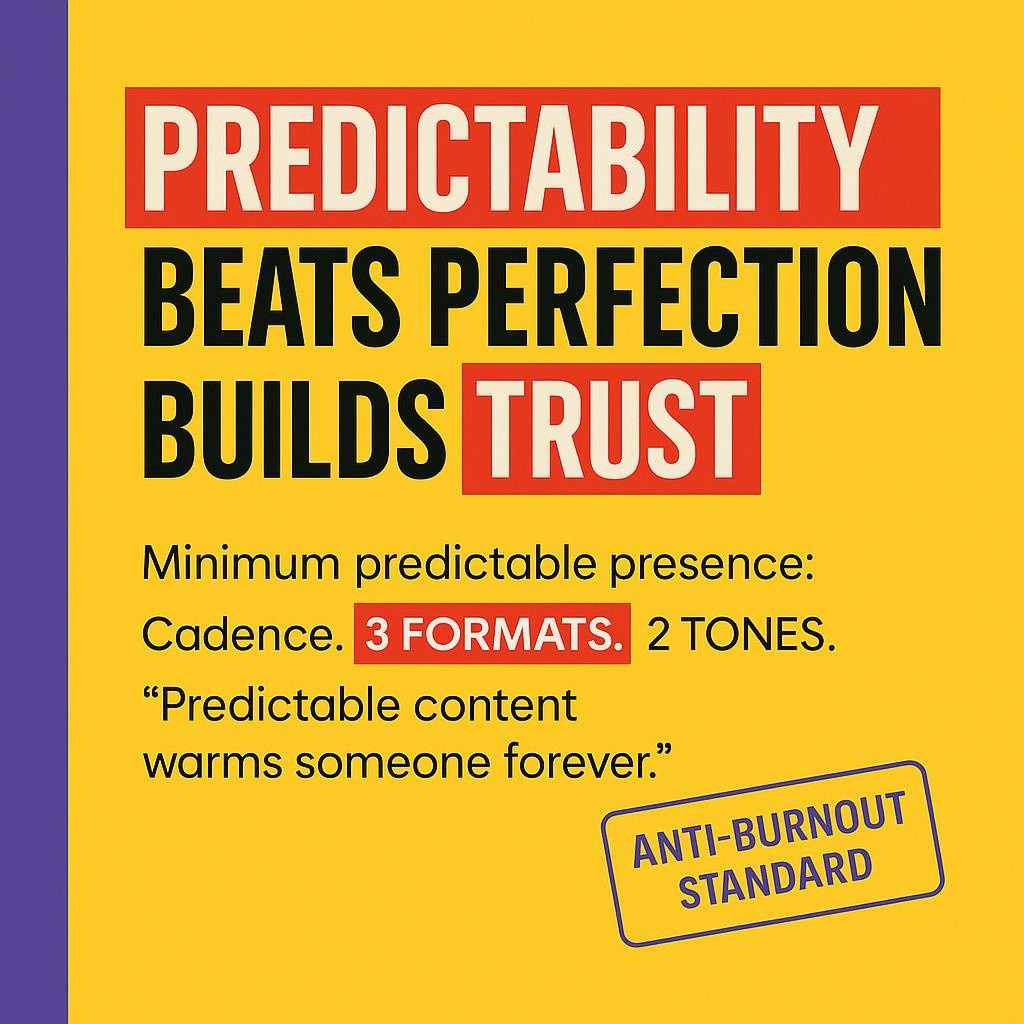
Predictability Beats Perfection: The Anti-Burnout Publishing Standard That Builds Trust
You post like crazy for a week, then business hits, and you disappear.
Then the guilt shows up. The pressure shows up. You force a few posts. Then you freeze again.
It’s not laziness. It’s a cycle, and it’s brutal.
Here’s the truth that breaks it: "Perfection doesn’t build trust. Predictability does."
Not because your audience is judging your commas.
Because your audience is judging your reliability.
Perfection looks impressive, predictability feels safe
Perfect content can be dazzling. It can even get a spike.
But trust is built the way it’s built in real life, through steady behavior over time.
That’s why this line matters so much: "Perfect content may wow someone once. Predictable content warms someone forever."
People admire perfection, but they trust what feels safe. And “safe” online means:
- reliable
- familiar
- steady
- consistent
- emotionally grounded
If your content is beautiful but random, you might get attention.
If your content is steady, you get belief.
The hidden reason disappearing hurts your brand (even if your product is great)
Most founders think content is about:
- reach
- impressions
- conversions
- algorithms
All real. But there’s another layer that quietly runs everything: emotional stability.
When a brand goes quiet, your audience may never complain. They may never DM you.
But their brain still asks:
- Are they still active?
- Are they stable?
- Should I trust them with my money?
That’s why daily presence isn’t just marketing. It’s reassurance.
And it’s not just for them. It’s for you, too.
Founders carry a constant background stress:
- “I should be posting.”
- “I should explain our mission better.”
- “I should stay visible.”
That “should” energy drains you. Predictable publishing gives you your breath back.
Trust has two requirements, and most brands only build one
Trust isn’t a vibe. It has two parts:
- Competence, you know what you’re doing
- Reliability, you do it consistently
Most brands chase competence. They polish. They edit. They perfect.
But people don’t trust those who “can.”
They trust those who “do.”
Stop “posting,” start building a rhythm people can feel
This is where the shift becomes anti-burnout.
The goal is not to create a masterpiece every time.
The goal is to create a heartbeat your audience can recognize.
That’s why this line is so practical: "Posting daily with recognizable cadence, tone, and thematic throughlines is ritual."
And customers don’t bond with randomness. They bond with:
- weekly segments
- predictable formats
- recurring characters or themes
- signature phrases
- signature visuals
- patterns they can anticipate and emotionally invest in
This is what makes your brand feel alive, not loud.
This is how you become part of someone’s routine, like a favorite podcast or newsletter.
The simplest way to become predictable (without becoming boring)
People worry that consistency means repeating yourself until everyone tunes out.
But the message is clear: "Repetition does not bore people. Repetition teaches people."
Because each repeat can come through:
- a new story
- a new metaphor
- a new example
- a new emotional angle
- a new platform
- a new format
That’s not “same content.” That’s the same truth, expressed with range.
And over time, something powerful happens:
"Authority isn’t declared, it’s repeated into existence."
Why your content feels harder than it should (decision fatigue is real)
If you keep asking:
- “What should we post?”
- “What format should we use?”
- “What angle haven’t we done yet?”
- “Does this align with our brand?”
You’re not failing at creativity.
You’re drowning in decision fatigue.
Predictability fixes that by removing choices. Not by making you robotic, but by giving you a structure you can trust.
That’s part of what we build at Inkflare. We turn a mission into recurring content patterns people begin to expect, recognize, and rely on. And we reduce the daily drag with a simple reality: "You approve; we execute."
Your one-page operating checklist for predictable presence
This is a simple operating standard you can run as a solo founder or a lean team. Keep it visible. Use it weekly. Don’t overcomplicate it.
1) Pick your rhythm, then protect it
Ask:
- What cadence can we sustain without burning out?
- What does “showing up” mean for us, daily presence or a steady weekly rhythm?
Your job is to stop negotiating with yourself. Predictability only works when it’s real.
2) Lock your rituals (so your brand becomes recognizable)
Choose and keep:
- Weekly segments (so people know what day it is with you)
- Predictable formats (so your content is easy to create and easy to consume)
- Signature phrases or visuals (so your brand becomes instantly familiar)
A ritual gives your brand a heartbeat. When people feel the rhythm, they show up for it, even when they’re not consciously aware of it.
3) Keep your tone steady, so your audience can relax
A tone is a mood. A voice is a personality that stays consistent across time.
If your tone swings wildly, your audience has to “decode” you every time. That’s friction.
Stable tone creates emotional continuity. Emotional continuity creates trust.
4) Teach like a guide, not a performer
If you’ve been trying to sound bigger, more polished, more “brand-like,” this is your permission to stop.
Modern audiences don’t need a perfect founder. They want a steady one.
A guide sounds like:
- “Here’s what we’ve learned.”
- “Here’s what might help.”
- “Here’s what we’ve seen in the field.”
It’s humility with clarity, wisdom without hype.
If you feel like you’re talking to nobody, it’s not your talent, it’s the room
Sometimes content isn’t failing because it’s bad.
It’s failing because you’re posting into a cold, empty space.
Most brands are talking to an empty room. And when that happens, founders blame themselves and go back to polishing, rewriting, delaying, and over-editing.
But the real fix is structural: warm the room with steady signals.
If you want a practical companion to this idea, read: Empty Room Problem: 7-Day Plan to Make Content Seen
The takeaway that should change how you publish forever
Perfection is pressure.
Predictability is momentum.
And momentum is what compounds into familiarity, then trust, then “I see you everywhere,” then demand.
So here’s the question to sit with this week:
If your audience isn’t waiting for your masterpiece, they’re waiting for your presence, what would you publish next if the only rule was simple: "You don’t need to be perfect. You need to be present."