Philosophy Is the New Differentiator: Why “Useful Tips” Aren’t Enough Anymore
Most brands are talking to an empty room.
They post. They try. They polish. They hit publish, and the internet shrugs. Not because the message is bad, but because it has no gravity, no center, no reason for a person to stick around.
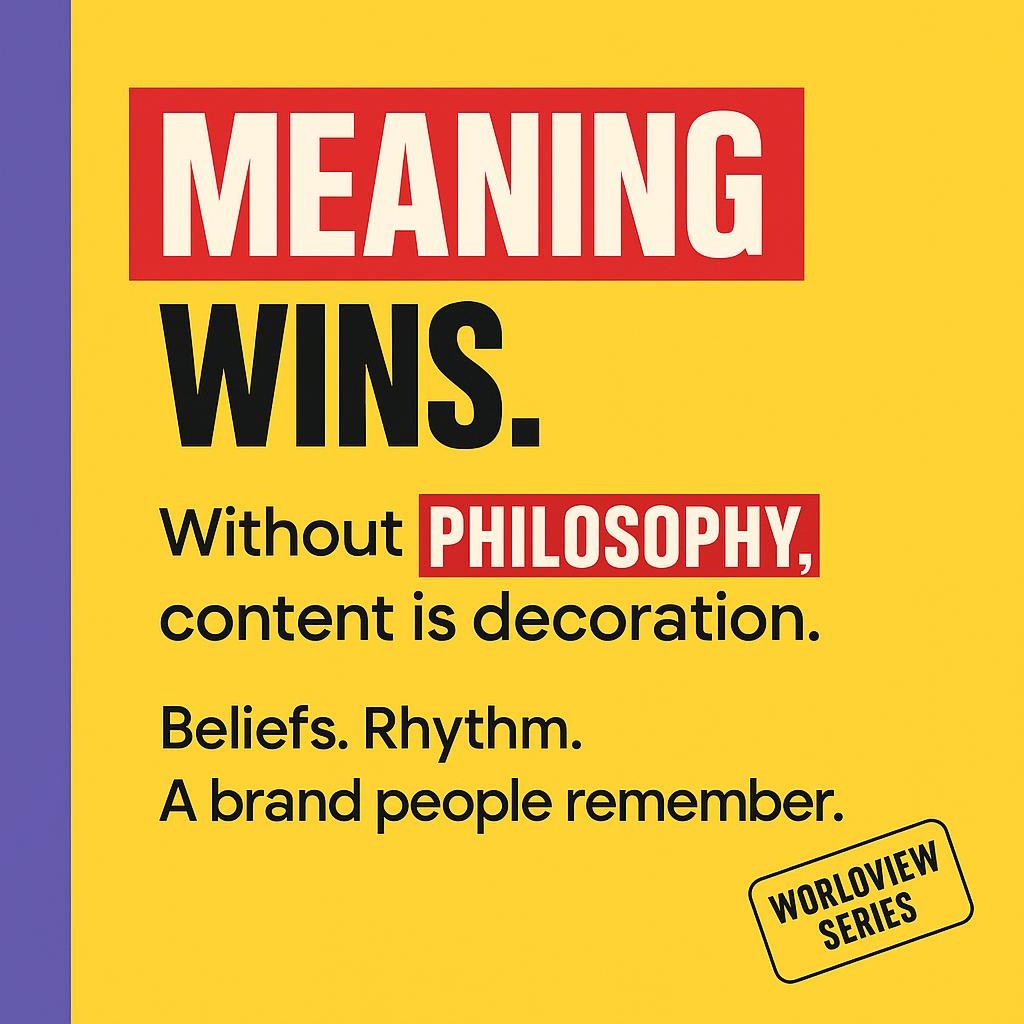
That’s why a painful line keeps proving true: "Content Without Philosophy Is Just Decoration".
Pretty decoration can get a like. It rarely builds loyalty.
Why “useful tips” don’t build a brand people remember
You can do everything “right” on the surface:
- great visuals
- solid advice
- clean formatting
- smart hooks
- platform trends
And still end up with content that feels interchangeable.
Because without a philosophy, your content collapses into "generic advice", "safe statements", "recycled ideas", and "interchangeable posts". It becomes digital wallpaper. Forgettable. Exchangeable. Indistinguishable.
The internet doesn’t need more information. It needs meaning.
And in a world where content is cheap, meaning becomes rare.
Meaning is the new differentiator (and AI proved it)
AI made content easy. So now everyone is producing more content than ever, and a lot of it feels shallow and samey.
That’s why this line matters so much: "Meaning is the new differentiator."
In this new reality, a brand that only says, “Here’s our product,” will lose to a brand that says, "Here’s the truth we believe about the world, and here’s how our product serves that truth."
That shift changes what you are in the market.
You stop sounding like a vendor. You start sounding like a guide.
The real goal: build a philosophical backbone, not a louder feed
A strong brand is not just consistent. It is coherent.
It knows what it believes. It repeats that belief with rhythm. It shows up with the same spine across:
- posts
- articles
- videos
- captions
- explanations
- analogies
- teaching frameworks
- customer stories
That’s why we built Inkflare the way we did.
We don’t just help you post. We help you build a philosophical backbone, a clear, emotionally resonant worldview that becomes the gravitational center of your brand.
Because people don’t follow noise. They follow worldview. They follow conviction.
Why philosophy builds loyalty (and filters out the wrong people)
A philosophy makes you stand for something.
And standing for something does two things at once:
- It attracts the people who feel aligned.
- It quietly repels the people who will never get it.
That’s not a downside. That’s the point.
When you articulate a clear worldview, your content becomes a beacon. Not a megaphone. A beacon.
It attracts people who believe in what you believe, customers who want depth over noise, and communities who want to learn from you. A philosophy becomes a filter, and the right people stay longer.
The founder problem nobody admits: without philosophy, content becomes exhausting
This is where it gets personal.
Founders don’t usually quit content because they “ran out of tips.” They quit because content starts to feel like a performance they can’t keep up forever.
Without a backbone, you start waking up to the same mental spiral:
- What should I talk about today?
- What do I even stand for?
- Do people understand what we’re building?
- Is there a deeper story I’m not expressing?
Without philosophy, every post feels like a performance.
With philosophy, every post feels like an expression.
And that’s not just nicer. It’s sustainable.
How to lead without sounding like a guru (become a guide)
People want leadership, but they’re exhausted by loud, certain “gurus.”
So how do you lead without preaching?
You become a guide.
Gurus position themselves above their audience. Guides speak differently. They say things like:
- Here’s what I’ve learned.
- Here’s what might help.
- Here’s what I’ve seen in the field.
- Here’s a perspective, use what resonates.
Guides create space for the audience to think. Gurus want followers. Guides create leaders.
This matters because philosophy is not just what you believe, it’s how you communicate it with humility, clarity, and humanity. It’s how your content becomes trustworthy, not loud.
The compounding secret: repetition creates trust (and trust creates growth)
A lot of creators fear repetition. They think repeating an idea means they’re being annoying.
But the truth is simpler and kinder:
"Repetition does not bore people. Repetition teaches people."
People don’t build trust from one brilliant post. They build trust from repeated exposure over time.
Post by post, your message becomes familiar. Your voice becomes predictable. Your audience starts to recognize you before they even see your name.
That is how authority is built, not declared, but repeated into existence.
Ritual beats random consistency (and it’s future-proof)
Most founders think the answer is “post more.”
But what they really need is ritual.
Ritual is not just repetition. It’s meaningful repetition, with rhythm.
Customers don’t bond with randomness. They bond with:
- weekly segments
- predictable formats
- recurring themes
- signature phrases
- patterns they can anticipate and emotionally invest in
Ritual gives your brand a heartbeat.
It also reduces decision fatigue, for you and for your audience. You stop asking “what should we post?” every day. They stop trying to decode who you are every time you show up.
And unlike trends, ritual lasts.
Algorithms change. Platforms rise and fall. But ritual is timeless. It’s how humans bonded 20,000 years ago, it’s how we bond today, and it’s how audiences will bond 20 years from now.
Your brand isn’t a product, it’s a place
Here’s another shift that changes everything:
People don’t just follow brands. They enter worlds.
That’s why fragmented content feels weak. A TikTok here. A LinkedIn post there. A blog once in a while. No narrative thread. No emotional stability. No atmosphere.
And that’s why this line hits so hard: "A page is a room. A feed is a river."
People don’t learn through one static page anymore. They learn through streams, through patterns, through a constellation of micro-moments that add up to identity.
So the goal is not “more posts.” The goal is a coherent world.
A brand-place feels grounded, wise, human, uplifting, and mission-driven. It becomes an emotional sanctuary people return to.
And when your world feels alive, your brand stops competing. It becomes inevitable.
A simple action plan: turn your content into conviction
You don’t need to “become a philosopher.” If you built something because you saw a problem, felt a calling, or believed in a better version of your industry, you already have a philosophy.
Here’s how to bring it to the surface, in a way you can actually use.
Step 1: Get clear on what you believe (and what you reject)
Your feed becomes proof of what you actually care about. Not what you claim. What you consistently talk about.
Ask yourself:
- What do we stand for?
- What do we not do?
- What do people get wrong in our space?
- What do we want our audience to believe after spending time with us?
Clarity creates courage. Courage creates voice.
Step 2: Give your worldview shape (so it has power)
Inkflare does this by:
- Extracting your core beliefs through your onboarding, your mission, your stories
- Naming the worldview (because naming it gives it power)
- Structuring it into content pillars, sub-themes, emotional arcs, and teaching formats
- Reinforcing it daily, so everything ties back to the same backbone
Consistency becomes belief clarity. Belief clarity becomes brand memorability.
Step 3: Build weekly rhythms your audience can feel
Pick a few recurring formats your audience can recognize.
Not because the algorithm demands it, but because humans bond with rhythm.
Ritual makes your brand feel alive. It turns your content from “posts” into a presence people rely on.
Step 4: Repeat your message until it becomes a beacon
This is where most people quit too early.
The brands that win long-term are not chasing spikes. They show up with clarity, consistency, conviction, narrative depth, and emotional resonance.
Because "Virality isn’t a growth strategy. It’s a mood swing."
If your work matters, your job isn’t to explode. Your job is to endure.
The question that decides everything
If your content is only useful, it will always be replaceable.
But if it carries philosophy, if it teaches with rhythm, if it repeats a worldview with emotional truth, it becomes something else entirely.
It becomes a beacon.
So ask yourself, honestly:
Are you publishing tips, or are you building a place people come home to?