The Founder Projection Trap: Why You Think You’re Being Repetitive (But Your Audience Still Doesn’t Get It)
You’re not over-explaining. You’re under-showing up.
Most founders live inside a full-color mental movie, the vision, the roadmap, the “why,” the late-night customer pain, the philosophy underneath every decision. Then you post one carousel… and wonder why people still don’t get it.
That gap isn’t because your message is weak.
It’s because you’re accidentally assuming the audience can see what you see.
The Founder Projection Trap (explained in plain English)
The Founder Projection Trap is simple: because you see the full picture, you unconsciously assume your audience does too.
But your audience has seen:
- Two Instagram posts
- One LinkedIn update
- A three-second scroll past your website
- Maybe one podcast clip if you’re lucky
So from your perspective, you’re repeating yourself.
From theirs, they’re still trying to understand what you even are.
Here’s the line we wish every founder taped above their desk:
"Yes. You did. Once. On a Tuesday. At 11:13 a.m. To 3 percent of your audience."
And the follow-up is the truth most people need to hear twice:
"Online, repetition is not annoying. It is necessary."
Why your audience doesn’t “get it” (even when you said it clearly)
Your audience isn’t learning you the way you think they are.
They’re not sitting down with a neat start-to-finish story. They’re catching you in flashes.
One post becomes a clue. One video becomes proof. One carousel becomes a lesson. One quote becomes evidence of your values.
They’re not judging you by one page. They’re judging you by a pattern.
And there’s another reality founders miss: the invisible majority.
Most people who are paying attention won’t comment. They won’t like. They won’t DM. They observe. They internalize. They evaluate.
If you’re waiting for engagement to “prove” the message landed, you’ll stop too early.
Repetition works because people buy on familiarity, not logic
This is the part that changes how you market forever:
People do not buy when they understand you logically. They buy when they feel familiar with you.
Familiarity is created when:
- They keep seeing you
- They keep hearing similar ideas
- Those ideas are expressed in slightly different ways
- Over time, it clicks, and your offer feels obvious
That’s the goal. Not “going viral.” Not “sounding clever.”
The goal is simple: your message becomes so familiar it feels like the obvious next step.
How to repeat your message without sounding repetitive
Repetition isn’t copy-pasting the same paragraph until your friends mute you.
Repetition works when the idea stays the same, but the expression changes.
It only works if it is:
- Varied in format (video, text, carousels, short posts, long posts)
- Delivered in different emotional tones (serious, playful, personal, analytical)
- Placed in different contexts (FAQ, story, analogy, customer example)
Most founders don’t have the time or mental space to do this consistently. So the message stays trapped in their head, while the audience keeps guessing.
This is exactly what we built Inkflare to fix.
Step 1: Turn your private clarity into a public message
Your job is not to “think harder.”
Your job is to translate what’s already real.
Inkflare starts by learning how you see the world, the problem, the solution, the belief system behind your work, the things you say in private that never make it into content.
Because that private clarity is usually the most powerful part of your brand.
Step 2: Build a structured content universe (not random posts)
Random posts feel like fragments.
Fragments are forgettable.
A cohesive universe is recognizable. It’s bingeable. It feels like a place people can step into.
That’s why we map core ideas, supporting beliefs, objections, customer fears, use cases, and stories, then turn those into content angles and content series.
The goal is not “more content.”
The goal is coherence.
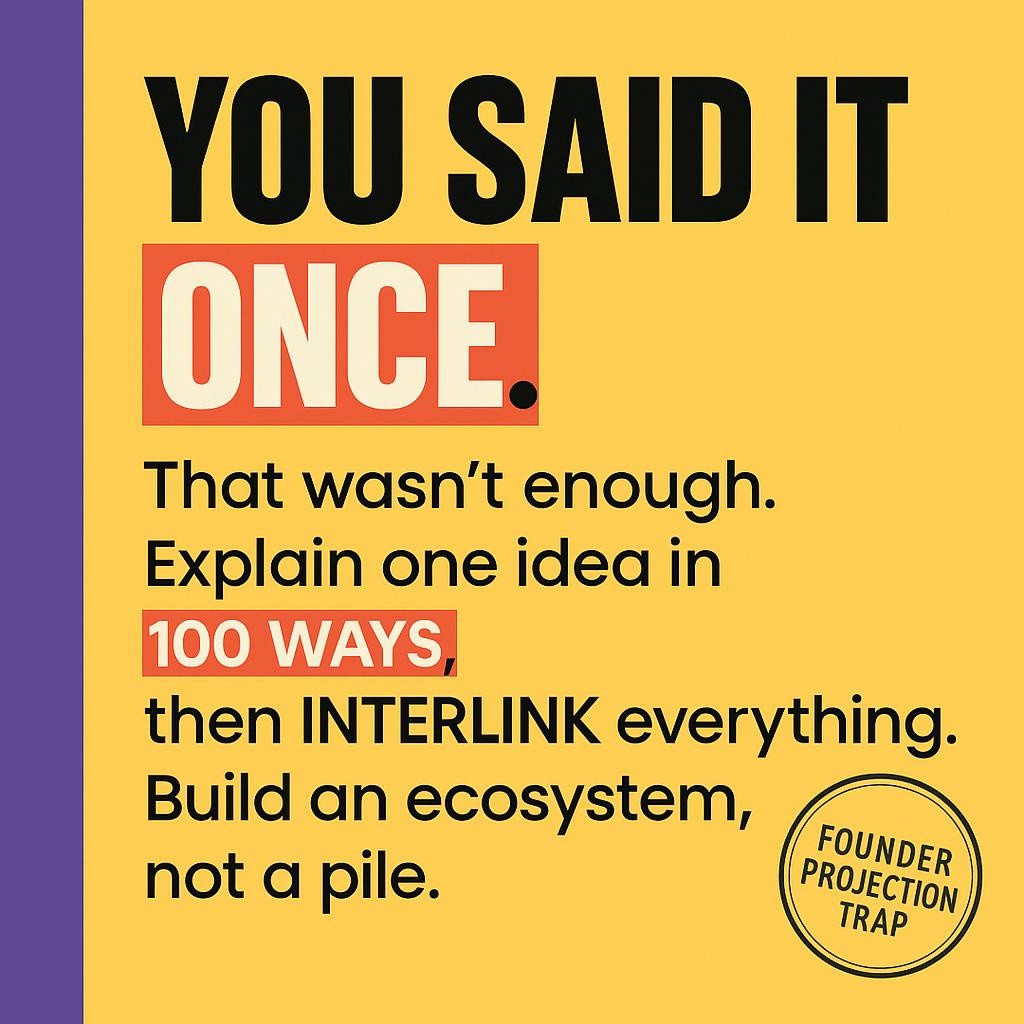
Step 3: Express one core idea in 100 different ways
This is where most founders finally relax, because it stops feeling like inventing. It starts feeling like teaching.
One core idea might become:
- A story about a customer
- A bold statement post
- A “hot take” reel
- A calm explainer thread
- An FAQ answer
- A visual diagram
- A teaching piece in your newsletter
Same truth. New doorway.
Because each time you repeat your core ideas, you do it through a new story, a new metaphor, a new example, a new emotional angle, a new platform, a new format.
And that’s when something important happens:
"Repetition does not bore people. Repetition teaches people."
“Publish and interlink everything” (so your content becomes an ecosystem)
If you want your marketing to last, you can’t treat content like disposable output.
You need structure that compounds.
Here’s the move that turns a pile into a system:
"Publish and interlink everything."
Why? Because you’re not trying to create isolated wins. You’re trying to build understanding over time.
When content is interconnected, every new piece strengthens the rest. Your audience gets more context. More reinforcement. More proof. More familiarity.
This is how your brand stops feeling like scattered posts and starts feeling like gravity, heavier in the market, more real, more felt, more substantial.
And yes, it helps with search. But it’s bigger than SEO.
It’s about memory.
"Humans remember universes. They forget fragments."
The “empty room” problem (and why your best post flopped)
A lot of founders think low engagement means the content wasn’t good.
Often, the content was fine.
The room was empty.
Most brands are talking to nobody, posting into a void where no one is listening, waiting, engaging, or being transformed.
So you post something great and the platform basically shrugs and moves on.
That’s why we focus on conditions, not just copy.
To be seen, platforms want signals, steady presence, rhythm, patterns they can trust.
That’s why we prepare the room with:
- daily multi-format posting
- cross-platform distribution
- content linked back to deeper narratives
- psychological consistency
- brand voice clarity
- rituals that create familiarity
- patterns that algorithms trust
When the room is warmed, your message has somewhere to land.
And it saves founders from a predictable emotional spiral:
Day 1: excited to post
Day 10: why is no one engaging
Day 30: maybe our business isn’t interesting enough
Day 60: silence
Day 90: one random “We’re back!” post
This isn’t laziness. It’s emotional depletion from speaking into a void.
A system prevents the spiral.
Ritual is the secret weapon (meaningful repetition that builds belonging)
Most founders think they need more content.
Here’s the real truth:
"Most founders think they need more content. What they really need is meaningful repetition that builds belonging."
That’s ritual.
Ritual looks like a recognizable cadence, tone, and thematic throughlines. It looks like weekly segments, predictable formats, recurring themes, signature phrases, patterns your audience can emotionally invest in.
Ritual does something most marketing never talks about: it lowers anxiety.
When you disappear, people feel subtle tension:
Are they still active? Are they stable? Should I trust them with my money?
Consistency signals safety, reliability, competence, maturity.
It also lowers your anxiety, that constant “I should be posting” pressure that drains your energy and creates guilt and avoidance.
This is why Inkflare exists. You run the business. The system keeps the heartbeat going.
Or in one clean line:
"You’re running the business. Inkflare runs the rituals."
A simple way to know if you’re stuck in the trap
Ask yourself this, honestly:
Are you speaking in “chapter eight” language to people who are still trying to read “chapter one”?
Because that’s what the Founder Projection Trap does. It makes you outpace your audience.
The fix isn’t to shrink your vision.
The fix is to meet people where they are, and walk them forward.
That’s what repetition is for.
That’s what interlinking is for.
That’s what daily presence is for.
Your mission is not too complex. Your audience is not too slow.
They just haven’t had enough chances to see the pattern yet.
So here’s the question that should change how you show up this week:
Did you really teach it, or did you just mention it once, on a Tuesday?