Your Content Should Feel Like a Mirror, Not a Stage (and That’s Why People Aren’t Converting Yet)
If your content feels like a performance, your audience feels like a spectator, and spectators don’t convert.
Most founders don’t have a messaging problem. They have a positioning problem.
They walk onto the content stage and announce:
- “Here’s what we do.”
- “Here’s how it works.”
- “Here are our features.”
- “Here’s why we’re great.”
And the result is painfully common: silence. Not because the product is weak, but because the content never made the audience feel like it was written for them.
Your content doesn’t need a bigger stage.
It needs to become a mirror.
Why your content isn’t converting (even if it’s “good”)
When your content is built like a stage, your audience experiences it like a performance. They watch. They judge. They scroll.
A stage asks for attention.
A mirror creates recognition.
Here’s the paradox that changes everything: people don’t fall in love with brands that talk about themselves, they fall in love with brands that talk about them, their struggles, their dreams, their fears, their questions, their worldview.
Your audience shouldn’t feel like they’re watching your performance.
They should feel like they’re looking into a mirror.
Humans bond with recognition, not explanation
You can explain your product flawlessly and still lose people.
Why?
Because "Humans bond with reflection, not explanation."
Explanation satisfies the mind. Recognition opens the heart.
People lean in when they feel:
- “That’s exactly how I feel.”
- “That’s my problem.”
- “That’s my frustration.”
- “That’s what I’ve been trying to say.”
- “Oh my god, this is me.”
That moment is not fluff. It’s not manipulation. It’s connection.
And connection has a clear chain reaction:
Recognition leads to resonance. Resonance leads to trust. Trust leads to alignment. Alignment leads to action.
That’s conversion, without the performance.
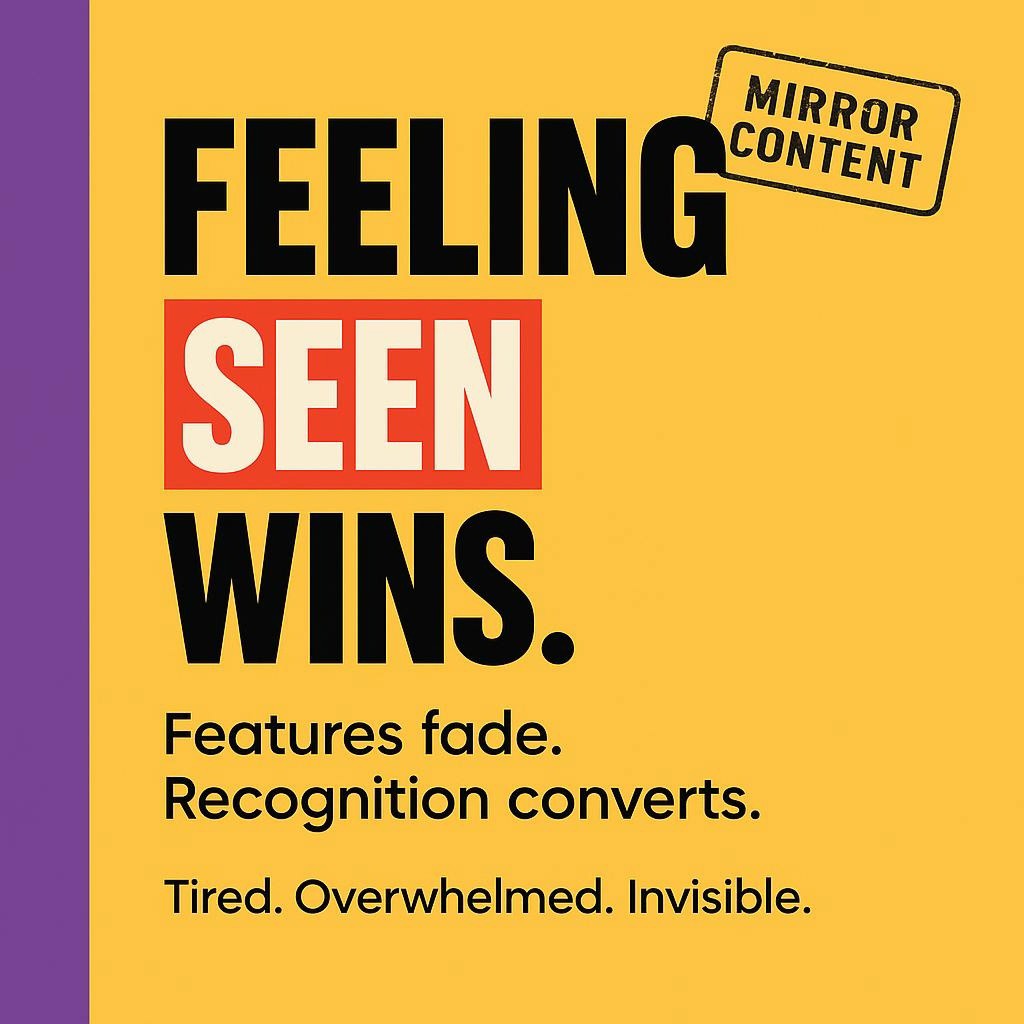
Features are forgettable, but feeling understood is unforgettable
This is the line most founders should build their whole content strategy around:
"Features are forgettable, but feeling understood is unforgettable."
No one wakes up thinking:
- “I need automated content workflows.”
- “I want AI-powered multi-format distribution.”
People wake up thinking:
- “I’m tired.”
- “I’m overwhelmed.”
- “I’m behind.”
- “I need help.”
- “I want my mission to reach more people.”
- “I can’t hire a full marketing team.”
- “I feel invisible online.”
- “I need to stay consistent, but I can’t keep up.”
Those are the emotional drivers. That’s what moves someone from scrolling to trusting to buying.
Features serve the mind. Understanding serves the heart. And people buy with emotion first, always.
So if your content is mostly specs, it’s trying to win with the wrong currency.
What mirror content actually does (and why it works)
Mirror content is not “better copy.” It’s a different job.
It’s built to do what most marketing avoids:
- name the audience’s challenges
- empathize with their pressure
- validate their mission
- mirror their internal dialogue
- give voice to their unspoken truths
It’s the difference between talking at people, and talking to them.
And it refuses to hide behind corporate wallpaper.
Most marketing fails because it sounds like marketing. It sounds like:
- “optimize”
- “streamline”
- “maximize efficiency”
- “leverage automation”
- “boost your online presence”
Mirror content sounds like a human being:
- "You’re doing the job of five people."
- "You’re growing a business nobody sees yet."
- "You have a mission bigger than your current audience."
- "You want to show up online, but you’re exhausted."
- "You want to teach. Not perform."
- "You want impact. Not noise."
That tone does something powerful. It creates belonging.
Because people gather around shared identity. When your content reflects the struggles and aspirations of purpose-driven founders, solo entrepreneurs, and small business builders, you aren’t creating “engagement.”
You’re creating community.
The fastest test: does your content describe your product, or their transformation?
A lot of content gets stuck here:
“Here’s our product.”
But the best content flips the narrative to identity:
"Here’s who you become when our product supports you."
That’s why mirror content converts. It’s not selling a tool. It’s reflecting a future self.
And it’s why a brand that reflects identity becomes a brand people never forget.
Ask yourself:
Are you listing what you do, or are you naming what they’re trying to become?
How to write mirror content today (without sounding like marketing)
You don’t need to pretend. You don’t need to craft every sentence perfectly.
You need clarity, emotional honesty, and a consistent voice people can recognize.
Here are the moves that matter most.
1) Lead with “where they are,” not “what you do”
Mirror content meets people in their lived experience, the places where they already are.
When someone feels seen, their defenses dissolve.
2) Say the quiet part out loud
Mirror content earns trust by naming the things people already feel but rarely say:
- pressure
- fatigue
- invisibility
- doubt
- ambition that feels heavy
If your audience is living it, your content should be willing to name it.
3) Replace jargon with real human language
Most founders think professionalism builds trust.
But “safe professionalism” often makes you invisible.
Clarity builds connection. Connection builds conversion.
4) Show up as a guide, not a performer
People don’t want forced authority. They want leadership that feels human.
And this line is the whole shift:
"Performance creates distance, Transparency creates intimacy."
When you stop trying to “be a marketer,” something changes. The truth comes out. The tone becomes real. The mission shines through.
5) Teach through story, not commands
Humans don’t learn best from instruction. They learn from narrative, especially when the lesson is relatable, the vulnerability is real, and the outcome is earned.
Stories build connection. Connection builds trust. Trust drives action.
Turn “tired, overwhelmed, invisible” into content people return to
Those emotional truths are not throwaway lines.
They are renewable fuel.
They also solve one of the biggest founder pains: content fatigue. The daily stress of “What should I talk about today?”
When your content reflects real emotional reality, you don’t need endless new topics. You need meaningful repetition, expressed through different angles, tones, and formats.
That’s how you build rhythm. That’s how you build recognition. That’s how you build trust.
Series theme 1: “I’m tired.”
This is the founder doing the job of five people.
Speak to the exhaustion of showing up online while running the business. Speak to the desire to teach, not perform. Speak to the need for steadiness.
This isn’t hustle content. It’s relief content.
Series theme 2: “I’m overwhelmed.”
This is decision fatigue. Too many platforms. Too many formats. Too much noise.
Mirror the pressure, then become the calm voice that reduces uncertainty. Brands become anchors when they feel stable, recognizable, and emotionally consistent.
Series theme 3: “I feel invisible online.”
This is the mission-led builder creating something real, and feeling unseen.
Mirror the ache, then reinforce the truth: consistency builds familiarity, familiarity builds trust, and trust builds action.
Over time, repeated presence moves people through layers:
Interesting. Familiar. Recognizable. Trusted. Ready.
That’s the long game, and it works.
Where Inkflare fits (and why this becomes sustainable)
Mirror content requires listening.
To create it, you have to understand your audience’s fears, hopes, pressures, insecurities, habits, decision triggers, internal language, and emotional world.
That’s hard when you’re the founder, the operator, the builder, and the person expected to post daily.
Inkflare exists to carry that weight with you, turning your mission, voice, and worldview into consistent content that reflects your audience back to themselves. Not generic. Not mass-produced. Seen. Heard. Understood.
Because your goal isn’t more posts.
Your goal is presence that feels like a mirror.
So here’s the real question to sit with before you write your next piece:
If your next post stopped trying to impress anyone, and only tried to make one person feel recognized, what would you finally say out loud?