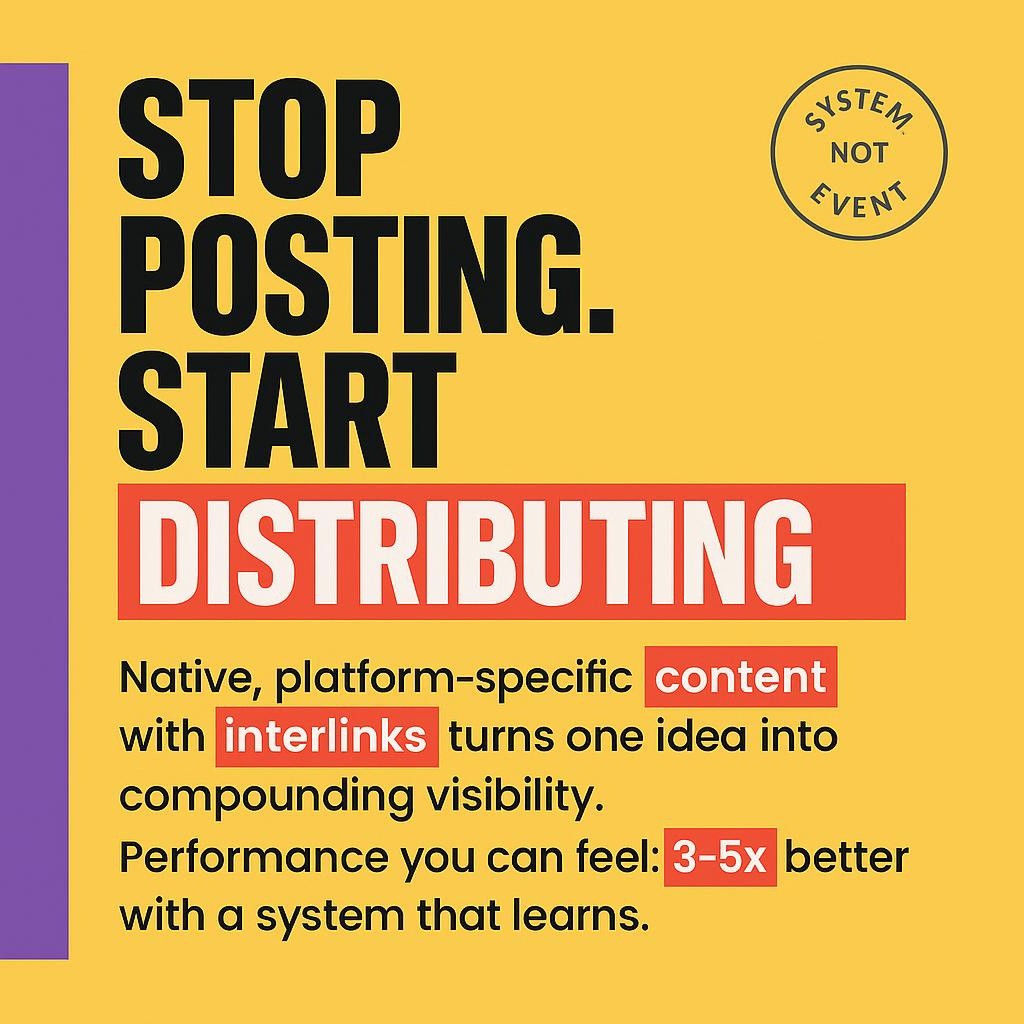
Stop Posting. Start Distributing: The Hidden Shift That 3–5x’s Performance
You are not short on ideas, you are short on a system. Posting is an event, distribution is a loop. When you make that switch, performance rises and stress drops.
The Pain You Can Name
A founder records a sharp six minute video on Tuesday morning. By Thursday, it is buried under Slack threads and client fires. A single LinkedIn post tries to carry the idea, then disappears in hours. No reuse, no links, no search presence, no compounding.
The work was good. The distribution was not.
If time is scarce and every platform wants something a bit different, you get stretched thin. Then you stop. That is the treadmill. The answer is not more posts. The answer is a distribution system that turns one strong idea into a connected constellation of assets, each native to its platform, each leading somewhere meaningful, each increasing discovery today and search durability tomorrow.
At Inkflare, we call it the distribution flywheel. “Presence, not just posts.”
The Core Shift: From Events To Systems
“Visibility equals authority times consistency times interconnection.” You can publish often and still stall if your pieces do not reinforce each other. Spikes fade. Momentum sticks.
Here is the shift that changes everything:
- Events become systems, so output compounds.
- Posts become pathways, so every asset leads somewhere useful.
- Content becomes infrastructure, so your work grows more discoverable over time.
Hold a simple standard, “Native or nothing.” Platform specific formats perform 3 to 5 times better than generic repurposing. A thread should read like a thread. A carousel should be built as a carousel, with a hook, scannable panels, and a link path. A blog should organize internal links and schema so search understands your topics. This is how you turn social reach into search permanence.
What “Distribution” Actually Does
Distribution is not blasting the same rectangle everywhere. Distribution is an intelligent loop that:
- Breaks one idea into channel native pieces, each with a clear job.
- Interlinks assets across social, search, and answer engines, so attention has a path.
- Routes traffic to a central hub, often a blog or resource that compounds through interlinks.
- Learns weekly which hooks, formats, and posting times move people, then tunes the next cycle.
The golden nugget is simple and powerful: steady interconnection turns output into an asset base. Picture a city. Each new piece is a street or storefront. Links are the transit system. As the map grows, discovery speeds up. Small teams look omnipresent without burning out.
Win Back Your Week
A real audit shows 14 to 22 hours vanish on manual content tasks. Planning, resizing, captioning, formatting, posting, re posting, then starting from zero next week. This drains creative energy and blurs strategy.
A proper loop gives those hours back. It centralizes planning, generates native variants from one source, interlinks automatically, and publishes on schedule. You focus on the spark. The system handles the spin.
Inkflare exists for this trade, less labor and more leverage. Your voice, multiplied, interlinked, and never generic.
Seven Days To See The Flywheel
Here is a clear path to ship and learn fast.
Day 1, choose the pillar
Pick one idea that matters to your ideal customer. Record a 5 to 8 minute pillar video, or outline a long form blog. Clarity first.
Day 2, build the native constellation
From that source, create:
- One blog organized around a clear question and answer.
- Two to three short clips with platform specific hooks.
- One LinkedIn carousel that previews the blog and links back.
- One email that tells the story and routes to the blog or video.
- Three to five answer style snippets for common questions across your site and social.
Day 3, interlink everything
Each clip points to the blog or a related resource. The blog links to the video, the carousel, and at least two related posts. The email links to the blog and one pillar page. Build a loop that never dead ends.
Day 4, finalize for each platform
Fix thumbnails. Trim intros. Write captions that start with the payoff. Add one clear call to action that matches the asset’s job. Keep the voice human and specific.
Day 5, schedule two weeks
Stagger formats by platform. Create small daily trails, for example clip in the morning, thread at noon, carousel in the afternoon, all pointing to the blog.
Day 6, ship
Let the loop run.
Day 7, learn and tighten
Review which hooks held attention and which links drove action. Tune headlines. Swap first panels. Reorder bullets. Save what worked. Next week, repeat with one new idea.
This is how you move from guilty posting to calm progress. Small start, big compounding.
One Idea, Ten Assets, Same Voice
Use this breakdown weekly:
- Video to clips, pull three crisp insights, write native hooks, cut to the strongest five seconds upfront.
- Video to carousel, distill the argument into 7 to 10 scannable slides, front load the promise, close with a path to the blog.
- Video to blog, expand examples, add internal links to related topics, include a short Q and A that mirrors the exact phrases people search.
- Video to email, tell the origin story, summarize the insight, invite the reader to the blog, keep it skimmable.
- Video to short answers, extract common questions, publish concise answers on your site and social, link back to the deeper post.
Each asset is native, and each one points to the others. That is distribution, not duplication.
SEO Gains Without Extra Grind
Search rewards clarity, relevance, and structure. When your assets cross reference each other with consistent language and internal links, you create topical clusters that search engines can understand. The blog becomes a hub. Clips and carousels act as feeders that send signals and people back to that hub. Over time, this interlinking accelerates indexing, reinforces authority, and increases your odds of ranking for the questions your audience asks.
You can strengthen the loop with simple moves. Use schema for key pages. Write descriptive alt text. Use clear headings that mirror search intent. Build internal links that map ideas into clusters rather than dead ends. Answer engines reward the same pattern, concise answers that point to in depth resources.
Keep It Human At Scale
Worried that automation will make you sound generic. That fear is valid and solvable. Model your voice once, then multiply it natively. Use your real language. Keep hooks specific. Share examples that come from your work. Use simple structure, a clear promise, brief proof, direct path.
Inkflare protects your voice and gives you back your time. “Machine powered humanity” is the goal. Your tone becomes a template. Your ideas become daily presence. Interlinks carry that voice across platforms without friction.
Quick Start Checklist For Lean Teams
- Pick one pillar idea that solves a real problem.
- Record 5 to 8 minutes or write 800 to 1200 words.
- Create native variants, clips, carousel, thread, blog, email, short answers.
- Add interlinks everywhere, never publish a dead end.
- Schedule for two weeks, cluster daily trails.
- Track what matters, hooks that hold, links that convert, pages that rank.
- Improve the next cycle, tighter hooks, stronger first five seconds, clearer headings, smarter internal links.
Repeat weekly. This is rhythm, not grind.
The Takeaway You Will Feel
When you stop posting and start distributing, your business feels different. You are no longer chasing algorithms. You are building a digital nervous system that routes attention where it creates outcomes. Vanity spikes fade. Durable signals grow, search visibility, qualified replies, booked calls, recurring revenue.
Consistency starts to feel like freedom. Your best work finally gets the permanence it deserves.
Inkflare was built for founders and lean teams who want that freedom. Learn your voice once. Publish daily, natively, everywhere that matters. Let interconnection do the heavy lifting.
One question to ship today, where will your next piece lead, and what will it link to? Build that path now, then let it run.