5 Trust Moves That Don’t Feel Salesy (But Lead to More Sales)
Trust is not a tactic, it is a promise kept over time. When you build trust in calm, repeatable ways, you quietly become the obvious choice when someone is ready to buy.
A coach told us this story. After launching her program and getting a handful of sign ups, she hit the wall that so many creators know. The feed moved on. Her inbox went quiet. She felt that pull toward pressure tactics and louder hooks, but her values would not let her. So she made a small shift. One useful idea a day, one gentle next step, one promise to show up weekly whether she felt inspired or not. Three months later, she was not louder, she was present. People started saving her posts. Bookmarks stacked up. Replies turned into conversations, then clients. She did not game the algorithm, she trained trust.
You are an author, a coach, an educator, a builder of frameworks that change people. Your marketing should reflect that care. At Inkflare, we believe your knowledge can do the marketing for you, and that trust grows best when it feels like service. These five moves are quiet, durable, and effective. Let them replace pressure with presence, then watch your reputation compound.
Why Trust-Based Marketing Works
People rarely buy because of volume. They buy because of relief. You lower the noise, you teach something that works, you keep your promises, and you invite a next step that feels light. Over time, those choices create a body of proof. Your content becomes a living library. Your ideas work like little workers that keep showing up in search, in saved folders, and inside teams. That is how you become the obvious choice.
Think of it like this:
- You are building equity, not paying rent. Paid ads are a spike that ends when the spend ends. Organic trust keeps paying out.
- You are growing a garden. Plant small, useful posts often. Let them keep feeding people. Water the ones people save.
- You are turning the lighthouse outward. Let your signal be steady and simple. People will find you when they are ready.
Now, the five moves.
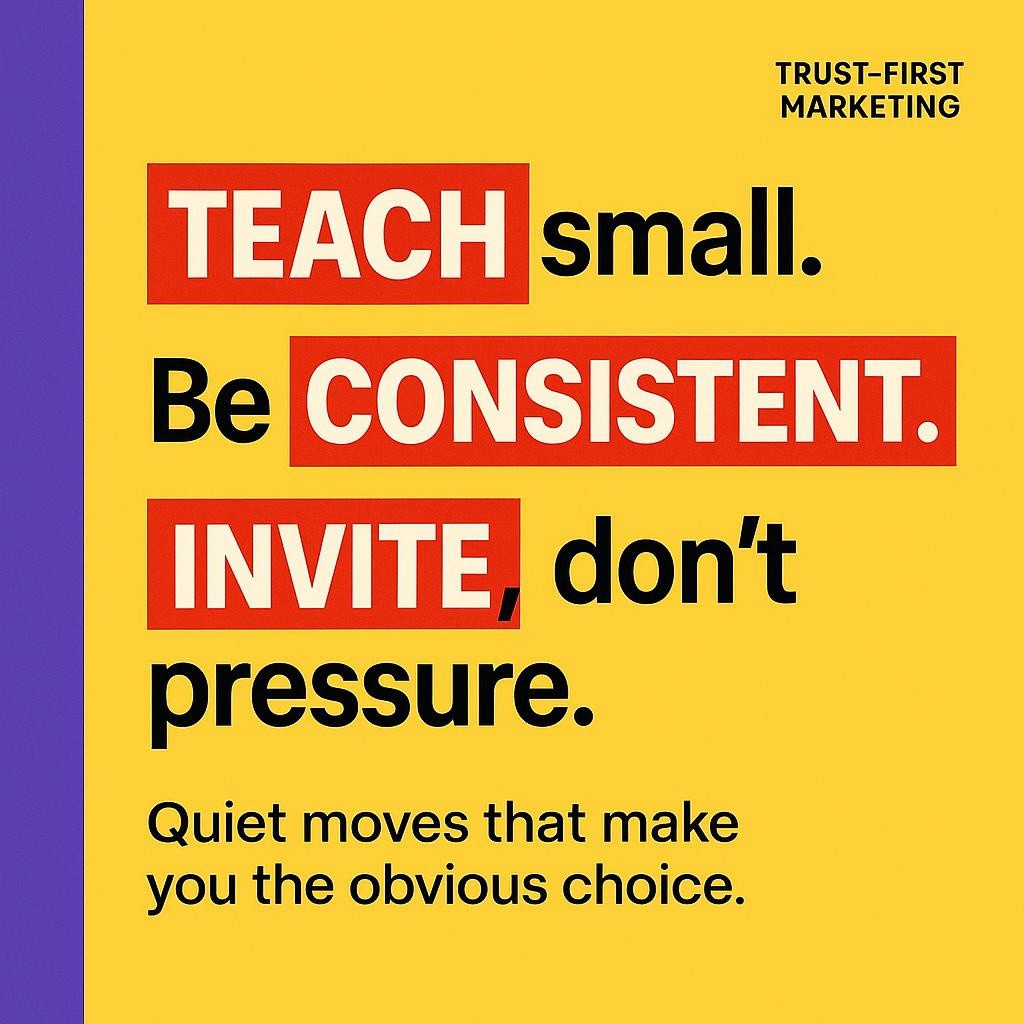
Trust Move 1: Teach in Small Doses
Big ideas are heavy. Small doses travel farther. A small dose is one principle, one short story, one action. It is complete. It respects attention. It gives a win right now.
Use this three by three micro teaching grid:
- List three core problems your reader faces.
- For each problem, list three small lessons or exercises that take under five minutes.
- For each micro lesson, add one gentle next step.
Examples you can post this week:
- Authors, share one paragraph riff from a sticky idea in your book. Add one question people can try today.
- Coaches, share a three sentence before and after from a client. Link a two minute audio that explains the shift.
- Educators, teach a complex concept with a simple metaphor. Give one step to apply it by tomorrow.
When someone saves your post, you are no longer fighting the feed. You are now in their personal library. That is trust you can see.
Action steps for today:
- Write down nine micro lessons from your chapters or signature program.
- Record them as short posts, carousels, or two minute audio clips.
- End each one with a small invitation, save this, get the checklist, try this question with your team.
Reflective question:
- If your reader only had five minutes with you, what would you teach that would help today?
Trust Move 2: Be Consistent, Not Perfect
Perfection is brittle. Consistency is believable. People are not counting commas, they are counting on you. A steady rhythm signals that you are reliable, which is exactly what buyers want to feel before they invest.
Pick a cadence that protects your energy. Weekly is powerful. Twice weekly is strong. Daily can work if you batch. The point is reliability, not speed.
A simple reliability plan:
- One anchor post each week that teaches a small dose.
- One repurposed asset that extends the anchor, like a short video or a carousel.
- One conversation starter, a question people want to answer.
- One quiet nurture, a short email that recaps the week and offers a next step.
If you miss, name it once and restart without drama. You are modeling the very habit you help your clients build.
How Inkflare supports you:
- We turn your book chapters, talks, and lessons into a queue of right sized assets that honor your voice. This lets you keep showing up while you rest. Organic presence grows when the work keeps publishing even when you are off grid. Your audience experiences you as consistent, not chaotic.
Reflective question:
- What is the minimum rhythm you can keep for six months without burning out?
Trust Move 3: Invite, Do Not Pressure
Pressure erodes trust. Invitation protects it. Buyers do not need a shove, they need a door that is easy to open. The best call to action is a tiny next step that costs little and moves them closer to a result.
Build a low friction CTA library and rotate it to avoid fatigue.
Discover CTAs:
- Save this for later.
- Share this with your team.
- Download the one page checklist.
- Watch the two minute explainer.
Deepen CTAs:
- Reply with your situation and I will point you to the right resource.
- Join the free mini workshop.
- Read the story that shows this in action.
Decide CTAs:
- See the curriculum.
- Book a 15 minute fit call.
- Start the seven day trial.
- Get the first chapter free.
Placement that helps:
- Put a micro CTA in the middle of a post when you teach a small dose for readers who are ready now.
- Put a second CTA at the end for those who want more after they finish.
- Add a light P.S. in email with a single, simple ask.
Tone that builds trust:
- Use plain language.
- Ask for one action at a time.
- Keep promises small and clear.
Reflective question:
- If your reader is interested but cautious, what is the smallest yes you can offer that still brings value?
Trust Move 4: Name the Problem With Care, Offer One Next Step
People hire you because you see their struggle without shaming them. You name it with care. You map a path forward. When you do that, you lower defensiveness and turn relief into motion.
Use this structure when you write:
- Mirror the moment. Describe what it feels like with specific details.
- Normalize the cause. Name the understandable reason behind it.
- Offer one next step. Give a small, doable action that builds momentum.
Mini story:
- A course creator told us her audience stalled at module two. Instead of pushing harder, she named the real hurdle, too many concepts competing. Then she offered one next step, spend 12 minutes on the single worksheet that unlocks module three. Completion rates rose. Sales followed, not because she pushed, but because she guided.
This move is ethical. It turns content into care.
Reflective question:
- What is the kindest true thing you can say about your reader’s current struggle, and what is one step that makes progress feel safe?
Trust Move 5: Make Promises You Can Keep, Then Keep Them
Trust grows when your words and your calendar agree. Make specific promises and keep them. Frequency, response windows, deliverable scope, these are all signals.
Small signals that add up:
- A simple autoresponder that sets expectations for replies within two business days.
- A weekly roundup that actually arrives weekly.
- A mini series that lands on the same day until it is done.
- A pricing page that is crystal clear and free of surprise fees.
Buyers forgive a missed comma. They rarely forgive a broken promise.
Reflective question:
- Which promise did you make in the last 30 days that you can honor again this week to double its effect?
Build Your Low Friction CTA Library
Create a document you can grab in seconds. Organize by intent.
For awareness:
- Save this guide if you are working on X.
- Send this to a colleague who handles Y.
- Want the cheat sheet version, grab it here.
For connection:
- Tell me your context and I will point to the right resource.
- Join the open Q and A on Friday, bring one question.
- Reply with the word START if you want the 7 day prompt series.
For conversion:
- See the outline and outcomes here.
- Book a 15 minute fit call, no pressure.
- Try the first chapter free, keep it even if it is not a fit.
Make each CTA measurable. Track saves, replies, click throughs, and bookings. Not every post should sell. Every post should serve. When service is steady, sales arrive.
Your Reliability Cadence: A Simple Weekly Blueprint
Use this as a starting point, then adapt it to your energy.
- Monday, draft the anchor lesson, one small dose that solves a real problem.
- Tuesday, repurpose the anchor into a short video or carousel.
- Wednesday, share a story or case that shows the lesson working.
- Thursday, run a conversation starter, ask a question people want to answer.
- Friday, send a short email that recaps the week, adds one fresh tip, and invites one next step.
Batch two or three weeks at a time if possible. If life intervenes, publish a one line check in with a single resource you love. Reliability is a pattern, not a prison.
Metrics that matter:
- Saves and bookmarks are signals of usefulness.
- Replies and quality comments are signals of relevance.
- Search queries and site time are signals of discoverability.
- Watch time and completion rates are signals of clarity.
Follower counts and raw impressions can swing wildly. Do not chase noise. Watch the signals that predict trust.
What to Say When You Feel You Are Repeating Yourself
Repeat the truth with fresh angles. Repetition is not laziness, it is leadership. Your audience does not see every post. People join at different times. They need the core message many ways.
Three ways to repeat without feeling redundant:
- Change the container. A paragraph becomes a two minute audio, then a slide, then a worksheet.
- Change the narrative lens. Tell the story from your view, then your client’s, then the skeptic’s.
- Change the time horizon. Show the five minute fix, then the five week payoff.
Consistency compounds authority. You are building equity, not chasing a spike.
How Much Should You Give Away
Give away the why and the what freely. Charge for the how together. Teach principles and small actions. Let the paid work provide depth, feedback, and accountability. The more someone tries your small steps and succeeds, the more they trust you with the bigger journey.
A useful boundary:
- Free, small lessons, checklists, stories, short Q and A.
- Paid, personalized roadmaps, deep feedback, community support, full transformation frameworks.
You will not run out of value. Your voice and judgment are not commodities.
What To Do When You Have Nothing New To Say
Curate with care. Pull a timeless passage from your book. Revisit a classic post and add one new observation. Share a client win with permission. Highlight a peer’s idea and explain why it matters to your audience. You are not a content vending machine. You are a guide. Guides know when to share, reflect, or rest.
If you need a system that keeps your evergreen ideas circulating, that is what we built Inkflare to do. We help authors, course creators, thought leaders, and educators turn existing work into a living library that keeps showing up for the people who need it. It learns your voice, keeps your cadence, and scales your wisdom at a fraction of agency costs. Your craft gets the attention it deserves, without you losing the rest that fuels it.
A Story of Quiet Compounding
Mira is a leadership educator with a signature framework that always landed in the room but rarely landed online. She committed to three months of small dose teaching. Each Tuesday she posted a two minute lesson. Each Thursday she shared a short client vignette. Each post ended with one invitation, save this for review with your team or get the one page brief. She promised an open office hour on the last Friday of each month and kept it.
What happened next:
- People started quoting her phrases back to her in discovery calls.
- Newsletter replies shifted from thanks, great post to here is our situation, could you help.
- The office hour became a low pressure gateway to paid workshops.
No hacks. No hard sell. Just service with a steady drumbeat. Her calendar filled because trust did.
A Field Guide To Trust-Based Marketing That Sells
Use this checklist to align your next month.
Clarity:
- One sentence promise you can keep.
- Three problems you solve, written in everyday language.
- Nine micro lessons mapped to those problems.
Cadence:
- One anchor teaching post each week.
- One repurposed asset from the anchor.
- One story and one conversation starter.
- One weekly summary email with a gentle CTA.
Calls to action:
- Three discover CTAs, three deepen CTAs, three decide CTAs.
- Add mid post and end post invitations.
- Track saves, replies, and click throughs.
Care signals:
- Response time expectation set and met.
- Replay and resource delivery times honored.
- Pricing and scope clear, no surprises.
Energy:
- Batch creation days scheduled.
- Two rest days protected each week.
- A back pocket set of evergreen posts for weeks that go sideways.
If you feel yourself tightening up, remember the principle, small doses, steady rhythm, clear invitations. The goal is not to perform, it is to serve.
Frequently Asked Questions
How do I sell without being salesy?
- Teach something useful, then offer one relevant next step. Keep your tone plain and your promises small. Repeat weekly.
What are examples of gentle CTAs?
- Save this for later. Download the one page version. Tell me your context and I will point to the right resource. See the curriculum. Book a fit call.
How often should I post?
- Weekly is a strong minimum for anchors. Add one or two repurposed assets. Consistency beats bursts.
What if I miss a week?
- Acknowledge it once, share one valuable resource, restart. Reliability is a trajectory, not an unbroken streak.
How much free content is too much?
- Share principles and small wins generously. Keep depth, feedback, and transformation inside your paid work.
What metrics matter?
- Saves, replies, search queries, watch time, and completion. Follower counts are noisy. Look for signals of trust.
Why This Approach Sticks
People do not remember who shouted. They remember who showed up, taught them something that worked, and invited them forward without pressure. These trust moves scale because they are rooted in service, not stunts. They honor your audience’s agency and your energy. Over time, your body of work becomes searchable, sharable, and self sustaining.
Inkflare exists to help you build that body of work. We are working authors and builders who got tired of seeing great ideas disappear after launch. We asked a simple question, what if the knowledge itself could do the marketing. Now we help creators turn books, courses, and coaching frameworks into steady, discoverable content streams, at roughly one fiftieth the agency price, while protecting the voice and rest that make the work good. Organic presence over paid ephemera. Voice over hacks. Rest as fuel for quality.
The five trust moves will always matter. Whether you use a tool or run your system by hand, you can start today. “One small dose taught. One promise kept. One invitation extended.”
Close your eyes and picture a reader or client you care about. What is the smallest thing you can teach them today that moves them forward by one step? Teach that, then invite the next good step. Do it again next week. Keep going until the calendar looks like trust.