The Anatomy of an Idea That Travels: Structure Your Blog to Be Remembered
Bold ideas do not win because they shout, they win because they are easy to carry.
We have sat where you are, with a book or a course you poured yourself into and a blog no one noticed. After our own launches fell quiet, we made a different choice. We stopped chasing tricks and studied the posts that keep moving for years. The pattern was clear. The pieces that travel have structure, clarity, and heart. Not one of these alone, all three together.
This guide is our best blueprint. It honors your voice, your time, and your reader. It turns a single post into a bridge, from casual reader to loyal follower, and it compounds while you rest.
A Quick Story With Big Lessons
A coach we admire teaches de-escalation for school leaders. Her first blog on burnout tried to do everything, a long list of symptoms, tools, and studies. It was well intended, heavy to read, and easy to forget.
We rebuilt it around one idea. She retitled it to promise one outcome. She opened with a single hallway scene. She taught one technique deeply. She ended with a quiet invitation to try it in the next hard conversation.
That post keeps getting saved and forwarded. Her phrases echo in staff meetings weeks later. That is what it means for an idea to travel.
What Makes An Idea Travel
Ideas travel when they are packed light. A reader should be able to learn your point, retell it in simple words, and apply it today. To make that possible, your post needs a spine.
- Structure, so the idea stands up under skimming.
- Clarity, so the reader never wonders what matters.
- Heart, so your words feel written for a person, not a metric.
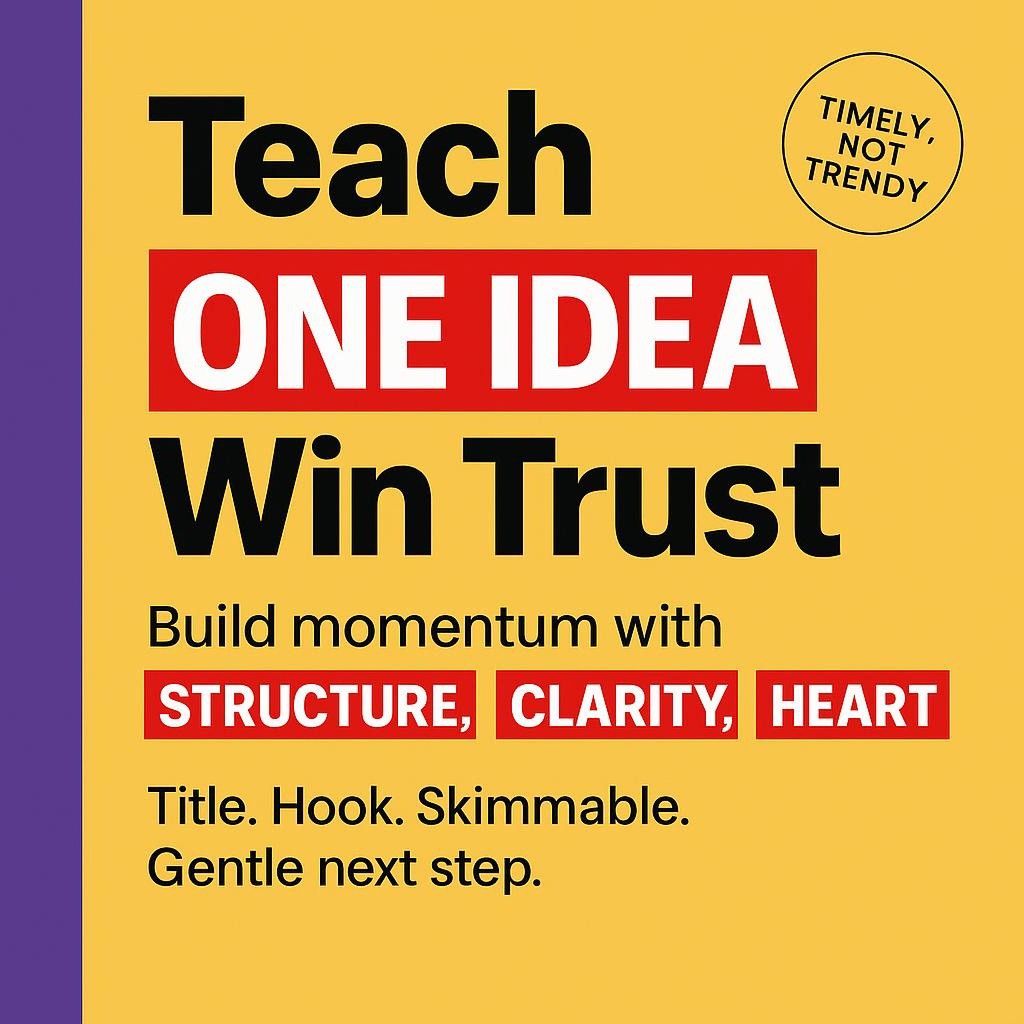
If you only keep one line, keep this. "Teach one core idea." When you teach one idea well, you give the reader a handle to hold and a story to share. You make it easy to remember, easy to pass on, and easy to act on.
The Five Parts Of A Post People Remember
The blueprint is simple. Start with a clear title, hook the first paragraph, teach one core idea, make it skimmable, and end with a gentle next step.
1) Write a Title That Promises One Outcome
Your title is a promise. It sets one clear expectation and makes a specific reader feel seen. Clarity is kindness. Curiosity is the second ingredient.
- Keep it under 65 characters when you can.
- Name the reader and the result. If only one fits, choose the result.
- Do not hide the point with cleverness. Your reader is not a puzzle to solve.
Title patterns that work:
- How to [do specific thing] without [common pain]
- The [number]-step [process] that [outcome] for [audience]
- Stop [unhelpful habit], Try This Instead, [simple shift]
- What I Wish I Knew Before [moment] as a [identity]
- The Quiet Skill Behind [outcome], and How to Learn It
Examples:
- How to Calm a Heated Parent Conversation without Losing Authority
- The 5 Questions That Turn a Draft Into a Publishable Post
- Stop Pushing Through Burnout, Try This Reset That Restores Momentum
Quick test, can your reader know this is for them in three seconds, and can they picture the outcome they will get?
2) Hook the First Paragraph With a Human Moment
Open with something your reader can feel. A scene, a sharp sentence, a quiet confession. You are building trust fast.
Try one of these:
- A single vivid moment. One hallway, one inbox, one kitchen table at midnight.
- A short line that surprises and rings true.
- A question that creates self recognition.
Three sentence opening template:
- Name the moment they know well.
- Acknowledge the cost of getting it wrong or the relief of getting it right.
- State your core promise for this post.
Example:
You publish the post and your heart drops when the first comment nitpicks a detail. You can feel the energy leaving your next draft before you even write it. Today, you will learn a way to structure your post so the right readers stay and the nitpickers lose interest.
3) Teach One Core Idea, Go Deep Not Wide
This section is the heart. Choose one idea and teach it like a craftsperson. Your reader does not need every tool, they need the right tool and the confidence to use it.
Use this sequence:
- The Question, what single problem or moment does this solve?
- The Shift, what belief must change for the solution to make sense?
- The Steps, what few moves produce a real result?
- The Stakes, what changes in the next 24 hours if they try it?
Example, the core idea is write for one person, not everyone.
- The Question, why do specific posts keep performing?
- The Shift, you thought broad equals bigger reach. In truth, specific equals shareable because people forward what feels like it was written for one friend.
- The Steps:
- Say your reader’s name out loud before drafting.
- Write them a useful note, not an article. Keep it direct and kind.
- Swap general nouns for the details they actually live with.
- Cut any paragraph that serves a different person.
- The Stakes, when you write for one, more of the right people arrive and stay, and your post keeps traveling because it is easy to recommend.
Hold this image, your idea is a seed. Depth is soil. Without depth, a seed sprouts and dies. With depth, it roots and survives many seasons.
4) Make It Skimmable, Respect Attention
A skimmable post says, we planned for your life. It uses clear headings, short paragraphs, and meaningful emphasis. Format is not decoration, it is how your meaning arrives.
Skimmability checklist:
- One simple line near the top that states the core idea in plain language.
- H2 and H3 headings that summarize the point, not cute labels.
- Short paragraphs, most with one to four sentences.
- Bulleted lists for steps, mistakes, metrics, or resources.
- Bold sparingly for lines you want remembered or quoted.
- Internal links to one to three related posts that continue the same journey.
- A short FAQ at the end that answers the real questions readers ask.
Small details that pay off:
- Use descriptive alt text so your idea is accessible and searchable.
- Place natural key phrases in headers where it helps the reader.
- Put your strongest line above the fold so the preview earns the click.
5) End With a Gentle Next Step
A pushy CTA breaks trust. A gentle next step respects agency and invites momentum. Offer one action for today, one resource to go deeper, and one low friction way to stay connected.
Soft CTA menu:
- Try this one minute exercise now, then tell me what changed.
- Save this checklist for your next draft. If you used it, reply with your before and after.
- If this helped, subscribe for one useful post each week that builds on this.
- Want personal help, book a short consult. No pitch, just an assessment.
You are not chasing a conversion that evaporates. You are building a relationship that compounds.
The Deeper Goal Your Post Serves
Your blog is not a billboard, it is a bridge. The near goal is to help. The longer goal is a movement, a slow path where a stranger becomes a subscriber, a subscriber becomes a student, and a student becomes a champion who brings their friends. Each strong post becomes one of your little workers, showing up in searches, bookmarks, and forwarded emails while you rest. This is organic equity. Paid reach is rent, useful for a push. Organic presence builds a home.
Before And After Examples You Can Steal
Better titles:
- Before, How To Be Productive
After, A 3 Block Day That Protects Deep Work Without Burning Out - Before, Improve Your Public Speaking
After, The 4 Beat Story That Makes Any Talk Land, Even If You Are Nervous
Better hooks:
- Before, Public speaking is important in many careers.
After, Your mouth goes dry and your slides feel like strangers. You have one minute before they decide to keep listening. Here is the four beat story you can tell before the slide even changes.
One chapter into weeks of content:
- One coach took a chapter on conflict skills and turned it into four posts. Post one taught a single listening technique. Post two showed a before and after script. Post three handled the most common mistake. Post four offered a printable checklist. Each post linked to the others and to a short email course. Over months, these pieces kept bringing in the exact readers she serves best.
SEO That Respects Humans
Search engines read patterns. People seek meaning. You can serve both.
- Write for a question someone would actually type. Use that question, or a tight version of it, as a header.
- Cluster related posts on one topic, then interlink them to build topic authority and reader momentum.
- Use synonyms and related terms in natural ways. Think like a teacher, not a keyword stuffer.
- Add a short FAQ that answers two or three nearby questions.
- Update posts when you have better examples or a sharper title. Keep the URL. Let it age.
Remember, the goal is not to trick a crawler, it is to keep a promise to a person who searched for help.
A 90 Minute Writing Flow That Protects Your Energy
You do not need a new personality to publish consistently. Try this weekly rhythm.
- Minutes 0 to 10, pick one reader and one problem. Say both out loud. Write one line that promises the outcome.
- Minutes 10 to 25, title sprints. Write ten versions. Circle two. Step away for one minute. Choose one.
- Minutes 25 to 40, write three different openings, a scene, a surprise, a question. Pick the strongest.
- Minutes 40 to 65, teach the idea. Use the Question, Shift, Steps, Stakes sequence. Stop at three steps.
- Minutes 65 to 75, skimmability pass. Add clear headings, shorten long sentences, bold one memorable line.
- Minutes 75 to 85, add a gentle next step. Link one older post that supports this one.
- Minutes 85 to 90, read it out loud. Cut filler. Publish or schedule.
Do this each week and you are building a garden that keeps producing, not a bonfire that consumes you.
Templates You Can Use Right Now
Title patterns:
- The Tiny Habit That Protects [Outcome], Even When [Constraint]
- A Simple Script For [Hard Conversation] That Preserves [Value]
- Why [Common Advice] Fails, And What To Do Instead
- The Beginner’s Map To [Skill] In 30 Minutes A Day
Hook starters:
- You will not forget the first time you…
- Here is the moment that changed how I…
- If you only do one thing today, do this…
- You are not lazy, you are missing a structure that…
Skimmability checklist:
- Do the headers advance the same idea?
- Are the examples concrete, not abstract?
- Could a new reader get the point by reading only the headers and bold lines?
- Are there one to three links to deeper help, not a maze?
- Is your best line near the top?
Gentle next steps:
- Try the steps with one person in your life by Friday. Notice one change.
- Save this post and use the checklist on your next draft. Send your before and after.
- If this post earned your trust, subscribe for weekly prompts you can use in ten minutes.
Common Mistakes And How To Fix Them
- Trying to do five things. Fix, choose one idea. Put the rest in a folder titled Next.
- Vague titles that hide the benefit. Fix, name a result and a reader in plain words.
- Openings that throat clear. Fix, start in the middle of the moment or with a line that snaps attention awake.
- Teaching without stakes. Fix, show what changes in the next 24 hours if they try your idea.
- Pushy endings. Fix, offer one small action and one way to stay connected, and let that be enough.
How Inkflare Fits In
At Inkflare, we believe your knowledge should do the marketing while you do the meaningful work. We built the product we needed as working authors and builders. It learns your voice, turns your books and coursework into a living library of posts, and keeps publishing on your behalf while you rest. You get professional grade presence at a fraction of agency cost, and you keep your voice intact. More importantly, you build organic equity. Each post becomes one of those little workers, showing up for the right reader at the right moment. We handle the consistency, you handle the craft.
If you want help turning one chapter or module into months of steady, discoverable content, Inkflare is your partner. We amplify wisdom, sustainably.
Short FAQ
What is the one thing I should never skip?
"Teach one core idea. Everything else is furniture." Build your room around that idea, title, hook, skimmable structure, gentle next step.
How long should my post be to rank and still be readable?
Write until the promise is kept and the steps are usable. Use clear headings and a short FAQ. Keep the URL. Improve the post over time.
What if my topic feels too small?
Small is shareable. People forward what feels written for one person. Specific language creates trust and travel.
The Golden Nugget
When you feel tired or tempted to complicate the work, return to the line that centers everything. "Teach one core idea." The clear title, the hooked opening, the skimmable structure, and the soft invitation are the room around that idea. Make it a room your reader wants to return to and invite someone into.
A Gentle Invitation
Your next post does not need to be louder, it needs to be easier to carry. Pick one reader and one idea today. Promise one outcome in your title. Hook with a human moment. Teach the idea like it matters, because it does. Make it skimmable. End with a soft invitation. Then rest, and let your little worker do its work.
What is the one idea you will teach next, and who are you writing it for by name?