Why Consistency Beats Perfection (And How to Make Consistency Easy)
Bold truth: perfection is the most elegant form of procrastination.
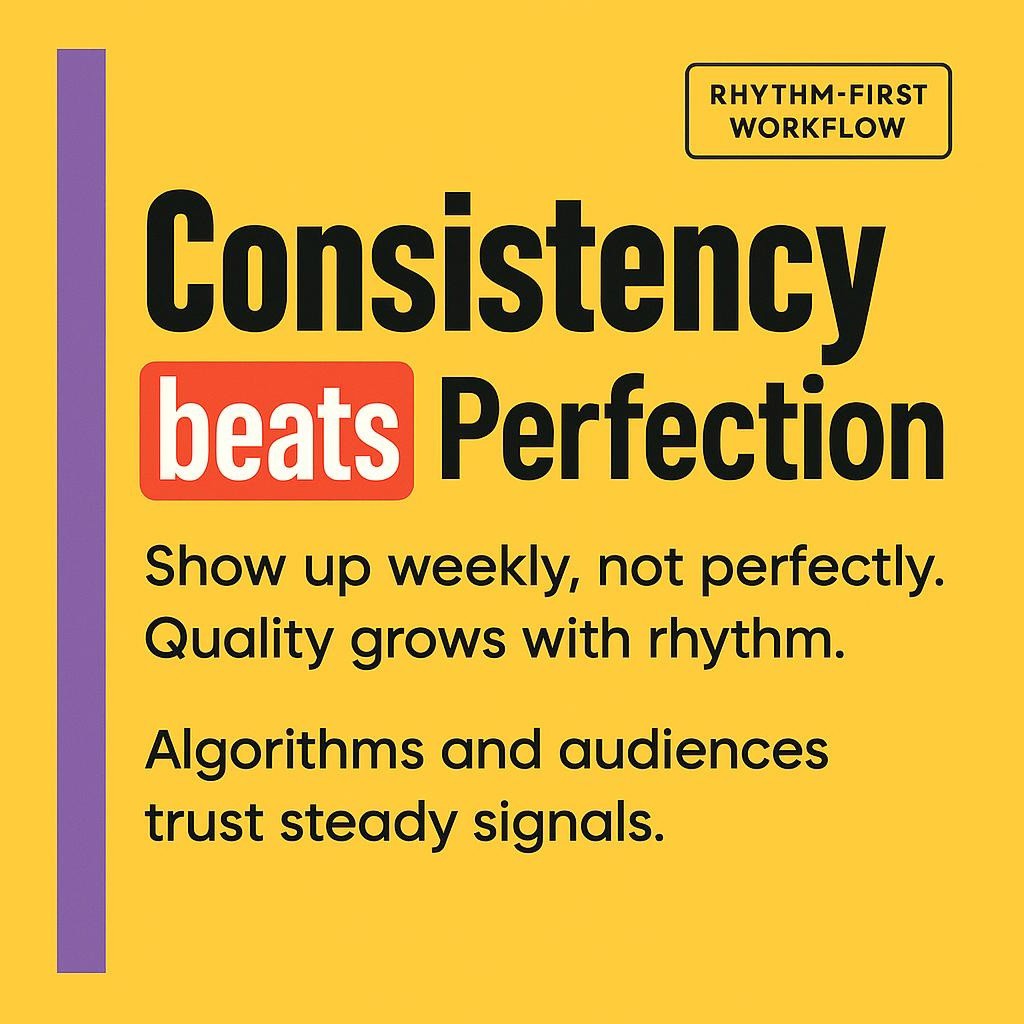
You have high standards because you care. But when caring turns into endless polishing, your best ideas never reach the people who need them. Visibility is built by steady signals, not rare, flawless pieces. Consistency is how algorithms learn you, it is how audiences trust you, and it is how your craft compounds over time.
At Inkflare, we keep seeing the same shift change everything. When creators move from perfection pressure to rhythm-first publishing, reach rises. Trust rises. Confidence rises. Quality follows cadence, not the other way around.
This is your permission to build a rhythm you can keep, and a system that keeps going even when life gets loud.
The Day After Launch: When The Noise Gets Real
You publish your book or course. The graph spikes. Congratulations. Then the slope softens, then flattens. You did not get worse. The world is just noisy.
This is when perfection knocks. You promise to post when there is time to make it great. A month slips away. Then two. Now the next post feels like it must be perfect because it has been a while, which means it never ships.
There is a kinder plan. Choose consistency as your strategy, then make consistency easy.
The Golden Nugget: Compounding Equity Beats One-Off Wins
Treat your content like assets. "ads are rent, organic builds equity". When you pay rent and stop, you disappear. When you build equity, your work keeps working for you.
Every helpful post becomes a little worker living on the internet. It shows up in search, gets saved, shared, and linked. One post rarely changes your world. One hundred little workers often do. Your ideas become a garden that keeps producing, even while you rest.
Why Perfection Feels So Convincing (And What To Do Instead)
Perfection dresses up as care, but it is usually fear. Fear of being judged. Fear of not being original enough. Fear of being boring. The antidote is not lowering your bar, it is designing a repeatable way to meet it.
Set a standard you respect. Then build a workflow that makes meeting that standard automatic.
A Rhythm-First Workflow You Can Keep For Years
Use three simple phases: Capture, Shape, Publish.
Phase 1: Capture (Live In Harvesting Mode)
- Pick three topic pillars that match your book, curriculum, or coaching method. For example: Mindset for Learning, Method in Practice, and Case Studies.
- Keep a capture file open everywhere. Notes app, doc, or voice memos. After a client call or class, jot the exact words you used to explain a tricky point.
- Mark repeatable winners. If you end up telling the same story twice and it lands, highlight it. Reuse is not laziness. It is signal.
Reflective question: What questions do people ask you again and again, and how can you answer them more simply next time?
Phase 2: Shape (Turn Raw Notes Into Clear Structures)
- Create two or three templates per pillar. For example: a 5-step how to, a before and after story, or a myth versus truth comparison. Templates do not limit creativity, they remove decision fatigue.
- Define your minimum viable post. One clear title, one core idea, one example, and one next step. Done is the point.
- Build a small story bank. Keep your short origin story, client mini wins, cautionary tales, and honest mistakes. Rotate them to reinforce your message without repeating yourself.
Reflective question: If someone had only two minutes, what is the one useful thing you would want them to take away?
Phase 3: Publish (Build a Steady Beat, Then Let It Scale)
- Choose a beat you can keep. Two posts a week for twelve weeks beats five posts a week for two weeks, then silence. Start smaller than you think, then raise it when it is easy.
- Batch by energy. Write when your brain is fresh, edit when it is medium, schedule when it is tired. Protect your prime energy for creating, not fighting tools.
- Automate the boring, guard the voice. Schedule posts and reuse headlines that work, but keep your unique phrasing and point of view in the final pass.
The Invisible Lift Of Regularity
Platforms notice patterns. People do too. When you show up on a steady beat, your work surfaces more often for the people who engage. Readers start expecting you, then looking for you, then saving you. Trust grows when you show up when you said you would.
The person who needs your help next Thursday cannot benefit from a post that never leaves your drafts.
Stories From The Field
- The coach with the silent blog. A leadership coach wanted every article to read like a chapter. Lovely prose, almost no publishing. We set a beat of one useful weekly post, two short clips from client sessions, and a monthly deep dive. In 90 days, saves tripled, new inquiries referenced headlines by name, and she stopped apologizing for being invisible. She did not get louder, she got regular.
- The educator with the crowded brain. A math educator had years of lessons stuck in long videos. We indexed recurring explanations, pulled crisp examples, and posted single tips with a practice prompt. Teachers started tagging him in their classroom wins. It was not a splashy launch. It was a steady stream of little workers that kept helping.
- The author who disappeared after the spike. After launch, he shifted to a rhythm: one weekly story from his research, one myth debunked, one behind the scenes lesson. Search traffic rose slowly, then older posts began getting rediscovered. The garden started feeding itself.
Set A Quality Bar That Invites Consistency
Perfection is endless. Standards are clear. Define them once, then ship to them.
- Define done. No factual errors. One clear takeaway. A skimmable structure. One proofread pass. If the post meets the standard, it ships.
- Time-box polishing. Editing is a container, not an abyss. Give yourself 20 minutes for style, then publish. Your first drafts get better because you practice more often.
- Use problem, promise, payoff. Name the problem in one sentence. Make a clear promise in one sentence. Pay it off in three to five bullets or one short story.
- Keep a list of go phrases. Save the lines that sound like you. Pull them when you are tired. You are protecting your voice, not cheating.
A Weekly Cadence That Compounds
You do not need every platform. Choose one primary channel, then echo to two simple secondary formats.
- Primary: one weekly anchor post, 600 to 1,000 words, on your site or main platform. Clear title, one idea, one example, one prompt.
- Secondary: two short pieces from the anchor. One quote card with a sentence that carries weight. One quick tip that summarizes a step.
- Optional: one personal note to your list. Brief and human. What you tried, what you learned, the question you are sitting with.
Hold this for 12 weeks and you have 12 anchors and 24 secondary pieces. That is 36 little workers pointing back to a body of work that signals trust.
Repurpose Without Feeling Repetitive
You already have more content than you think. It is trapped in longer assets.
- From book to posts. Pull one story, one definition, one caution, and one action step from a chapter. That is four posts. Close with a friendly next step.
- From course to clips. Pinpoint where students usually get stuck. Explain that moment with a fresh example and a quick practice. One moment, one clip, one win.
- From coaching to case studies. Write the before, intervention, and after in plain language. Guard privacy. Share the pattern. Trust grows with clarity.
- From talks to threads. Turn your sequence of points into a series. One point per post, each linking to the next. Guide readers through your thinking.
Rest Is Not Optional, It Is Fuel
Consistency is not constant output. It is predictable presence. You can rest, and you should.
- Plan rest weeks. Every eighth week, publish proven pieces you have already shipped. Your audience gets clarity. You get recovery.
- Build a buffer. Stay two weeks ahead. Life will interrupt. Your future self will be grateful.
- Protect your voice. Do not chase novelty for its own sake. Your audience needs your point of view, not every trend. Rest keeps your point of view honest.
How Search Rewards Patience
Search is slow by design. It rewards persistent usefulness. Clear titles on a steady beat help search engines map your expertise. Posts cluster around your themes. Pages interlink. Over months, your pieces buoy each other.
This is content equity. You are building a library. A reader finds one post, then three more, then subscribes because you keep showing up with help that matters.
Make Consistency Easy, Keep Your Voice
Tools should protect your energy, not flatten your voice. Inkflare was built to learn your tone, respect your ideas, and turn your work into steady, discoverable posts. Authors, coaches, and educators use it to turn chapters, lessons, and frameworks into ongoing visibility at a fraction of the agency cost. The intent is simple, "publish while you rest", and let your knowledge carry your message forward.
If you use any tool, ours or another, keep these principles:
- You steer the message. Let software schedule and format. Keep the insights and the final pass.
- Keep one source of truth. Store pillars, templates, and your story bank in one place. Fragmentation kills momentum.
- Lead with ethics. Attribute fairly, avoid invented stories, be transparent about how you publish. Trust compounds faster than reach.
A 7-Day Starter Plan You Can Follow Now
- Day 1: Choose your three pillars and write one sentence promise for each.
- Day 2: Draft three simple templates you will reuse. Keep them short.
- Day 3: Capture ten raw notes from recent calls, classes, or messages.
- Day 4: Turn one note into your anchor post using problem, promise, payoff.
- Day 5: Create two shorts from that anchor, a quote and a tip.
- Day 6: Schedule next week’s posts. Add 30 minutes to capture new notes.
- Day 7: Rest. Walk. Read your anchor out loud once. Ship on Monday.
By the end of week one, you have three published pieces and a system starting to hum.
Measure What Matters, Not What Shouts
You are building a body of work. Watch signals that reflect real value.
- Leading indicators: saves, replies, search impressions, time on page, completion rate for short videos.
- Lagging indicators: inbound inquiries, newsletter growth, invitations to speak and collaborate.
- Personal indicators: your energy after publishing, the ease of writing, the number of times a post lets you answer a question faster.
If these trend up, keep the beat. If they stall, adjust your pillars, sharpen your titles, and tighten your examples. The answer is rarely to publish less, it is to publish more clearly.
When Perfection Flares Up Again
It will. Use this tiny script.
- Ask: What is the core promise of this post in one sentence?
- Check: Does the draft deliver that promise with one example and one next step?
- Decide: Am I protecting the reader from confusion, or protecting my ego from judgment?
- Ship: If it meets the bar, publish it. If not, give yourself 20 minutes to revise, then publish anyway.
You are not writing for the critic in your head. You are writing for a busy human who needed your help five minutes ago.
Why This Matters To Us
Inkflare was born from a hard truth we lived. Writing the book was hard, getting it noticed was harder. So we asked a braver question: "what if the knowledge itself could do the marketing?" We believe creators should not have to choose between creating and being seen. We are here to level the field so wisdom, not budget, sets who is found.
We hold a simple promise: "publish while you rest". A post written in Los Angeles can spark change in Nairobi because "knowledge has no borders". Your ideas can travel farther than you could ever push alone.
And we carry a simple line at the heart of our work: "We amplify wisdom, sustainably."
Try This Today
- Write one post that solves one problem, with one example and one next step.
- Use a line you already say to clients or students.
- Give it a clear title and a gentle prompt at the end: Want more like this, follow along on Thursdays.
Tape this above your desk: “Show up, simply and steadily, so your knowledge can keep working while you rest.”
When you sit down to publish, ask one brave question: What is the next smallest useful thing I can ship today? Then ship it. The rest will compound.