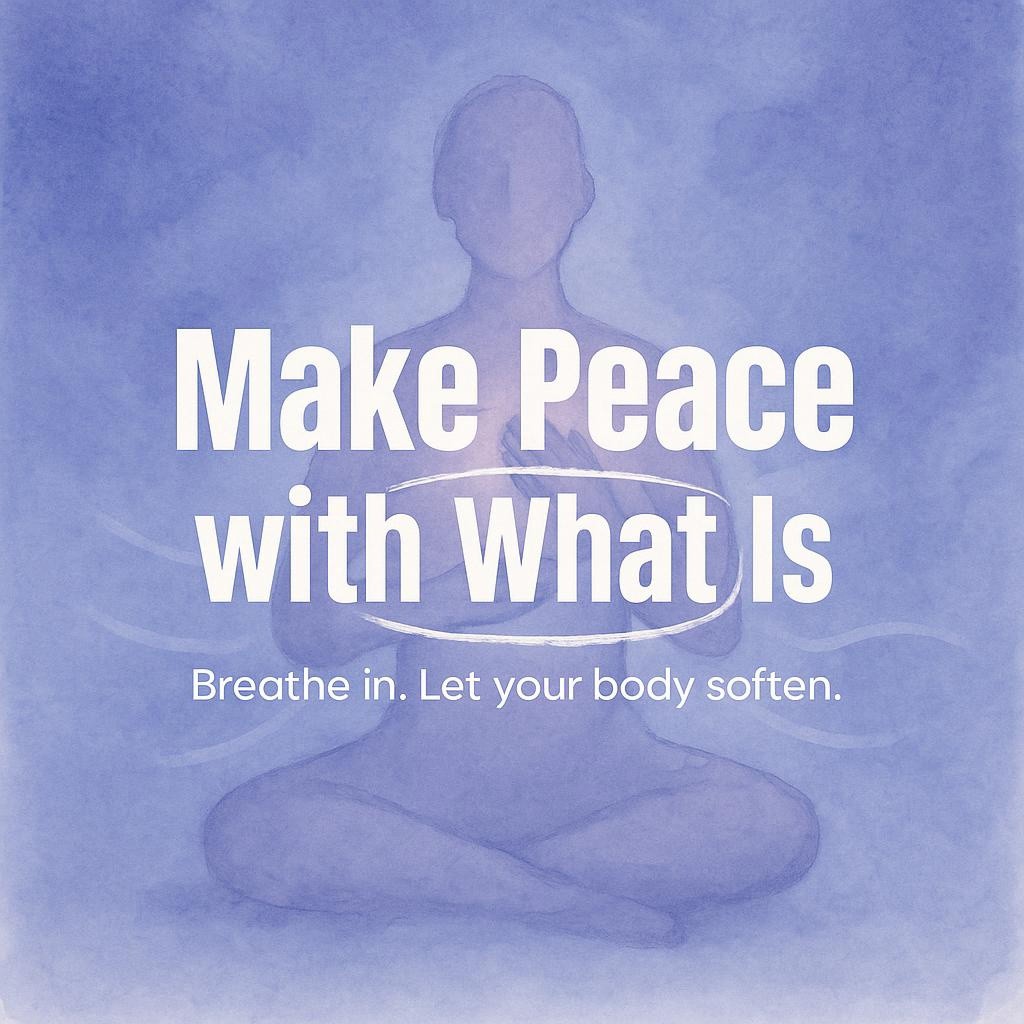
Make Peace with What Is: A Simple Breath Practice to Calm Anxiety and Dis‑Ease
Making peace with “what is” means telling the truth about what’s happening, then calming your body enough to respond with care and clear thinking. In "Let’s Be Peace" a contributor learned this the hard way while facing cancer: “Resisting ‘what is’ allows stress, worry, and fear to be present,” and “Resistance is rooted in fear.” Peace does not erase a hard reality, but it can settle your system so “healing and then answers can come forth.” When you stop fighting the moment inside your body, you often find your next step faster, and with less fear.
What “making peace with what is” means (and what it does not)
Making peace with “what is” is not pretending you like what’s happening. It’s not forcing a smile. It’s not checking out.
It is a choice to stop arguing with reality long enough to be present with it.
The book says this plainly: “To struggle with ‘what is’ will certainly, over time, create suffering.” It also makes an important point about forgiveness and hard experiences: “This doesn’t mean at all to agree with what has happened.”
So if you are thinking, “If I accept this, I’m saying it’s okay,” you can put that down.
Try these simpler truths instead:
- “This is real.”
- “I don’t have to approve of it to face it.”
- “I can take one step.”
And please hear this too, because many people need it: “There is no perfect way of embracing ‘what is’ in your life, and that is okay.” You can have messy days. You can feel afraid. You can still practice peace.
Why resistance keeps anxiety alive (and why peace helps your body heal)
When you resist reality, your body often tightens as if it has to fight the moment itself.
In the reference document, the author puts it in direct, practical terms: a “system of stress can create a suppressed immune system,” and “a strong immune system is needed for the body to heal.”
Even if you are not dealing with illness, you may recognize the pattern:
- tight chest
- clenched jaw
- stomach in knots
- racing thoughts
- trouble sleeping
This is what dis‑ease can feel like before it becomes anything else, a sense that you are not safe inside your own life.
Peace changes the conditions inside you. The author says, “Peace… calms the entire system where healing and then answers can come forth.”
That line matters, because it gives you a new goal. You are not trying to “win” against life. You are trying to get your system calm enough to hear your own wisdom again.
The Peace Breath: “breathe peace in” and “breathe out what is not peace”
One of the clearest practices in the book is simple and repeatable. One contributor writes: “One of the best practices I have dedicated my life to is to breathe peace into my body each morning and night before retiring, and breathe out what is not peace… i.e. judgment, anger, bitterness, resentment, etc.”
Here’s how you do it, like you’d do it sitting across from a friend over coffee.
Step 1: Pick one word, “peace”
“By simply holding the word peace in your mind while drawing in a breath, and allowing the feeling of peace to settle into your heart, you are now intentionally breathing in peace.”
Breathe in gently through your nose. Let your shoulders drop.
Step 2: On the exhale, let something go
“On the out-breath let go of the fear, anger, rage, etc. you may be holding onto.”
You are not forcing yourself to feel better. You are loosening your grip.
Step 3: Do it for a few breaths, not forever
The contributor even names the doubt you might have: “While this may sound too simple to work… I will tell you this is a powerful practice to have in your healing toolkit.”
If you want more structure, the book also suggests breathing counts like 4-4-4-4 or 4-7-8 (inhale, hold, exhale).
What this practice can build over time
The author shares a quiet but strong result: “This practice alone has helped me immensely in being with ‘what is’ while trusting that whatever comes along, then I can handle it. Over time, this has up-leveled my confidence and ability to find solutions.”
That’s the point. Peace is not passive. Peace makes you steadier, and steadiness makes you more capable.
If you want more nervous system support alongside this idea of acceptance, you might also like these related posts: Forgiveness Protocol: 7 Days to Calm Your Nervous System and Let’s Be Peace: Calm Nervous System Reset, Real Tools.
A real moment: fear, a body signal, and the start of peace
Peace can sound like a nice idea until life gets serious.
In "Let’s Be Peace", a contributor shares sitting in a doctor’s office, terrified, and trying to decide what to do next. She took deep breaths and listened for a body answer. “Almost immediately, I felt a gripping in my stomach, as if a fist were sitting in the center of me. Right then I felt I had my answer.”
She also shares something many people miss: “Before I could embrace peace I had to learn that a body in stress and fear has a very difficult time healing.”
Then comes the turning point. Even with fear present, “I felt a kind of peace settle over me, which helped to settle my mind and calm my fear enough to feel the difference.”
From that calmer place, she describes being able to receive guidance, what she calls “downloads,” and she names the key: “calm your mind and system down so that information can come through.”
You do not have to call it a download. You might call it a gut feeling, clarity, or the next right step. But the path is the same.
What to do after you calm down: ask better questions
The book never asks you to pretend fear is gone. It suggests you check in with yourself, with honesty and kindness.
Here are the questions the author offers when fear is present:
- “What feels right for me?”
- “What direction should I move in?”
- “What resources do I need to have?”
- “What will help me to move through this current challenge?”
- “Can I be with the fear that is coursing through me without judging myself?”
Notice what these questions do. They pull you out of panic and into relationship with yourself.
The book also adds something many of us forget: asking for help is part of peace. “Asking for help is an important component of the healing process and is part of the peace process.” One way to do that is to “breathe into your heart and allow it to open up as much as possible, then request that the solution be brought for your highest good and the highest good of all.”
If you’re dealing with health concerns, the book is clear that this work is not a substitute for professional care. Get the medical support you need. Peace and practical help can live in the same room.
The deeper shift: staying open when life looks “bad”
One of the stories in the book is about an old farmer whose horse runs away. The neighbors call it bad luck. The farmer says, “Bad luck, good luck, who in the world knows?” Then the horse returns with wild horses. Good luck. Then the son breaks his leg. Bad luck. Then the army comes and does not take the son because his leg is broken. Good luck.
The point is not to deny pain. The point is to stay open long enough for the larger meaning to show itself.
The reference document asks it this way: “How many times did all of us see a situation as bad only to realize later that it was a blessing? Let us stay open!”
Peace often starts right there, with openness. Not because you know how it ends, but because you are willing to meet what is here.
Peace is not perfection. “You are allowed to fall down.” The work is to get up again, breathe again, and return to the present.
If you want one steady takeaway, let it be this: when you make peace with “what is,” you give your body a chance to soften, and you give your life a chance to show you what comes next.
Reflective question: What are you fighting in your life right now, and what might change if you stopped fighting the moment long enough to breathe peace into your heart?