
Why Teams Can Hit Every Target and Still Make the Customer Experience Worse
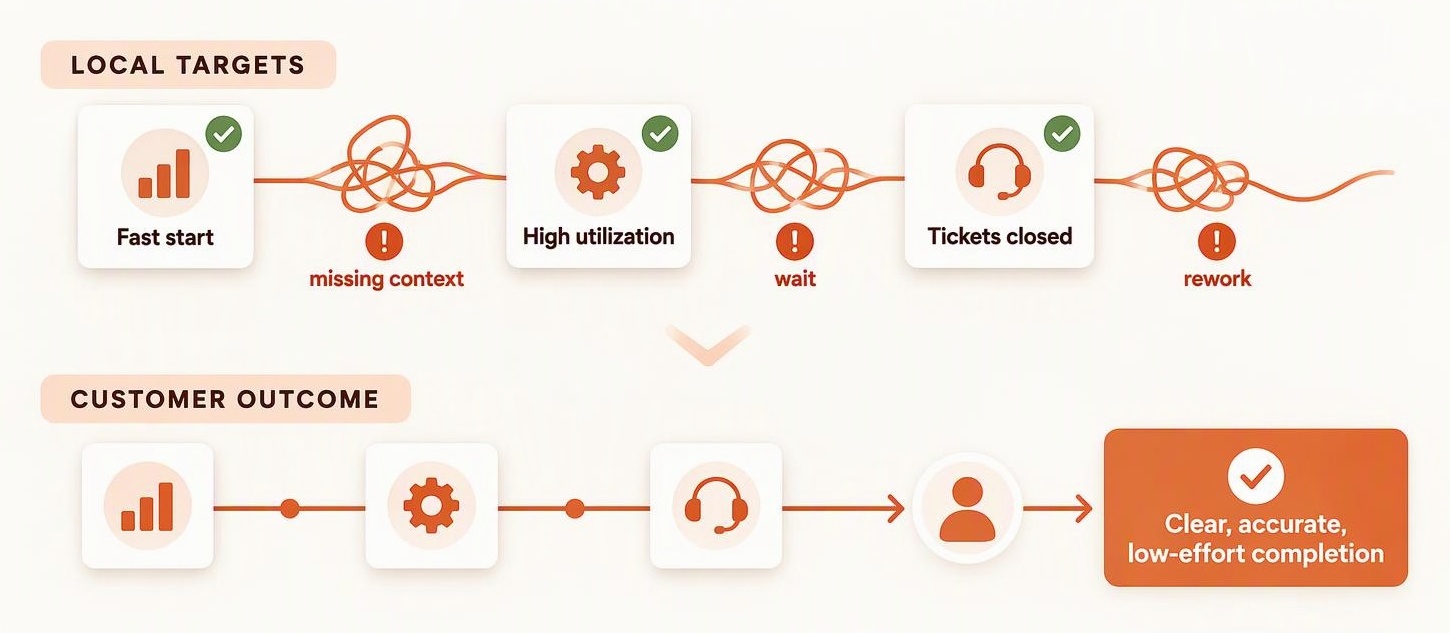
A team can hit every target and still make the customer experience worse when each department optimizes its own part of the work rather than the outcome the customer receives. Sales may promise a fast start, operations may protect capacity, and support may close tickets quickly. Each choice can look reasonable on a local scorecard, yet the customer experiences one fragmented process.
The distinction is simple: component performance is not system performance. Department goals measure pieces of work. A customer-centered purpose defines what the whole system must deliver, and it helps leaders see when local efficiency is creating delay, rework, or confusion elsewhere.
Why can every department meet its goals while the customer experience gets worse
Department goals usually track one component of performance: response time, utilization, volume, cost, or on-time completion. Those measures are useful, but they can hide what happens after work leaves the department. A fast response is not necessarily a clear answer. High utilization is not necessarily a timely handoff. A completed task is not necessarily a completed customer need.
Sales may be rewarded for increasing orders, production for maximizing equipment utilization, and purchasing for reducing costs. Each department can be doing exactly what management expects, yet the customer experiences long lead times, missed commitments, or inconsistent service. What’s easy to miss is that the people in those departments aren’t necessarily doing anything wrong. They’re responding to the objectives and measures their leaders have established.
Picture a customer who contacts a company because an order hasn’t arrived when promised. Customer service responds within its target time, explaining that the order is being processed and someone will follow up. From the department’s perspective, that counts as a timely response. But the customer still doesn’t know when the order will arrive, what caused the delay, or what’s being done to fix it. The response hit the target and left the actual problem untouched.
The pattern often looks like this:
- A team protects its local target.
- The handoff becomes harder for the next team.
- Delay, missing information, rework, or unanswered questions appear downstream.
- The customer spends more effort navigating the gap.
This is not a failure of individual teams trying to do good work. It is a leadership problem when the system makes trade-offs invisible. Leaders’ intentions are typically good, but intentions are not the same as impact. A leader’s assumption that they’re doing the right thing can blind them to what’s actually happening downstream, and it takes real practice to ask questions that challenge that assumption rather than confirm it. The better response is not to assign blame. It is to examine the work crossing boundaries and ask what condition the customer actually encounters from beginning to end.
What does a customer-centered unifying purpose change
A unifying purpose is a clear statement of the outcome people served should receive from the whole system. It is not a slogan on a wall, a collection of department goals, or a request for everyone to agree more often. It is a decision rule for moments when priorities conflict.
Compare an internal purpose, such as maximizing team output, with a customer-centered purpose: helping a customer complete a need accurately, clearly, and with minimal unnecessary effort. The first directs attention inward. The second asks whether the combined work produces value at the point of use.
Functional metrics still matter. A purpose does not erase capacity limits, quality standards, or service commitments. It gives teams context for interpreting those measures. When a local number improves while the shared outcome gets worse, the number may be signaling a trade-off that needs to be redesigned, not defended.
What priority test should leaders use at the handoff
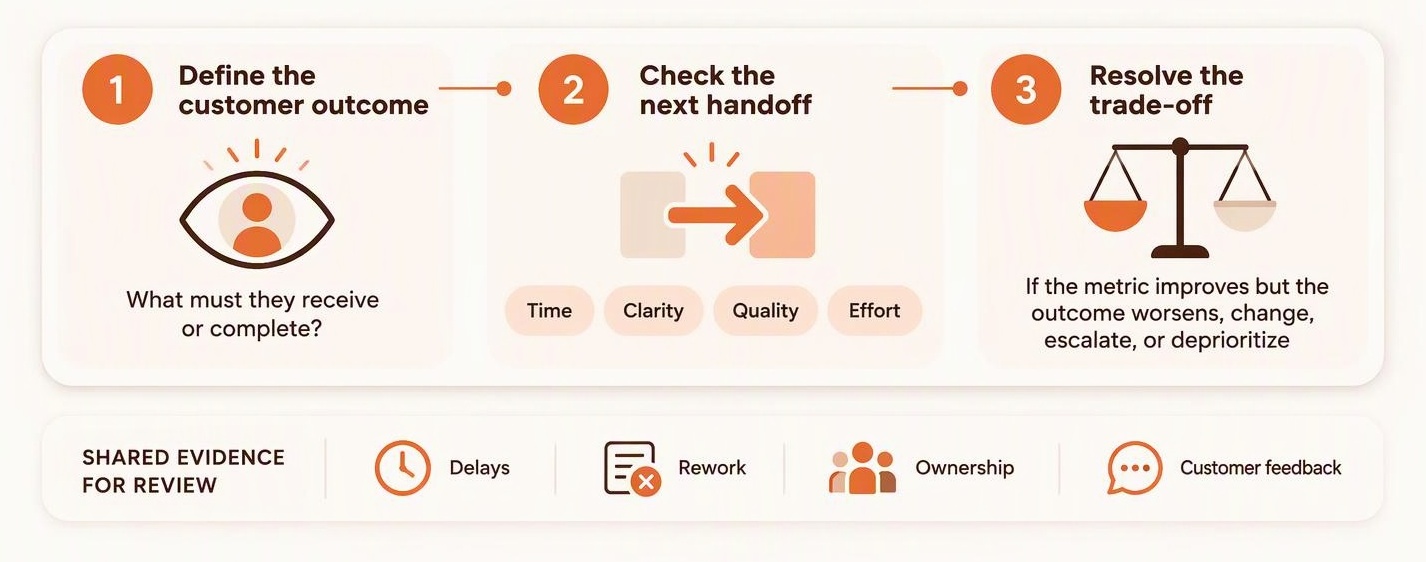
A short, visible review can make cross-functional trade-offs easier to discuss. Here is a system to try in the next weekly review:
- What is the target condition for the customer from beginning to end? Describe the outcome in observable terms, including what the customer needs to receive or complete.
- What happens at the next handoff? Check the effect on time, clarity, quality, and effort. Identify what information, ownership, or decision is missing.
- If the local metric improves but the customer outcome worsens, what should change? Decide whether to adjust the work, escalate a constraint, or temporarily deprioritize the local target.
Go See the real handoff rather than relying on assumptions. Ask What, Then Why before proposing a fix. Show Respect for the constraints each group manages, because a useful solution must work under actual conditions. Make delays, rework, ownership, and customer feedback visible in one shared review instead of distributing the evidence across separate reports.
Make the customer outcome the boundary for local success
Functional excellence matters, but it is not sufficient when customer value is created across several teams. The practical boundary for local success is whether the work helps the whole system deliver its stated customer outcome.
Test these questions on one important handoff in the next weekly review. Results vary by context, team relationships, and consistency of practice, but visible trade-offs give teams a better basis for coordinated decisions. When purpose becomes a working decision rule, teams can protect what matters most without mistaking a strong department score for a strong customer experience.