
Why Regular Gemba Walks Can Leave Leaders Less Informed
Regular Gemba walks can reduce a leader’s awareness when the routine becomes an inspection for visible defects rather than a method for learning how work actually happens. Leader standard work should make observation, inquiry, respect, and follow-up reliable, so people can surface barriers instead of waiting for the leader to find details to fix.
There is nothing magical about Gemba walks. Gemba means going to the real place where work is done, but presence alone does not create understanding. A walk becomes useful when it helps a leader see the process conditions that make good work easier or harder.
Why can more Gemba walks produce less real learning
More Gemba walks produce less learning when people experience the leader as a finder of faults. Picture a leader who repeatedly points out an untidy area, a missed step, or a local delay. The visible detail gets corrected, yet the team stops mentioning the workaround that created the delay because the visit has taught them what gets attention.
The leader is physically close to the work but becoming less informed about it. People manage the visit rather than explain the work, especially its uncertainty, handoffs, and recurring obstacles. The Leadership Lesson: standard work must standardize how leaders learn, not merely where they stand or what they inspect.
What should leader standard work standardize on a Gemba walk
A learning-oriented Gemba walk is a repeatable process for understanding the current condition and deciding what support is needed. Here is a system to try:
- Clarify the purpose and target condition. State what the walk is meant to learn, not just the area being visited.
- Go See the work and its flow. Observe the work as it moves, including handoffs, waiting, and variation.
- Ask What, Then Why. Use open questions before offering an interpretation or solution.
- Show Respect. Listen without taking over work that belongs with the team.
- Record decisions, owners, and a return point. Make the next step visible.
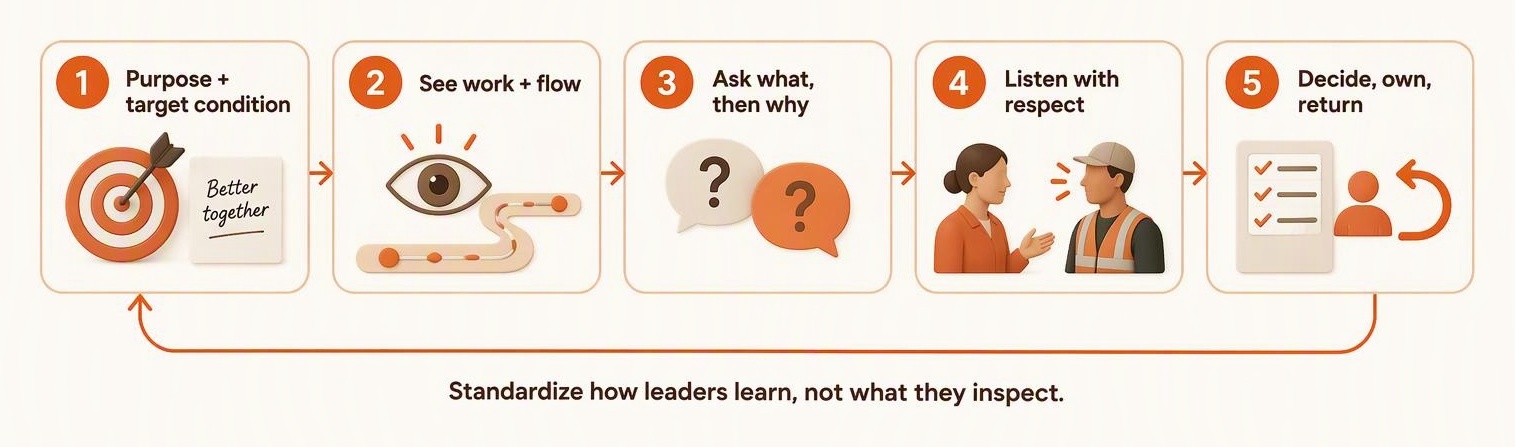
This is a comparable learning rhythm, not a script that forces identical conversations. The purpose of a supervisor’s walk may differ from a senior leader’s, but each needs to be clear and periodically assessed.
What is the difference between an inspection routine and a learning routine
An inspection routine asks, “Did people follow the rule?” It often ends when a visible issue is corrected. That can be appropriate when immediate safety, quality, or customer risk requires action, but it is not enough to understand why the issue appeared.
A learning routine asks, “What is happening? What changed? What barrier is being managed? Can this process meet its target condition?” It treats a visible defect as a clue to examine the system rather than as the entire problem.
| Inspection routine | Learning routine |
| — | — |
| Verifies visible compliance | Understands work conditions and flow |
| Leader finds and fixes details | Team identifies barriers and tests improvements |
| Ends at correction | Ends with ownership and follow-up |
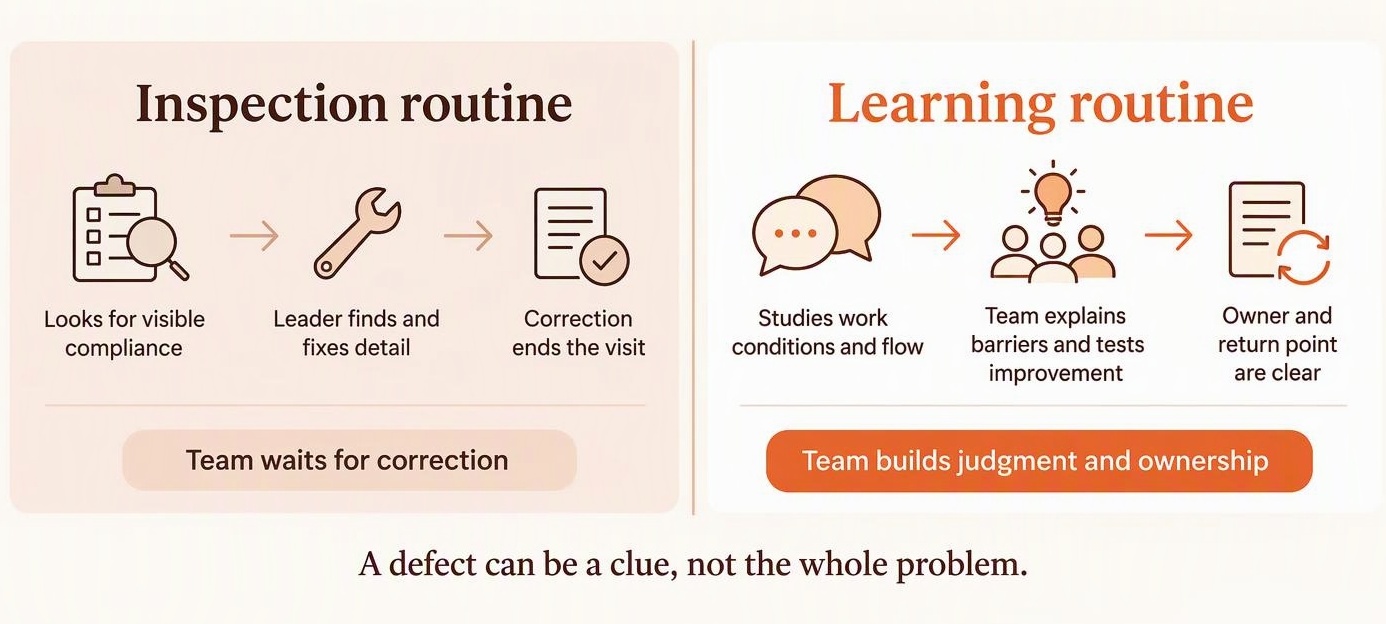
Inspection can train people to wait for leader correction. Learning helps people build the judgment and accountability to improve conditions in their own work.
How can leaders ask questions without taking ownership away
Respectful inquiry keeps the discussion with the people closest to the work. Start with the current condition: “What is the target condition?” and “What is happening now?” Then explore the obstacle: “Where does the work become difficult or uncertain?” “What changed?” and “What have you tried?” Finally, clarify support: “What help do you need from me?”
Resist solving the first visible detail unless immediate risk requires it. A leader’s job is not to become the fixer of every local problem. It is to expose the process conditions, clarify who owns the next step, and remove barriers that sit beyond the team’s authority.
A walk earns credibility when people can see what was learned, what will be addressed, who owns it, and when the leader will return. Before one recurring walk, write its learning purpose. Capture one barrier, not one defect, and revisit it in the next weekly review. Results vary by context, team, and consistency of practice, but this follow-up loop can make leadership attention more useful and visible.