
Why Meeting Action Items Fail Even When Someone Owns Them
A named owner does not, by itself, create an executable commitment. Meeting action items stall, restart, or produce the wrong output when priority, scope, available capacity, and a realistic start point remain unspoken before the person accepts the work. A short commitment check changes the handoff from a name in meeting notes into a credible agreement about what happens next.
That distinction explains a familiar surprise: the meeting ends with every action assigned, yet the team later discovers that the work conflicted with more urgent responsibilities, began from an incorrect interpretation, or could not start when assumed. The problem is often not a lack of accountability. It is that the practical conditions for acting were invisible when the assignment was made.
Why can a clear meeting owner still leave work unstarted
A clear meeting owner can still leave work unstarted because assignment records responsibility, while execution depends on conditions the assignment may not reveal.
Consider a manager who asks for someone to investigate a customer issue. A team member says yes, their name goes into the notes, and the meeting moves on. Later, that person discovers the request conflicts with a committed deadline, requires input from another department, and lacks a shared definition of the recommendation expected. The action may sit untouched, start late, or return as work that needs to be redone.
The delegation example in Learn to See the Invisible describes this pattern: team members reported unclear project priority, unclear expectations, uneven workloads, and a need for earlier coaching. The result was work that restarted, drifted, or prompted a late scramble. This is a current-reality problem to examine together, not a character judgment about the person named as owner.
A nominal handoff says, “Alex owns it.” An executable commitment lets Alex explain what the work means, where it sits among existing commitments, and when it can genuinely begin. Those details make the work visible while the people who can clarify tradeoffs are still present.
What is the difference between assigning work and confirming a commitment
Assigning work identifies who is responsible, while confirming a commitment tests whether the responsibility can be acted on as agreed.
| Assignment | Confirmed commitment |
|—|—|
| A task is named | The intended outcome is clear |
| An owner is recorded | The owner understands the priority relative to other work |
| A due date may be listed | Scope, boundaries, and quality expectations are understood |
| The meeting moves on | Capacity, dependencies, and support needs are surfaced |
| Follow-up may be assumed | A realistic first move and review point are agreed |
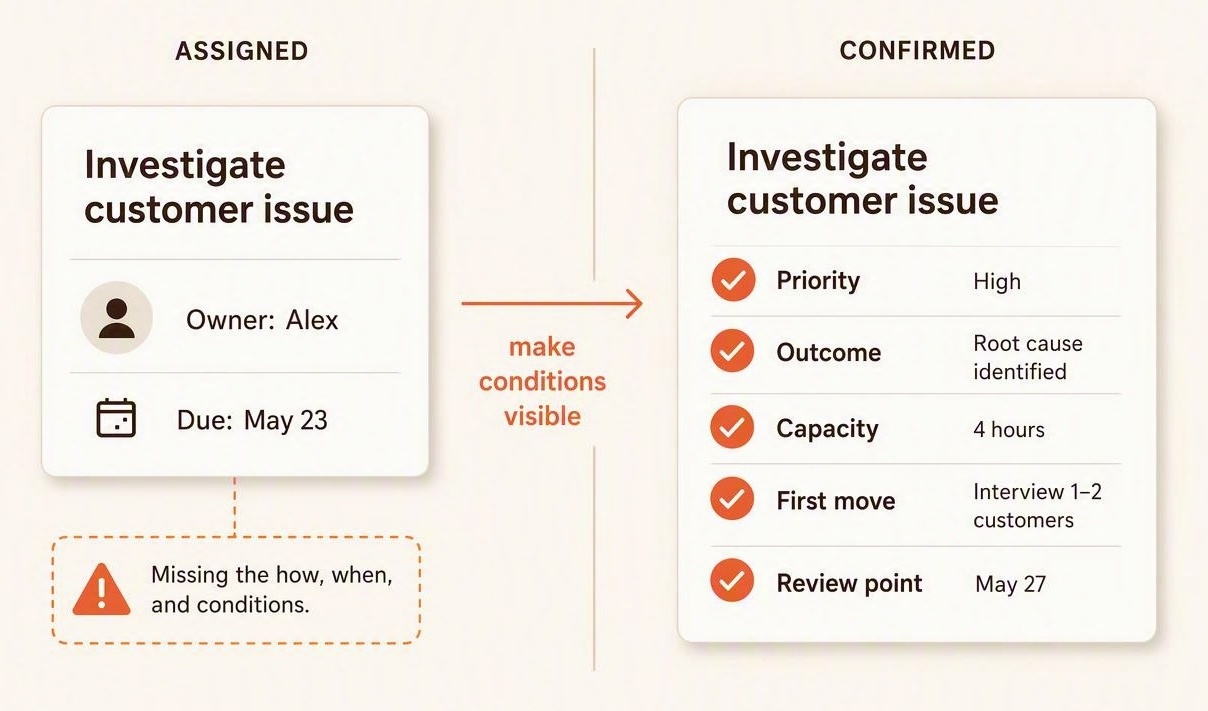
The second column is not an invitation to turn every action item into a long negotiation. It is a brief reality check. The team needs enough information to decide whether to proceed as proposed, adjust the scope, change the priority, provide support, select a different owner, or defer the work deliberately.
This practice also makes acceptance meaningful. A quick yes can reflect goodwill, pressure to be helpful, or an assumption that the work is small. In the book’s example, some staff members felt pressure to step up and accept new tasks, while others wanted clearer priorities and expectations. A useful meeting practice makes room for an informed yes, a qualified yes, or a request to resolve a tradeoff before calling the item assigned.
What must be clear before an action item is treated as committed
An action item is ready to be treated as committed when priority, expected scope, capacity, and start point are visible to the owner and the team.
-
Priority
The owner needs to know how this action ranks against existing responsibilities. Priority is not simply a label such as “urgent.” It answers what may be delayed, paused, or delegated if this work takes precedence. Ask: “What does this action displace, or where does it rank among your current commitments?”
-
Expected scope
Define the result the team needs, not merely the activity someone should perform. Clarify the decision, recommendation, draft, analysis, or completed change expected, along with relevant boundaries and the level of quality required. Ask: “What will be true, or what will exist, when this action is complete?”
-
Capacity
Capacity includes more than open time. It includes workload, needed skills, access to information, coordination with other people, and the support required to complete the work responsibly. Ask: “What competing work, dependency, or support need could affect this?”
-
Start point
A requested finish date can create the illusion of a plan when no one has identified when the work can begin. The first realistic move might be scheduling a conversation, obtaining data, clarifying a decision, or reserving time after another commitment is complete. Ask: “When can you make the first meaningful move, and what has to happen first?”
These conditions reflect the revised delegation routine described in Learn to See the Invisible: pause to discuss whether the person has time, whether the task is quick or more substantial, why it will take that long, and when it can start. The aim is to make an action practical before the meeting treats it as settled.
How hidden conditions create stalled work, restarts, and mismatched output
Hidden conditions create predictable failure paths because the action appears clear in meeting notes while the work itself remains unclear in practice.
A priority conflict produces work that does not start. The owner may reasonably continue with commitments already understood to be more important, while others assume the new action is underway. The gap stays invisible until a status check or deadline exposes it.
An unclear outcome produces restarts and rework. One person may interpret “review the process” as gathering observations, while the meeting expected a recommendation, decision, or implementation plan. Both people can be acting in good faith, but they are working toward different finish lines.
Missing capacity or a blocked start point produces silent delay and unreliable updates. The owner may need a stakeholder response, access to information, coaching, or relief from competing work before starting. Without a visible first move, a status such as “in progress” can conceal that no meaningful work has begun.
These issues are often detectable at handoff. That is why making workload and work-in-progress visible can be useful. The book notes that work capacity is commonly difficult to see in office settings, especially when incoming work exceeds what people can handle or when rework is growing. The purpose is not to monitor people more closely. It is to make better choices about the work the team is asking them to accept.
A meeting commitment check to use before recording the action
A short meeting commitment check helps a team confirm whether an action is executable before it is logged as assigned.
Here is a system to try when a new action emerges in a planning, decision, or team meeting:
-
State the action and intended outcome
Say what needs to happen and why it matters. Replace “Look into the issue” with a clearer outcome, such as “Bring back a recommendation on the customer-impacting options.”
-
Ask the prospective owner to reflect its priority
Invite the person to place the work among current commitments. A neutral prompt is: “How does this fit with the work you already have committed?”
-
Confirm what is in and out of scope
Name the boundaries that prevent the work from expanding or heading in the wrong direction. Ask what output, decision, audience, or level of detail is expected, and what does not need to be addressed yet.
-
Identify capacity, dependencies, and support
Surface obstacles that could affect execution while the group can respond. Ask: “What information, decision, partner, or support will you need?”
-
Agree on the first realistic move and follow-up point
Record when the owner can begin, what the first move will be, and when the team will review progress or changed conditions. A useful facilitation question is: “Before we record this, what needs to be true for you to begin?”
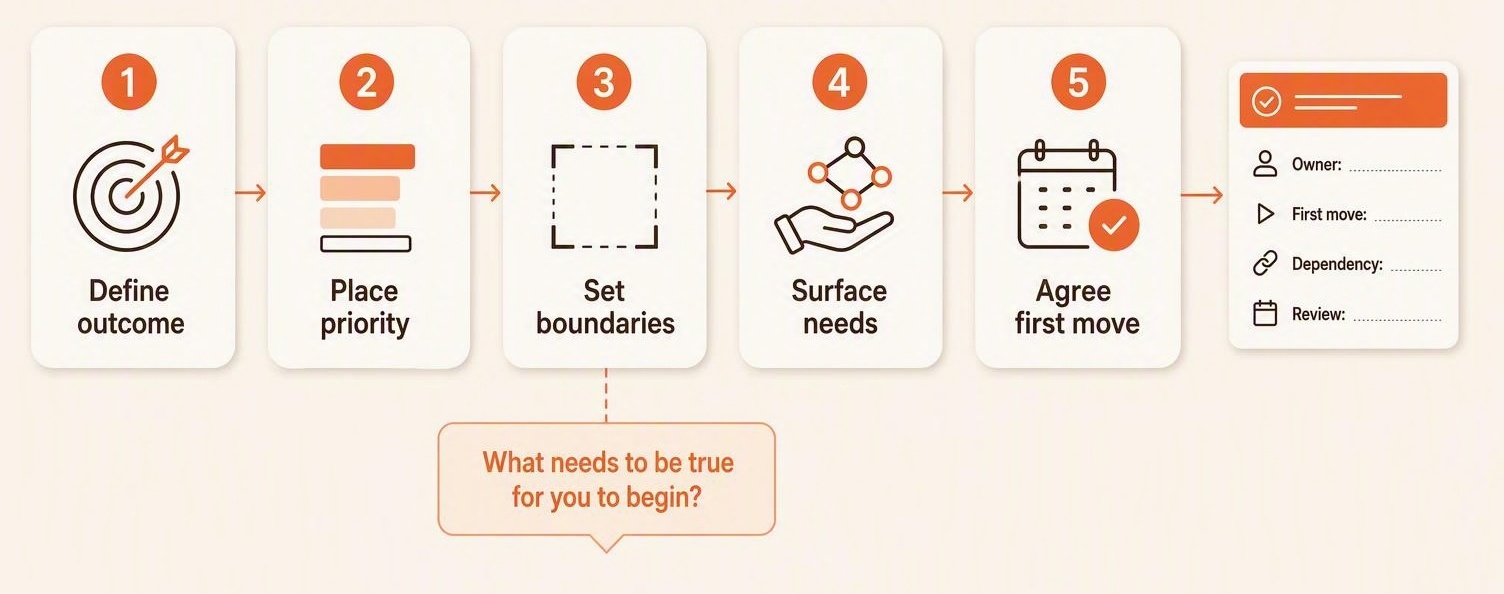
The goal is not to pressure a yes. It is to make the tradeoff visible and adjust the commitment if needed. The right outcome may be a smaller first step, a different owner, a reprioritized workload, an explicit dependency, or a decision to wait. In each case, the team has learned something important before ambiguity becomes rework.
Use a visible action log or shared work system to capture the outcome, owner, first move, dependencies, and review point. Keep it simple enough that it supports the people doing the work rather than creating a separate reporting burden. Results vary by team context and consistency of practice, but a visible commitment check can give teams more useful feedback about whether assigned work is actually ready to move.
How should the meeting close connect commitment to follow-through
A meeting close should connect each executable commitment to a shared decision, a communication path, and a review point.
Before closing, ask three questions: What did we decide? Who needs to know, and how will we communicate it? How will we follow up on progress? Learn to See the Invisible recommends using these questions at the end of meetings so participants agree on the decision and what will happen next.
For an action item, record the decision or intended outcome alongside the commitment details. Then identify the stakeholders who need the information, the person responsible for communication, and the forum or date for reviewing progress. This prevents a team from treating an internal meeting agreement as though everyone affected already understands it.
Follow-up is not surveillance. It is a feedback loop for checking whether conditions have changed, whether a dependency is blocked, whether the scope needs refinement, or whether the owner needs a decision or support. A visible review creates a place to address reality early rather than waiting for an apparent commitment to become an avoidable surprise.
Make acceptance visible before calling work assigned
Accountability starts with informed acceptance, not with a name beside a task.
In the next planning or decision meeting, test one question before recording an action: “What needs to be true for you to begin?” Listen for the priority conflict, unclear expectation, workload constraint, or dependency that the meeting might otherwise leave invisible.
The purpose is not perfect planning or a longer meeting. It is a more honest handoff, one that gives people a workable commitment and gives the team a useful basis for follow-through. Adapt the practice to the context at hand, then use what becomes visible to improve the next conversation.