
Why Effective Team Huddles Do Not Solve Problems in the Room
Short team huddles lose their value when they become full status reports or live problem-solving sessions. A more useful huddle makes exceptions visible, confirms any decision that is needed, and assigns one owner to the next action. The detailed investigation and resolution then move to a separate follow-up conversation with the people who need to be involved.
This can seem counterintuitive. A meeting full of updates and energetic debate can feel productive, yet the team may leave without a shared view of what changed, what decision was made, or who will take the next step. The huddle’s job is not to resolve every issue. Its job is to make reality visible and route the right work to the right place.
Why does a short huddle become a long meeting without creating clarity
A huddle becomes long without becoming clear when it treats every piece of work as equally worthy of group discussion. One common pattern is the round-robin update: each person recounts what they completed, what they plan to do, and what is proceeding as expected. The group hears a great deal, but the important deviations can disappear inside routine reporting.
The other pattern begins when someone raises a real problem. Rather than naming the issue and agreeing on the next move, the room starts diagnosing causes, proposing options, and debating details. Some of that thinking may be useful, but it is rarely useful for every attendee. The discussion expands while the practical coordination questions remain unanswered: What changed? Does a decision need confirmation? Who owns the next action?
A huddle is a coordination loop, not a complete account of work and not a working session. In Learn to See the Invisible, effective huddles focus on information relevant to participants, exceptions rather than work that is functioning normally, decision validation, and visible action responsibility. The guidance is equally direct about not solving problems in the huddle beyond someone committing to an action.
What is the real job of a team huddle
The real job of a team huddle is to detect exceptions, confirm necessary decisions, and route an owned next action. An exception is a meaningful deviation from an expected plan, condition, metric, commitment, handoff, or risk threshold. It may be a blocked dependency, an emerging delivery risk, a missed commitment, or a change that affects another team.
This definition gives the meeting a useful filter. Routine work does not need to be verbally recited just because it exists. It can remain visible in the team’s board, tracker, or normal workflow. The huddle draws attention to the condition that needs shared awareness or a coordinated response.
A clear huddle performs three jobs:
- Surface the exception: State what differs from the expected condition.
- Validate the decision or commitment: Confirm what the team has decided, when a decision is needed.
- Route the action: Name one owner for the immediate next step and make the commitment visible.
The huddle may identify that deeper work is required. That does not mean the huddle has failed. It has succeeded when the team can see the deviation and knows what will happen next.
What belongs in a huddle and what belongs in follow-up work
A useful sorting rule separates coordination from investigation. The huddle should establish what is different, what it affects, and who will move it forward. Follow-up work should give the appropriate people enough time and context to understand, decide, and resolve the issue.
| Belongs in the huddle | Belongs in follow-up work |
|—|—|
| Changes to a plan, commitment, condition, or metric | Root-cause analysis |
| Blockers, missed commitments, and emerging risks | Option development and detailed solution design |
| Dependencies that require another person or team | Technical troubleshooting |
| A decision that needs brief confirmation | Detailed trade-off debates |
| A clear assignment of the next action and owner | Work requiring only a subset of huddle attendees |
| Timing and participants for the next conversation | Extended investigation, testing, or implementation planning |
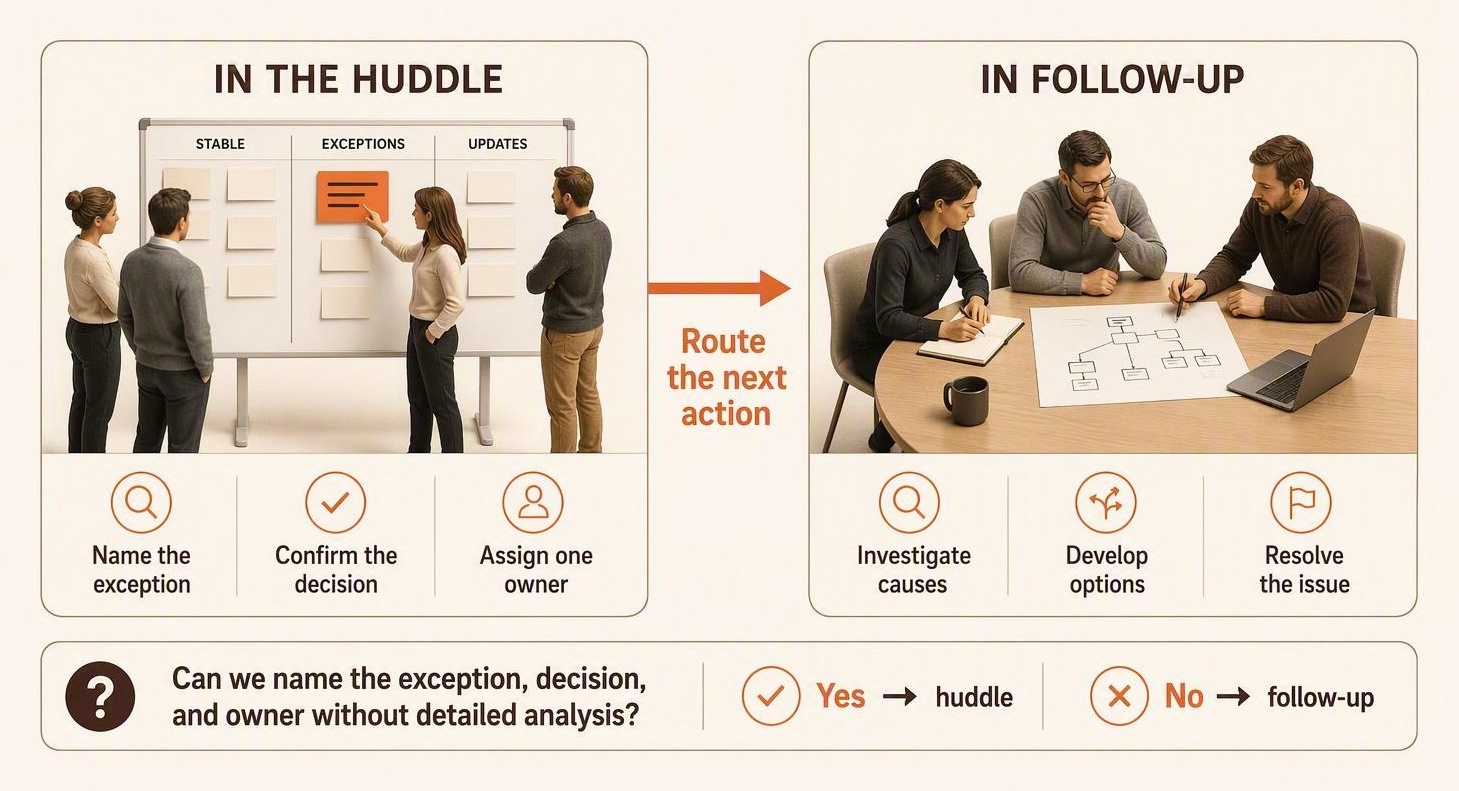
Use this boundary question when the discussion starts expanding: Can the group identify the exception, confirm the needed decision, and name an owner without detailed analysis? If the answer is yes, complete those steps and move on. If the answer is no, route the matter to follow-up work.
This is not an attempt to minimize the problem. It is a way to respect both the problem and the group’s attention. A complex issue deserves the people, information, and time needed to examine it properly. A huddle rarely provides all three.
How exception-focused huddles protect the team’s attention
Exception-focused huddles protect attention by keeping normal work visible without making everyone narrate it. The operating system holds the routine picture: planned work, commitments, measures, handoffs, and open actions. The huddle then asks what has changed in that picture.
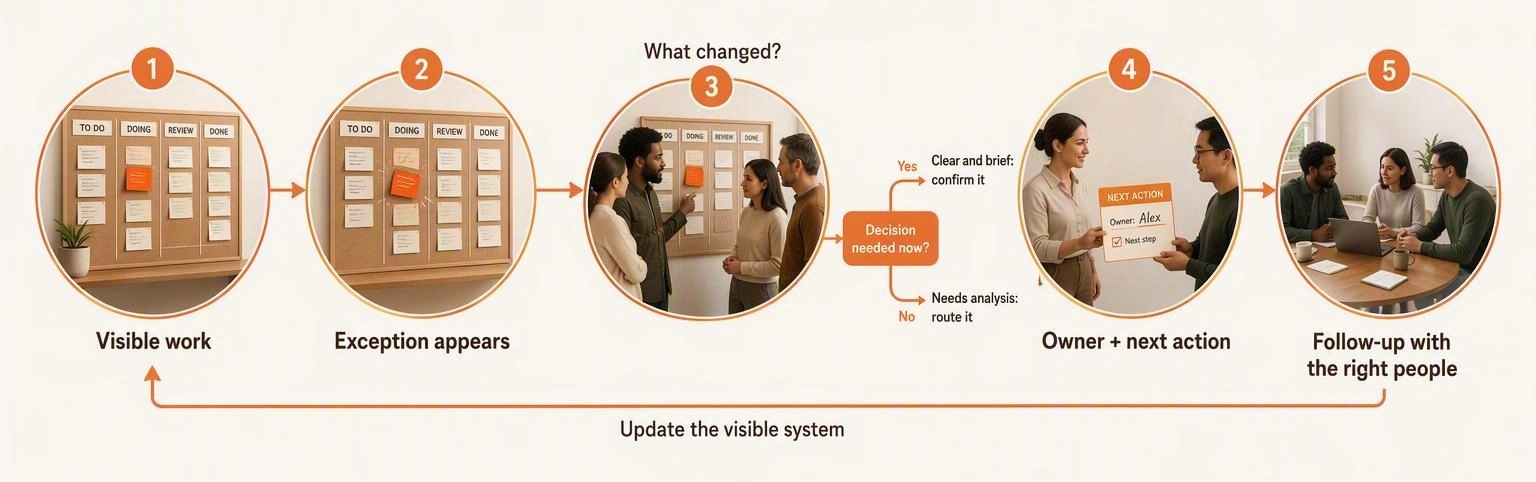
The sequence is straightforward. Normal work remains in the visible system. A deviation enters the huddle. The team establishes its relevance and urgency. Someone accepts responsibility for the next action. The people who need to investigate meet afterward, then bring back an update or a decision when appropriate.
That sequence gives the full team enough context to coordinate without forcing every participant into every investigation. It also makes commitments easier to inspect. A visible board or tracker should help people identify key issues quickly and understand what decisions or actions the information is meant to drive.
The practice depends on a respectful environment. Raising an exception should be treated as facing current reality, not as an invitation to assign blame. When the team can name problems early, leaders have a better chance to remove barriers before the issue becomes harder to manage.
How to run a huddle that detects and routes exceptions
A repeatable huddle routine gives the group a shared way to distinguish an important signal from a discussion that belongs elsewhere. Here is a system to try:
- Review visible work and expected conditions. Start with the board, tracker, or other shared view of commitments, measures, and handoffs. Do not use the huddle to recreate information that is already visible.
- Ask only about deviations. Ask what changed, is at risk, is blocked, or requires a decision. This directs attention toward the information that may alter the team’s plan.
- State the exception plainly. Use a simple factual sentence: “The design review cannot start because the required input has not arrived.” Avoid jumping immediately to theories about why it happened.
- Confirm whether a decision is needed now. If a clear and brief decision can be made with the information present, state it and check that participants understand it. If not, name the decision that the follow-up needs to produce.
- Assign one owner and a specific next action. “Jordan will confirm the source of the missing input and outline recovery options.” Ownership is not a vague promise that the group will address the issue.
- Set the follow-up forum, people, and timing. Identify who needs to join the working session and when the team should expect an update.
- Record the commitment where the team can see it. Capture the exception, owner, next action, and update point in the team’s visible system.
A facilitator can keep the routine focused with four questions:
- What is the exception?
- What decision or action is needed?
- Who owns the next step?
- Who needs to join the follow-up?
These prompts do not prevent problem solving. They place problem solving in a setting where it can be done with the right scope. Results vary by team context, meeting cadence, and the visibility of the underlying work system, so refine the prompts and exception criteria as the team learns.
What a routed exception sounds like in practice
A delayed deliverable can easily pull a huddle into an unbounded debate. Someone says that a dependency is late. One person suggests a workaround, another questions the original estimate, and a third raises a related technical concern. Soon the team is discussing several possible causes and solutions, while no one has agreed on what happens next.
A routed exception sounds different: “The external approval needed for the release has not arrived, so the planned release date is at risk. The decision today is not whether to change the date. Priya will confirm the approval status and identify the earliest feasible path. Priya, the release lead, and the approval contact will meet after this huddle. We will update the board before tomorrow’s huddle.”
The underlying issue is still unresolved. Yet the group now knows the exception, the impact, the action owner, the people needed, and the next update. That is shared clarity. The follow-up conversation can investigate causes and options without consuming the full team’s coordination time.
How do you keep the boundary clear when the team wants to solve the issue immediately
A facilitator should allow a brief in-the-moment decision when it is clear, reversible, and can be confirmed without investigation. For example, the team may be able to shift a routine handoff, notify an affected partner, or choose between two already-understood options. State the decision, its owner, and the communication required, then continue.
For other cases, use a respectful redirect: “This needs a working session. Before moving on, let’s confirm the owner, the people needed, and the next update.” This does not dismiss the issue. It protects the time required to address it well while preserving the huddle’s role as a shared awareness loop.
If the team repeatedly struggles with the same boundary, examine the system during a weekly review. Are exceptions defined clearly enough? Is the work board current enough to support a brief discussion? Are follow-up actions being recorded and revisited? Small adjustments to these conditions can make the huddle more useful over time.
A huddle creates clarity by making the next move visible
A huddle does not need to resolve every issue to be useful. Its value comes from exposing meaningful deviations, confirming what must be decided, and routing an owned next action to the right follow-up work.
At the next huddle, replace general status updates with one question: What changed, is at risk, blocked, or requires a decision? Before the meeting ends, record an owner for every action. This small practice makes the next move visible and gives the team a clearer way to respond to current reality.