
Why Delegated Work Still Comes Back to the Leader for Decisions
The hidden gap between assigning work and delegating judgment
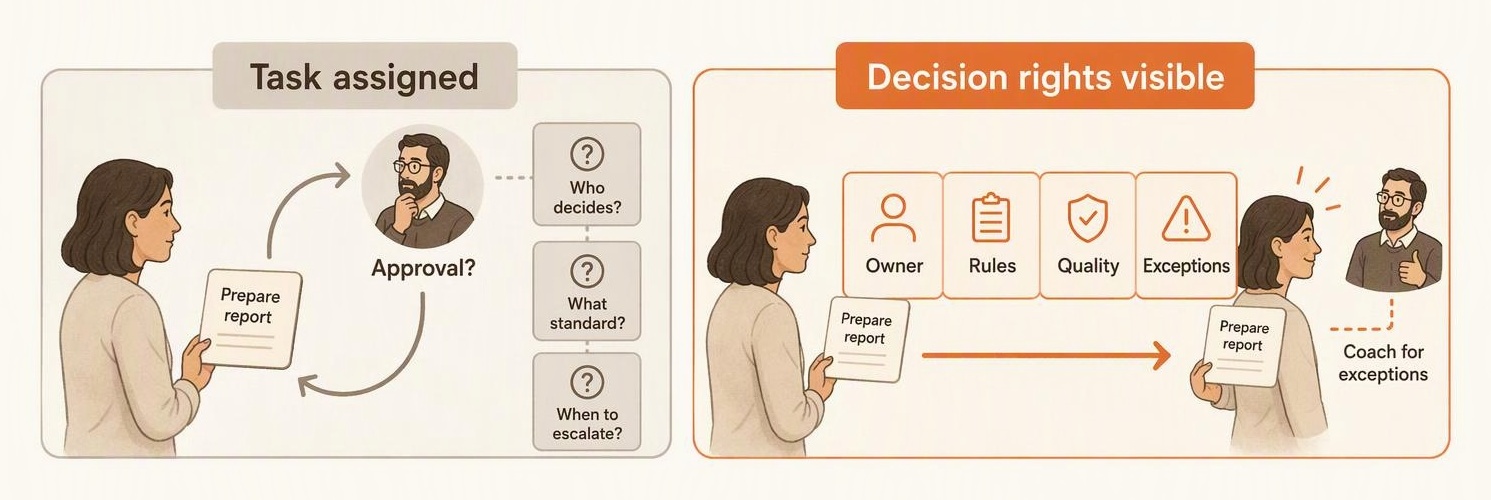
Capable teams often escalate routine decisions because delegation transferred the work without clarifying the decision boundary. A leader remains accountable by making the rules, quality constraints, and exception conditions visible, then coaching within those guardrails instead of reclaiming each routine choice.
The pattern is familiar: someone owns an assignment, makes progress, then pauses for approval on a choice the leader assumed they could make. It is easy to conclude that the person needs more direction. A better question is, what decision rule was never made visible? When the leader is the default decision maker, accountability can quietly become a bottleneck.
Why do routine decisions keep escalating after work is delegated
Incomplete delegation means assigning a task without specifying who decides, what standards must be protected, and which conditions require escalation. The team may be capable and committed, yet still lack a safe basis for exercising judgment.
The cause-and-effect pattern is straightforward:
- Vague authority leads people to seek approval before acting.
- Unclear quality standards make a reasonable choice feel risky.
- Undefined exceptions make every unusual situation appear leader-owned.
- Quick leader intervention teaches the team that escalation is the expected route.
This is not an argument for abandoning leadership judgment. It is a way to reserve it for choices with meaningful risk, broad consequences, or limited reversibility. Start with a diagnostic question: Which routine decisions does the team repeatedly bring upward, and what boundary is missing?
What decision rights should a leader make visible
Visible decision rights give a team a practical basis for moving work forward without creating a rulebook for every technical action. Capture the agreement on a simple decision board, checklist, or working agreement that the team can see and revise.
Make four elements explicit:
- Decision owner: Who makes the routine call and who needs to be consulted?
- Governing rules: What operating rules apply, such as an expected project duration or validation before work begins?
- Quality constraints: What cannot be compromised, even when speed or convenience is tempting?
- Exception conditions: Which limited cases need stricter protocols or leadership involvement?
In one software delivery example, a group aligned around project duration, requirement validation through mock-ups, reusable work for routine programming, and stricter protocols for audited projects. Those shared rules gave people a clearer basis for action while distinguishing routine work from exceptions. The point is not to prescribe every move. It is to make the few conditions that govern good judgment visible.
How shared rules shift a leader from controller to coach
Shared rules allow a leader to manage the conditions for good decisions rather than trying to control every decision itself. This matters because intentions do not equal impact, and that gap is one of the most important lessons leaders need to learn, particularly when it comes to delegation. A leader may genuinely intend to empower someone by delegating responsibility. But what happens next matters more than the intention. Does the leader continue to question every decision? Step in when things aren’t moving quickly enough? Provide answers rather than help people discover answers for themselves? The intention was to empower. The impact may have been to undermine the very autonomy the leader meant to grant.
In the source example, the leader learned to manage the agreed rules and use observations of project conversations to coach the team, rather than direct technical work beyond the leader’s expertise.
When a routine issue arises, coaching questions keep ownership with the team: What rule applies here? What is the target condition? Is this an exception or a routine choice? What help do you need from me? These questions do not remove accountability. They make the team’s reasoning visible and identify where a rule needs improvement.
A leader still needs to step in for higher-risk, irreversible, or cross-team decisions. But for ordinary choices, returning the question to the team gives colleagues room to resolve issues together. Letting go of control does not mean accepting chaos. It means building sufficiently clear, reliable processes for people to act responsibly.
Make decision boundaries visible in the weekly review
At the next weekly review, choose one recurring escalation and Go See the actual decision path. Ask What, Then Why: Was the owner unclear? Was a quality constraint invisible? Did an exception lack definition? Or did the leader unintentionally reclaim a routine decision?
Test one clarified boundary for a week, then review what happened with the people doing the work. Revise the rule from evidence, not assumption. Results vary by context, team, and consistency of practice, but accountability is strengthened when leaders make the rules visible and remain available to coach.