
When Completed Work Hides a Broken Process
A team can appear productive while delivery quality and leadership credibility erode because people are quietly compensating for missing rules, inputs, decisions, or handoffs. A workaround completes the immediate task, but it does not prove the process is reliable. When detours become routine, each person may solve the problem differently, adding variation that can lead to rework, delays, and inconsistent quality.
Consider a task that ships only because someone chased missing information in chat, found an unofficial approver, and manually repaired an incomplete handoff. The board shows completed work. What it does not show is the rescue effort required to make ordinary work possible. The person solved an instance, not the operating condition.
Why can completed work still signal an unreliable process
A completed task shows that someone found a route through the work this time. A reliable process consistently provides the needed input, clear decision right, available resource, and defined handoff without depending on individual rescue efforts.
The distinction matters because initiative is not the problem. Teams need judgment when a true exception occurs. The warning sign is a recurring workaround, especially one so familiar that nobody names it. Many leaders praise employees for finding creative workarounds, and that recognition is often deserved. People do show real initiative and ingenuity in making things work. But the praise rarely comes with a harder question: why was the workaround necessary in the first place? Too often leaders celebrate the person who solved the immediate problem without questioning the system that created the need for one. The workaround becomes the new normal, and the underlying problem stays exactly where it was. A better response is curiosity about what made the original path impossible to follow as designed. As Learn to See the Invisible notes, workarounds can remain hidden precisely because the work got done, while their accumulated variation makes the process less stable and more prone to quality problems.
A useful question for leaders is: What invisible work is the team doing just to make ordinary work possible?
Four common workarounds that reveal missing execution rules
Recurring detours are evidence to examine, not personal failures to correct.
-
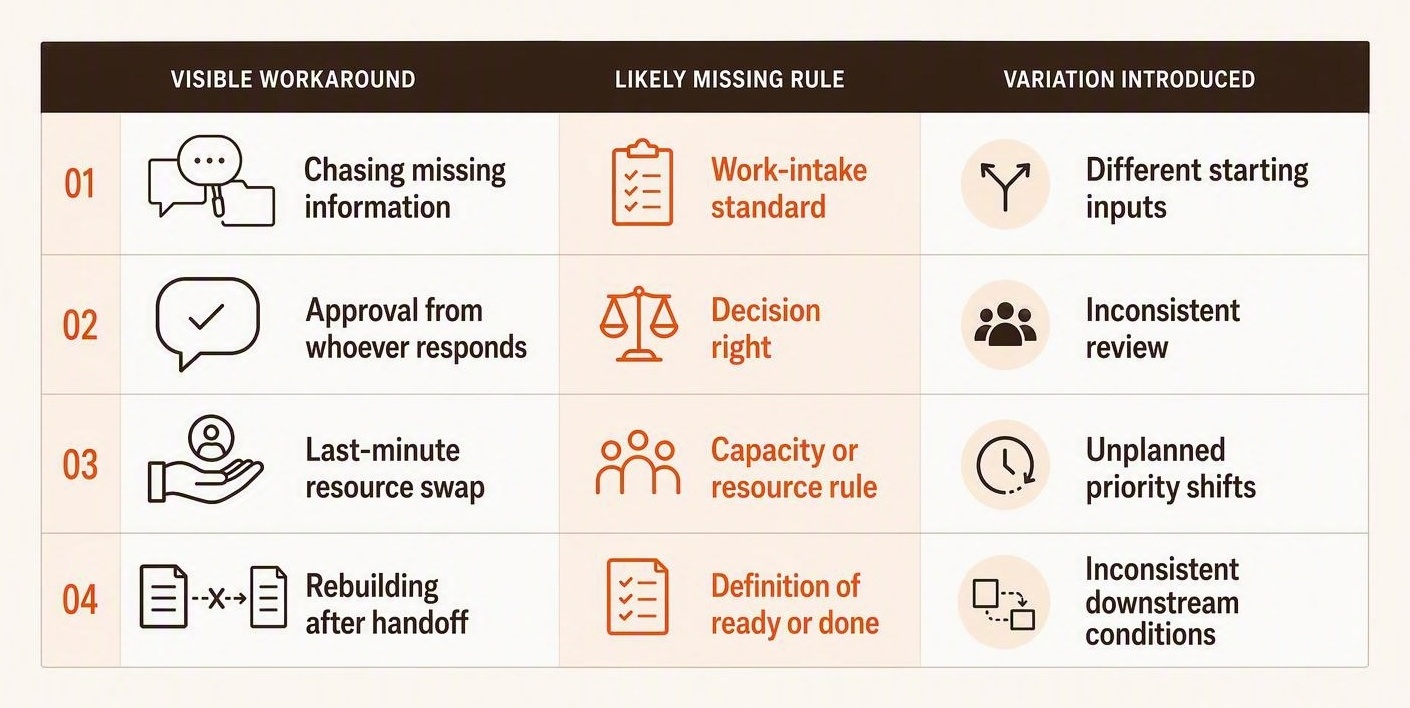
Chasing missing information: A team member searches email, chat, and shared folders for details needed to begin. The likely gap is an unclear work-intake standard. The variation is that each person starts with different information.
-
Getting approval from whoever responds: Someone seeks an informal green light because formal authority is unclear. The likely gap is an undefined decision right. The variation is that similar decisions receive different levels of review.
-
Borrowing people, tools, or budget at the last minute: The task moves only after an improvised resource swap. The likely gap is a missing capacity or resource rule. The variation is that priorities shift without a shared basis.
-
Rebuilding work after a handoff: A downstream colleague reinterprets, reformats, or repairs what arrived. The likely gap is an unclear definition of ready or done. The variation is that downstream work begins from inconsistent conditions.
How repeated improvisation creates rework and credibility risk
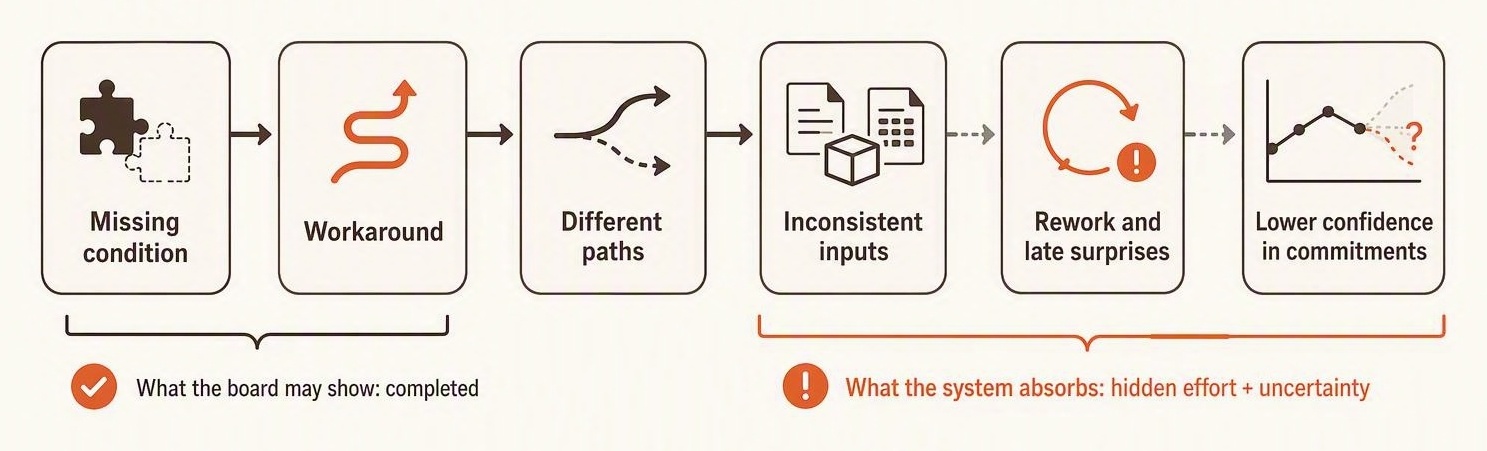
Repeated improvisation creates a predictable chain: a missing condition produces a detour, different people choose different detours, and downstream teams receive inconsistent inputs or expectations. Rework then looks like an individual execution issue when the underlying problem is an unstable path for completing the work.
Leaders may only see late surprises, uneven quality, or commitments that need revision. They may not see the calls, messages, favors, and manual fixes that kept the task moving. That gap matters because forecasts based on apparent flow exclude the real cost and uncertainty of the workarounds. Over time, confidence declines when delivery appears predictable until it suddenly is not.
How to make workarounds visible without adding bureaucracy
A lightweight weekly review can turn hidden detours into useful improvement evidence. This kind of practice shows up in different forms in organizations around the world, not always built around a four-column log. What matters most isn’t the log itself, it’s the conversation the log creates. Suppose employees routinely have to track down missing information before they can complete a task, and have quietly built a workaround around it, say, calling someone they know who can get them the answer fast. Rather than simply telling people to follow the process, a lead can treat that workaround as the starting point for the conversation: what is actually missing, and what would it take to make the official path as reliable as the shortcut people built on their own.
Start with three behaviors: Go See the actual path the work took, Ask What, Then Why about repeated detours, and Show Respect by treating the workaround as information rather than a reason to blame someone.
Keep a small visible log with four columns: task, detour, missing condition, and owner of the next experiment. Do not attempt to repair every problem at once. Choose one recurring condition, clarify ownership, improve an input, make a decision right explicit, or define a handoff standard.
This practice reflects the book’s guidance to observe real work rather than manage from assumptions, then clarify decisions, communication, and follow-up. Results vary by team context and consistency of practice.
Reliable execution begins when the detour becomes visible
The goal is not rigid work or the elimination of judgment. It is to stop confusing heroic completion with a dependable system. Bring one recently completed task to the next weekly review and ask: What workaround made this possible, and what is the target condition we should build instead?